About the Post:

Indus-Sarasvati Civilization, also known as the ‘Harappan Civilization’ or ‘Indus Valley Civilization‘, continues to amaze the archaeologists since the time of its discovery in the early years of the 20th century CE/AD. The entire world is awestruck by its enviable prudence, sophisticated lifestyle, admirable culture, administrative excellence, technological superiority, wonderful water management, overseas trade relations, and a never-ending list of impressive features. This bronze-age civilization which began to gain prominence around circa 3300–2600 BCE, touched the zenith during circa 2600–1900 BCE but then slowly started to decline around circa 1800 BCE and eventually lost its identity after circa 1300 BCE. Many scholars suggest climate change and the drying up of River Sarasvati as the major reasons for the disintegration of the Harappan society. However, my Indian mind ever remains tantalized by the Puranas and Itihasas of our sub-continent and hence I always seek their help in solving the archaeological puzzles of India. This post is all about the indigenous events of the distant past that plausibly caused the fall of the glorious Harappans.
Sneak Peek:

The story of the Kuru Dynasty, during and after the Mahabharata period, seemingly travels almost parallel to the rise, fortune, and fall of the Harappan Civilization. In order to get a better understanding of India’s proto-history, we need to explore the credible connection between the two. Since the story of the Harappans, as well as that of the Kurus, involves elaborate details, I felt it would be apt to present the matter in parts. Continue reading part-1 for an overview of the Kuru Dynasty……
The Kuru Dynasty:
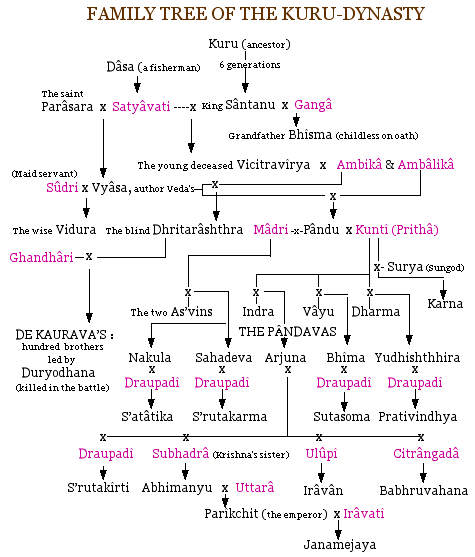
The five Pandavas (sons of king Pandu) and the hundred Kauravas (paternal cousins of Pandavas), of Mahabharata fame, belonged to the Kuru Dynasty. These heroes, along with their ancestors (starting from king Kuru) and the descendants of Arjuna (one of the Pandava brothers) – king Kshemaka being the last – constituted the Kuru Dynasty, which in turn was a branch of the Puru Dynasty; the Purus and the Kurus were part of the legendary Chandra-vansha. According to the sacred Hindu texts, Surya-vansha and Chandra-vansha (Solar and Lunar Dynasties respectively) were the two significant royal clans ever since the days of yore; incidentally, they shared a common ancestry. It is a well-known fact that Lord Vishnu incarnated as Rama in the Solar Dynasty and much later as Krishna in the Lunar Dynasty.
The Kuru Kingdom:

The Kuru territory of Mahabharata days was a large and powerful dominion located between River Sarasvati and River Ganga; it was split into three parts namely Kuru-Rashtra, Kuru-Jangala, and Kuru-kshetra.
Kuru-Rashtra:
Lying between River Yamuna and River Ganga, Kuru-Rashtra formed the eastern part of the kingdom where most of the Kuru population lived; Dhritarashtra (a Kuru king and the father of the Kauravas) ruled this region, with Hastinapur as its capital. It roughly coincides with the western part of present-day Uttar Pradesh, bordering Haryana.
Kuru-Jangala:
Kuru-Jangala was a huge area full of jungles and bushlands. It was ceded to the Pandavas, as their rightful share, by Dhritarashtra; it was located between River Sarasvati and River Yamuna. The Pandavas, with the help of Lord Krishna, cleared the forest called Khandava-prastha (situated in Kuru-Jangala) and founded their capital city named Indra-Prastha; modern historical research pins its location in the region of present-day New Delhi.
Kuru-Kshetra:
According to Mahabharata, Kuru-kshetra was a sacred plain region sandwiched between the divine waters of River Sarasvati (in the north) and River Drishadvati (in the south). This region, also known as Brahma-Varta/Dharma-Kshetra, was located just above the confluence of the two holy rivers and it happened to be the venue of the Great War of Mahabharata. Though we do not find clear information on who ruled this region, it can be guessed that Kuru-kshetra (named after king Kuru who performed great austerities there) was inherited and controlled by the Kauravas, during the Mahabharata period. The contemporary Kurukshetra is a town in the modern state of Haryana; however Kuru-kshetra of Mahabharata days was a region vaster than the present-day town, and its boundaries correspond roughly to the central and western parts of Haryana and southern Punjab, in modern India.
The Kurukshetra War:
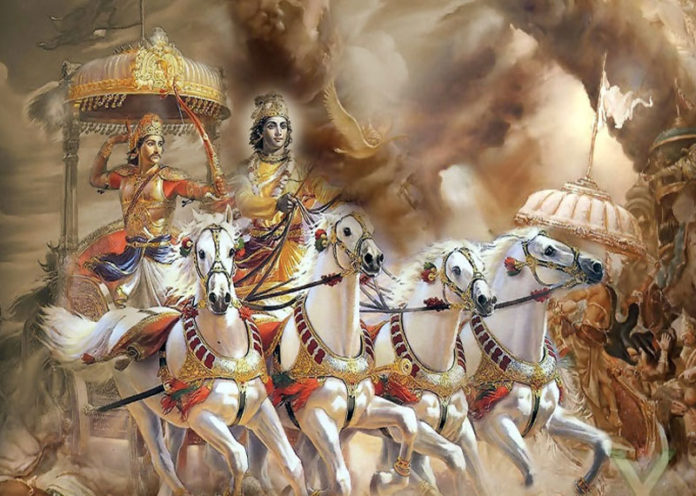
Once Duryodhana (eldest of the Kauravas) invited the Pandavas (living at Indra-Prastha) for gambling and he, with his maternal uncle Shakuni’s help, deceitfully won the dice game. As per the bet, the defeated Pandavas had to surrender their kingdom to Duryodhana and undergo twelve years of vana-vasa (exile in the forest) and one full year of agyata-vasa (living incognito). Thus Duryodhana unrighteously annexed the Kuru-Jangala again to his kingdom and refused to return it to the Pandavas even after they completed their period of exile; this dispute grew into the Mahabharata War/Kurukshetra War, which is the central theme of the epic Mahabharata. Most of the kingdoms that prevailed in the land of Bharat (ancient Indian subcontinent), during the Mahabharata times, participated in this war; many of them allied with Duryodhana and some backed the Pandavas while the remaining few chose to stay neutral.
Political Status of the Kurus:

The very fact that most of the rulers of Bharat took part in the Kurukshetra War, proves the influential status of the Kurus during the Mahabharata days. The popular events narrated in Mahabharata are more than enough to realize that the Kurus were powerful not only before the war but also after the battle. Long before the Kurukshetra War, Duryodhana had crowned his friend Karna as the king of Anga-Desa; this shows Duryodhana’s authority over the Anga-Desa. Yudhishthira (eldest of the Pandavas), after establishing Indra-Prastha, performed Raja-suya Yajna (as suggested by Narada) thereby declaring himself as the king of kings; for this, the four brothers of Yudhishthira subjugated all the rulers of their times. After the Mahabharata war, the Pandavas ruled the entire Kuru territory with Yudhishthira as the monarch; during this period, Yudhishthira performed Ashwamedha Yajna (as per Vyasa’s advice) for which Arjuna—accompanied by the sacrificial horse—conquered all the kingdoms of the earth. The Pandavas, before leaving the mortal world, crowned Arjuna’s grandson Parikshit as Yudhishthira’s successor. After Parikshit’s death, his son Janamejaya became the Kuru king; he, after conquering the other dominions of his days, performed several Ashwamedha Yajnas. Later Janamejaya’s descendants continued to rule the Kuru land for a long time; Kshemaka was the last of them.
Closing Message:
Part-1 has only introduced the Harappans and the Kurus; there is still a lot more to discuss. Hence this topic will be continued in part-2.
End-Note:
Thanks for reading this post; please leave your feedback in the comment box below.
Check the Home page for the latest posts from our blog.
Browse the Blog page to find all the posts.
Visit the About page for the introduction to the blog.
Learn about the Research, Titbits, and Bliss sections of this blog.
To know the terms and conditions of this blog, please read the Norms page.
Go to the Contact page to message me and/or to find me on social media.
 DetectHistory.in