The first article in the new series of “Bliss” is the life-history of Manickavasagar – a prominent devotee of Lord Shiva. He was a renowned Tamil poet and is the author of the eighth volume of Tirumurai (composition on Lord Shiva in Tamil language). Let us read his story, in which he casts away his normal life to pursue the path of glory….
Early Life
Manickavasagar was born in Vadhavoor in southern Tamilnadu, on the banks of river Vaigai. He belonged to the family of temple priest and was referred as Vadhavoorar. His parents were Sambupadachariar and Shivagnanavati. According to accounts, the Pandya king (Varagunavarma II) had selected him as a Minister, upon seeing his military acumen.
Enlightenment
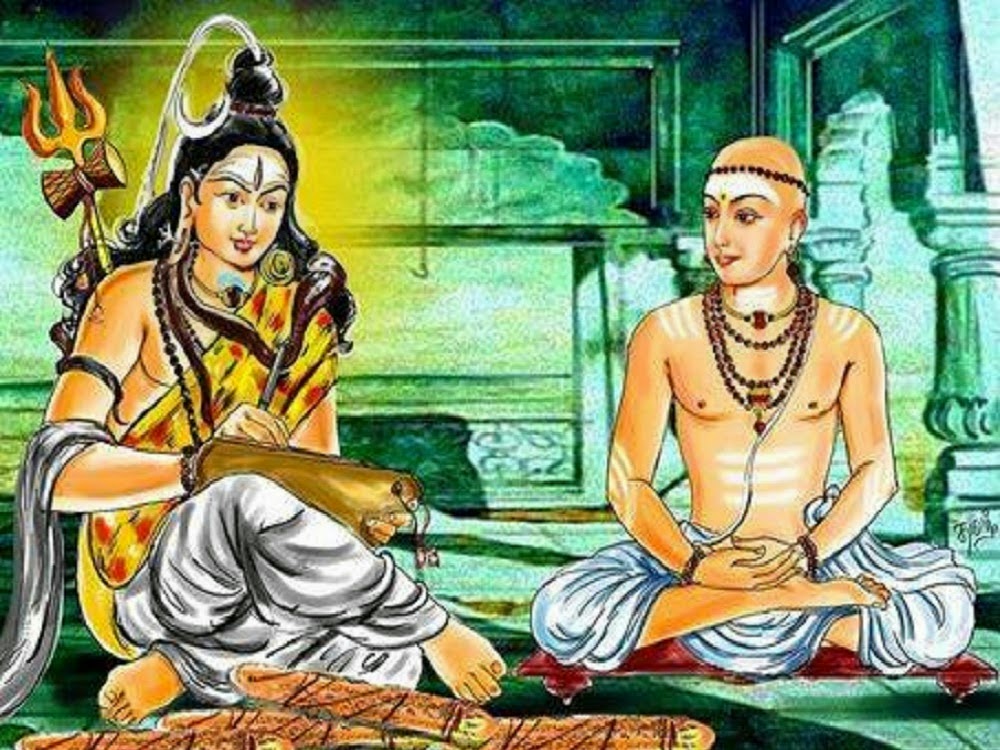
Once, the Pandya king entrusted him with a huge sum of money (collected as tax) to purchase horses for his cavalry. On his way to acquire horses, Manickavasagar happened to meet Lord Siva in an ascetic form, sitting under the tree with his disciples. He received initiation from Lord Shiva himself and realized that material things are transitory. So, he spent the money entrusted to build a temple for Lord Shiva in Tirupperundurai and feed the shivanadiyars (devotees of Lord Shiva).
Imprisonment
News of Manickavasagar mishandling tax money reached the ears of Pandya king and he was arrested.
In order to protect his devotee, Lord Shiva sent word that the horses will be delivered on the day of Avani Moolam (based on tamil calendar). The jackals in the jungle were turned into horses and Lord Shiva, in the form of a trader came to Pandya kingdom to deliver them, personally. The King was pleased. He released Manickavasagar and apologized for his act of unkindness.
During nightfall, all the converted horses turned into jackals and fled to the forest. King was very angry and as a punishment, ordered Manickavasagar to be taken to the banks of Vaigai river and make him stand in the scorching sand at noon time.
Once again to protect his devotee, Lord Shiva causes flood in the banks of the vaigai river to cool the sand. To keep the water from entering the city, the King ordered all his people to raise their allotted portion of the flood protection wall.
Granny Vanthi
In the Pandya kingdom, there lived an old lady by name Vanthi. She lived alone and earned a livelihood by selling “Puttu”, an eatable made of rice-flour. As she was weak, she searched for an appropriate laborer, who can raise her portion of the flood wall.
Again, Lord Shiva dressed as a laborer, offered to work in exchange for some of her “Puttu”. She offered and Lord Shiva went to the river bank. But instead of working, he strolled around mischievously. On inspection, when the King found that only Vanthi’s portion was not raised, took a stick in hand and beat the mischievous worker.
The pain caused by the blow of stick, was felt by everyone in the kingdom, including the King. Lord Shiva completed the allotted work and vanished.
Acquittal
The Pandya king realized his mistake and realized the greatness of Manickavasagar. He fell at his feet and requested for forgiveness. Not only the king, but the entire kingdom understood the glory of Manickavasagar and how Lord Shiva was merciful to protect his devotee.
Pilgrimage
Manickavasagar started travelling from one place to another, singing and spreading the greatness of Lord Shiva. Finally, he reached the town of Chidambaram.
Debate with Buddhist
Hearing about the glory of Chidambaram, the chief Buddhist monk in the court of Sri Lankan king expressed interest to go to Chidambaram. The monk intended to establish the supremacy of Buddhist doctrines there and win those Saivites to Buddhism. The king also accompanied the monk with his dumb daughter to Chidambaram. When the Buddhist monk came and challenged the priests for a debate on respective philosophies, they agreed and deputed Manickavasagar to represent them.
In the course of debate, unable to stand the monk’s denigration of Saivam with blatant lies, Manickavasagar prayed to Goddess Saraswathy Devi to stop this tirade. Suddenly the flow of words from monk’s mouth ceased and he sat there dumbstruck. The King who witnessed Manickavasagar’s greatness, apologized and accepted to convert himself and the kingdom to Saivam (worship of Lord Shiva) if he could make his daughter speak. Manickavasagar again prayed to Saraswathy Devi to bless the king’s daughter with speech. Then the little girl not only started to speak, but also convincingly started exposing the Monk’s lies and false arguments. Now the king along with the monk converted to Saivam. Manickavasagar then prayed to Saraswathy Devi for forgiveness of the monk and he got back his speech.
Attaining Mukthi
One day, tamil composition of Thiruvasagam were found on the steps of the Chidambaram temple. There was a footnote stating that upon Manickavasagar’s recital, they were written by the Lord of the town. When Manickavasagar was approached by the temple priests, to explain the meaning of the verses, he replied that the purport of verses was Lord Shiva. Saying this, his body was believed to be dissolved in a blinding light without leaving a corpse behind.
Compositions
Tiruvasagam, Tiruvembavai, Tiruppalliezhuchi, and Tirukkovaiyar are the famous compositions of Manickavasagar. Thiruvasagam is referred as “honey” as in sweetness and medicinal value – as a remedy to save people from the cycle of “rebirth”.
Manickavasagar’s stone image is worshiped in almost all prominent Shiva temples of Tamil Nadu.
Myth vs Truth
There are abundant mysteries surrounding Manickavasagar’s life, that is yet to be explored and answered.
When did Manickavasagar live – the century he belonged to?
The most popular belief is Manickavasagar lived during the 9th century. Then the prominent question arises: Why is Manickavasagar’s life not included in the epic “Periya Puranam” (regarded as 12th Tirumurai and compiled by Sekkizhar, in 12th Century) – a collection of stories of sivanadiyars (Devotees of Shiva)? The Periyapuranam has references to stories of other Naalvars (Four Saints – Sundarar, Sambandar, Appar and Manickavasagar)
If we infer that Manickavasagar had lived later than 12th century- after Sekkizhar’s time, which leads to: Why are his compositions then classified as 8th Tirumurai and not after “Periya Puranam” (12th Tirumurai)? Is the precedence given as Lord Shiva himself wrote the verses?
The Avudaiyar’s temple in Tirupperundurai, that is considered to be the temple built by Manickavasagar using tax money, is still not offering concrete evidence of its time period or having constructed by Manickavasagar. It is a usual convention that rulers in ancient times, maintained and added structures to the temples – thus different portions of the temple, indicate different timelines and inscriptions.
Let us wait and watch if we find answers in the future…
End-Note
Thanks for reading this post; please leave your feedback in the comment box below.
Check the Home page for the latest posts from our blog.
Browse the Blog page to find all the posts.
Visit the About page for the introduction to the blog.
Learn about the Research, Titbits, and Bliss sections of this blog.
To know the terms and conditions of this blog, please read the Norms page.
Go to the Contact page to message me and/or to find me on social media.
 DetectHistory.in