Have you ever wondered that Yudhishtra, the eldest Pandava had “righteousness” as his greatest virtue, as compared to the maze of Bheema and bow of Arjuna? Nakula and Sahadeva shared accolades in wielding the axe and sword. Let us see how Yudhishtra saved his brothers using “Dharma” (righteousness) as his weapon…
Exile
Yudhishtra played the game of dice with Sakuni and lost his kingdom, brothers, wife and even himself. He was exiled for 12 years to live in the forest and then had to live in hiding for one year. Even in exile, Pandavas continued to offer support and guidance, when people approached them.
Brahmin’s Arani
A brahmin who lived in the forest approached the Pandavas to retrieve his arani – a pair of wooden blocks used to start fire by friction. He used the arani to light fire for vedic rituals and usually hanged them in a tree. A deer roaming in the forest had playfully entangled the stick in its antlers and ran away into the forest. The brahmin wanted his sticks to perform his routine rituals and requested Pandavas to help him. Pandavas intended to resolve his issue and followed the hoofprints of the deer, to track and retrieve the arani.
Enchanted Lake
As Pandavas ventured deep into the forest, they were exhausted and wanted to rest a bit before pursuing their quest. Yudhistra requested Nakula, to fetch water from a lake that was visible from the top of a nearby tree.
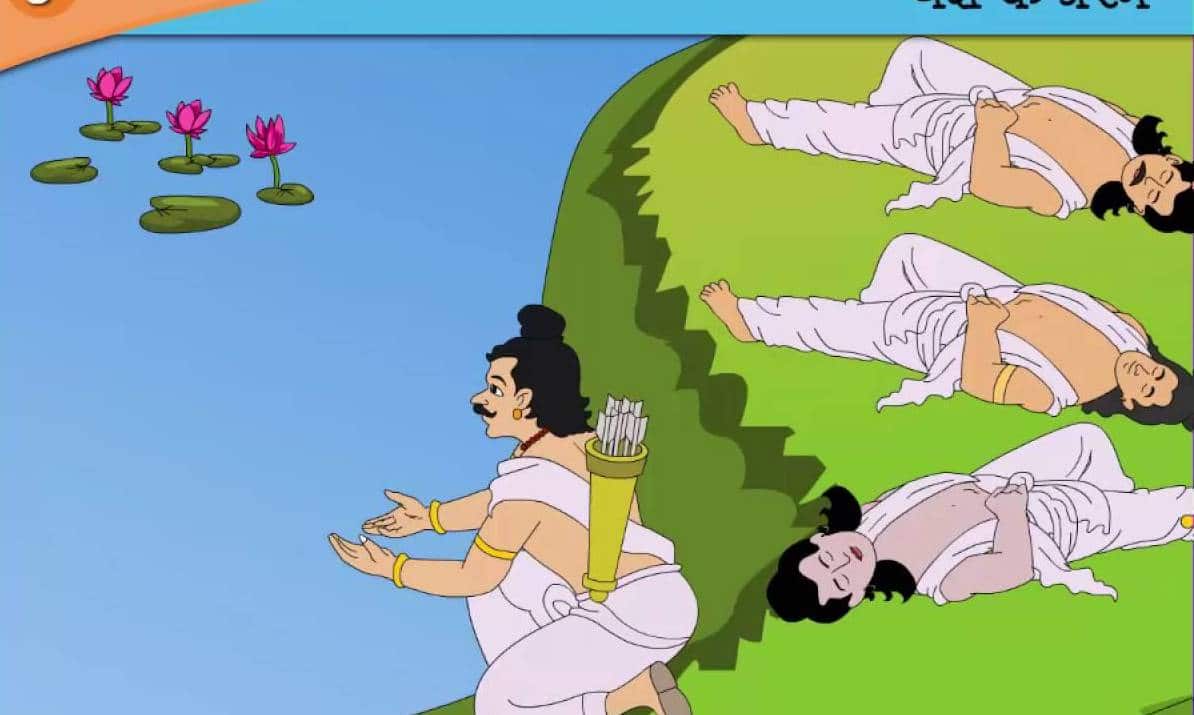
Nakula immediately left and upon reaching the lake, decided to quench his thirst and then take water to his brothers. In that instance, a crane standing in the lake commanded Nakula that it was an Yaksha and the owner of the lake and he should first answer its question before drinking the water. The crane also warned that he would face dire consequence if he didn’t heed to the command. However, Nakula ignored the crane, drank water from the lake and consequently, fell down dead.

After a while, Yudhishtra got worried about Nakula’s prolonged delay. He sent Sahadeva to check on Nakula and to fetch water for others. Sahadeva reached the spot and saw Nakula lying unconsciously on the ground. He wanted to sprinkle water on Nakula and when he touched the water from the lake, the crane yet again cautioned. It dictated Sahadeva to answer its questions before using the water from the lake. It pointed out that Nakula is dead, as he disregarded the Yaksha.
Sahadeva too, ignored the crane’s instructions and was also unsuccessful to revive Nakula. He went ahead and drank water as he was thirsty and fell down dead.
Yudhishtra sent Arjuna and Bheema, one after another to check the situation. They too were shocked to see their brothers lying on the ground and were furious as to who caused such a unfortunate end to the skilled warriors. When the crane identified itself as an Yaksha, owner of the lake and to answer its questions, both Arjuna and Bheema ignored the warning. They too drank water from the lake and fell down dead like others.
33 Questions
As none of his brothers returned, the worried Yudhishtra decided to go in search of his brothers and reached the lake. He was grief-stricken at their plight and wailed as to who might have caused the death of such mighty warriors.

As before, the Yaksha in the form of a crane introduced as the owner of the lake and ordered to answer its questions. Yudhishtra humbly greeted the crane and agreed to answer the questions, as only the crane could narrate the turnout of events and explained his brothers’ current plight. He realized that it was not a human enemy that defeated his brothers or else they would have been victorious.
The crane totally asked 33 questions on concepts of gods, metaphysics, philosophy and similar topic that were both significant and difficult. Yudhisthra responded fittingly and correctly to all the questions.
Reviving the brothers
The Yaksha was pleased with Yudhishtra’ conduct and wisdom. It offered to revive one of his brothers as an appreciation for Yudhistra’s merits.
Yudhishtra chose to revive his half-brother Nakula over his own brothers – Bheema and Arjuna. When questioned by the crane, he replied that as a lineage of Kunti/Pandu, he was alive and wished that the parallel lineage of Madhuri/Pandu should also thrive and hence made a choice from the twin brothers.
Amazed by the Dhrama principles followed by Yudhishtra, the Yaksha revived all the brothers. The happy Yudhishtra thanked and requested to reveal its true identity, as the miraculous events were beyond the powers of a Yaksha.
The lord of death – Yama, revealed his true form vanishing from the crane form of Yaksha. He also blessed the Pandavas wishing them success and returned the brahmin’s arani. Yudhishtra was born to Kunti by the grace of Yama (using Sage Dhuruvasa’s divine mantra) and he intended to test Yudhishtra. He took the form the deer to lure them and was impressed by Yudhistra’s adherence of Dharma. Indeed, Dharma emerged victorious overpowering the mortal valiance and aid of weapons.
Did you Know?
One of our regular blog readers shared information about the “Rathna Girishwarar” shrine in “Aiyyar Malai” that was worshipped by the Pandavas. We thank his intention to make all our readers aware of such a distinguished place of significance in our vicinity.
There are many hymns about this temple in “Thevaram” by Thirunavukkarasar and Sundarar. Arunagirinadhar has also sung about its glory in “Thirupugazh”. There are about 50 rock inscriptions from the 11th to 16th century AD indicating that the temple received patronage from the Cholas, Pandyas, Hoysalas and Vijayanagara kings. The height of Aiyyar Malai is 342 M (approximately 1100 Ft) and one has to climb 1017 steps to reach the hill top.

The Rathna Girishwarar temple was referred as the “Aiyvar malai”, indicating the visit of the Pandavas. Over the years, the name distorted and is now called as the “Aiyyar Malai”. It is believed that the five pandavas stayed here briefly during their forest exile.
A similar shrine of Rathna Girishwarar is also present in Mutharasanallur, near Trichy (South Tamilnadu). The legend indicates that an elderly chieftain Mutharasan had a routine of visiting the three shiva temples in Kulithalai area. He would see the Kadambhavaneshwarar in the morning, Rathnagirishwarar (Aiyyar malai) in the noon and Engoinathar in Musiri area in the evening. As he grew old, he was incapable of adhering to his routine, when the Cauvery river was in floods. He prayed to God and had the divine vision of all three temples in his own place. He built his temple with Rathna Girishwarar as the main deity with the other two lords having separate temples in side. Hence visiting here ensures the virtue of visiting all the three temples.
End-Note
Thanks for reading this post; please leave your feedback in the comment box below.
Check the Home page for the latest posts from our blog.
Browse the Blog page to find all the posts.
Visit the About page for the introduction to the blog.
Learn about the Research, Titbits, and Bliss sections of this blog.
To know the terms and conditions of this blog, please read the Norms page.
Go to the Contact page to message me and/or to find me on social media.
 DetectHistory.in