About the Post:

It is quite true that the majority of the people hardly show any interest in topics related to the subject of History, but Harappan Civilization is undoubtedly an exception; the whole world is fascinated by this pride of the Indian subcontinent. This glorious bronze-age civilization, also known as the Indus-Sarasvati Civilization or the Indus Valley Civilization, has left behind stunning archaeological remains such as sophisticated cities/towns, enchanting artifacts, and intriguing inscriptions.
The Harappan inscriptions have been a hot topic ever since the discovery of the Indus-Sarasvati Civilization in the late 1800s/early 1900s. On one hand, we have seemingly unending discussions about the nature and language of the script, and on the other hand, we have a bunch of unapproved decipherments, proposed by a wide range of passionate researchers. Amidst such a situation, this blog aims at interpreting the hitherto undeciphered script of the Harappans, and hence this new sequel series.
Sneak Peek:
The decryption of Egyptian hieroglyphs was done in the 1820s. The Mesopotamian cuneiform was interpreted in the 1850s. The Mayan script was decoded in the 1950s. Will the Harappan script ever get deciphered? Read on to find out the answer……………..
Harappan Script:
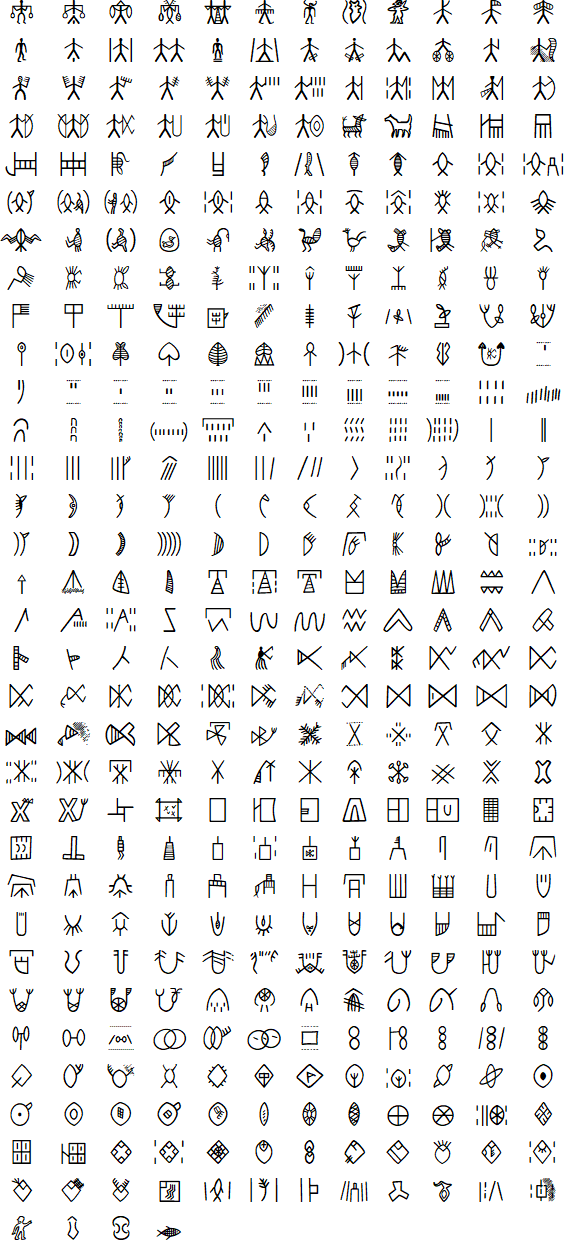
The Harappan script (also known as the Indus script) is a corpus of symbols used by the Indus-Sarasvati Civilization; Harappan symbols/signs are largely pictorial in appearance. Some of the Harappan symbols include what can be termed as special characters or abstract signs that resemble modern apostrophe/quotation-mark/circle/brackets or such other characters; few other Harappan/Indus signs appear to be an amalgamation of two or more Harappan symbols. Certain Harappan signs which look like counting strokes are widely believed to have represented numbers.
Inscriptions:
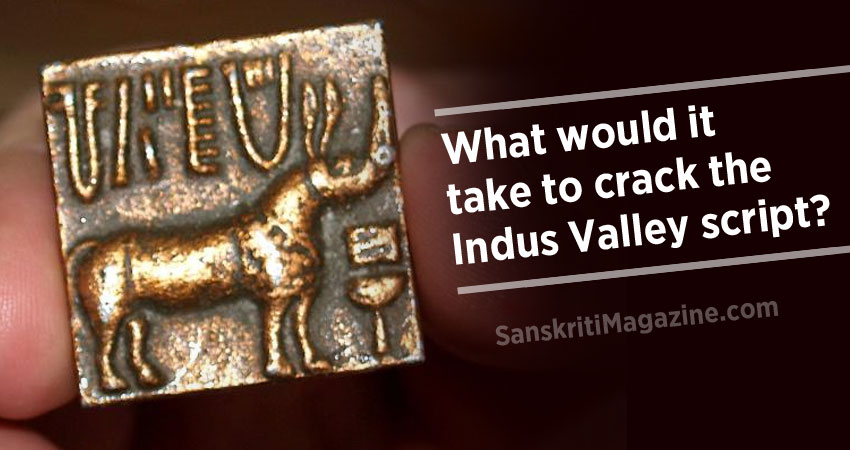
Indus/Harappan inscriptions are found on a wide variety of Harappan objects like seals, pottery, personal ornaments, copper tools, ingots, etc; over 4,000 inscribed objects have been unearthed so far. Harappan inscriptions are usually found only on man-made objects but as an exception, an Indus inscription on a natural stone was discovered for the first time at Dholavira. The average length of the Harappan inscriptions is less than five signs. Nevertheless, recent findings have revealed a copper plate having 34 Indus symbols inscribed onto it.
Nature of the Script:
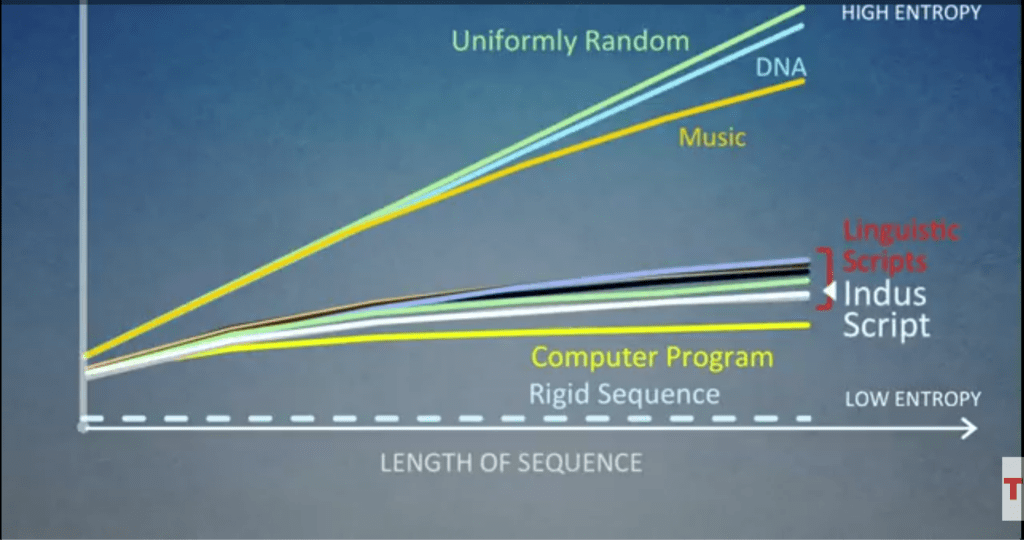
Whether the Harappan script codes a language or not is a million-dollar question; as most of the Indus inscriptions are extremely short, scholars find it difficult to judge whether or not these symbols constituted a script, in the first place. Moreover, since the number of principal signs is about 400, which is considered too large a number for each character to be a phonogram, the script is generally believed to be logo-syllabic. In a 2004 article, Farmer, Sproat, and Witzel presented a number of arguments stating that the Indus script is non-linguistic. However, the significant research by Rajesh P. N. Rao et al., using computer models, has given an insight into the linguistic nature of the Harappan script.
The Language Dispute:
Among those who firmly believe that the Harappan script is linguistic in nature, there persists difference of opinion regarding the underlying language. According to a few scholars, the Indus script represents an Aryan language while according to a few others, the script encodes a Dravidian language; of course, there seems to exist yet another opinion as per which, the Indus script possesses both Aryan and Dravidian characteristics.
The Direction of writing:

To get an idea about the direction of writing, let us just go through the following excerpt from Wikipedia’s page about the Indus script:
According to some historians the Indus script was probably written from right to left…………………….The inscriptions are thought to have been written mostly from right to left since there are several instances of the symbols being compressed on the left side, as if the writer is running out of space at the end of the row there, but they sometimes follow a boustrophedonic style……………………….However, as almost all of the signs are used on seals, which create a mirror image impression on the clay or ceramic on which the seal is affixed, the writing on the seal must be reversed (as is AMBULANCE on the front of the emergency vehicle, to be read in a rear-view mirror). Hence, it cannot be deduced that the language itself was written from right to left. Also writing on jars was left to right, which supports that.
Attempts at Decipherment:
Efforts have been made to interpret the Indus script ever since 1875 when Alexander Cunningham published for the first time, the drawing of a seal with Harappan symbols. To date, there are very many claims of decipherment, but none of them has yet managed to gain scholarly consensus. The Indus script remains undeciphered to date mainly due to the absence of bilingual inscription. Despite the lack of clues, eminent scholars like Iravatham Mahadevan (late) and Asko Parpola have done marvelous research regarding the Indus script; their contributions are highly valuable. Jonathan Mark Kenoyer and his team are involved in the systematic analysis of the Indus inscriptions; their work turns out to be more promising. Last but not the least, the recent work of Bahata Angshumali Mukhopadhyay has not only gained popularity but has also received appreciation.
I have not done proper coursework on this subject, and hence I am not able to furnish complete details pertaining to the field of Indus-script-research. Nevertheless, I am sharing whatever information I manage to gather from online sources. I sincerely apologize for not being able to list out all the scholars who have worked/have been working to decipher the Indus script; my inability has to be attributed to the limitations of a layman or perhaps to that of an independent researcher.
My Research:
It was during 2010 – 2011 that I came to know about the Harappan script; I was then pursuing my PG Diploma in Archaeology. On learning that the Indus script probably represented a proto-Dravidian language, I decided to try my hand at deciphering the same; needless to say, my mother tongue is Tamil. My passionate research began in 2010, and by 2017 I got thoroughly exhausted due to the fruitless efforts of my tiny intellect. Hence I sought the blessings of the almighty in order to realize my objective; it was only then that I found myself able to interpret the Indus script. So far, I have deciphered only five or six Indus inscriptions, and I am pretty much aware that there is still a lot more work to be done.
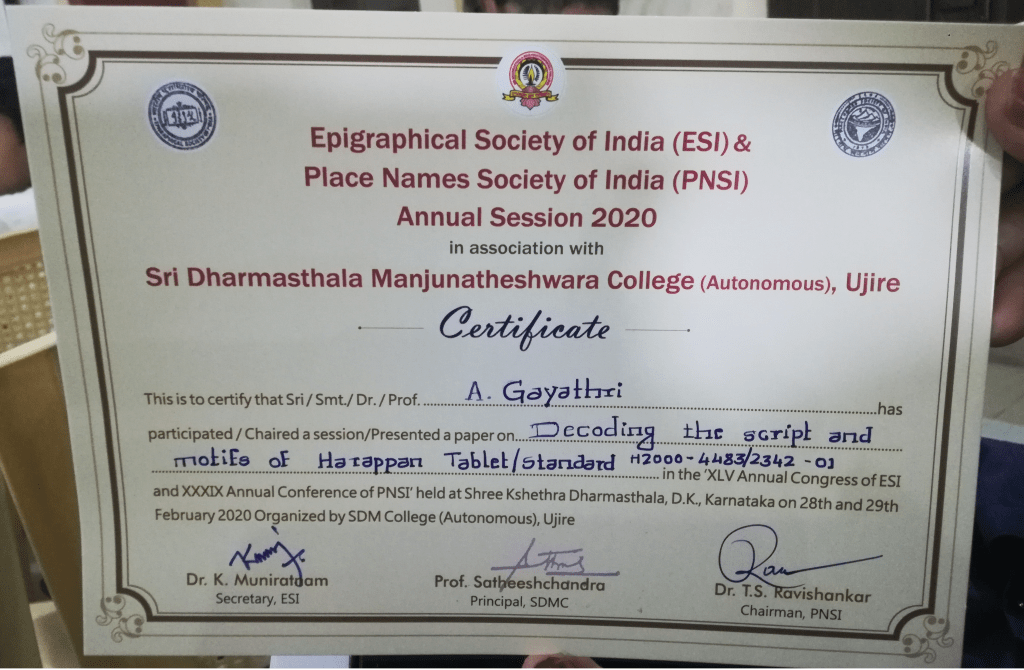
I am an amateur enthusiast who has ventured into the ocean of Indus-script-research, guided by my intuition which happens to be the sole beacon of light. Nevertheless, I am ever grateful to Dr.T.Sathyamurthy (former Superintending Archaeologist, ASI) for his genuine encouragement; but for his mentorship, I would not have gotten the opportunity to present my research papers at national conferences. I am also thankful to Dr.T.S.Ravishankar (former Director of Epigraphy, ASI) for his continuing support ever since the time I first met him at a conference.
It was not only the efforts of Bhagiratha but also the penance of his ancestors that made the River Ganges descend from heaven to earth. Similarly, suppose I succeed in my attempts at deciphering the Indus script, I shall attribute the achievement to the endeavour of each and every Indus-script-researcher.
Closing Message:
This post (part-1) has given only an overview of the Indus script and that of my research about the same; the upcoming sequels will speak about the plausible decipherment of the Harappan inscriptions.
End-Note:
Thanks for reading this post; please leave your feedback in the comment box below.
Check the Home page for the latest posts from our blog.
Browse the Blog page to find all the posts.
Visit the About page for the introduction to the blog.
Learn about the Research, Titbits, and Bliss sections of this blog.
To know the terms and conditions of this blog, please read the Norms page.
Go to the Contact page to message me and/or to find me on social media.
 DetectHistory.in
