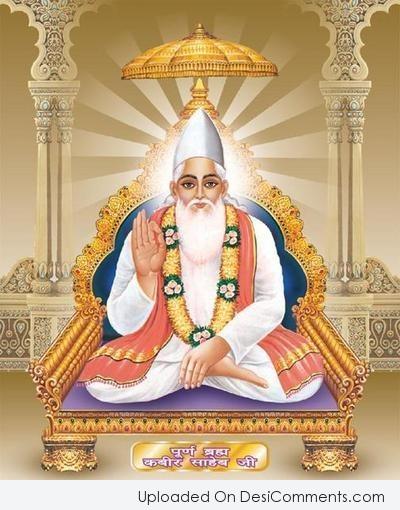
The only Saint who remains connected to three prominent faiths in India – Hinduism, Islam and Sikhism, is the Mahant Kabir Das. He was initially despised by both Hindus and Muslims, but eventually both religions claim Kabir for themselves. Let us read the story of his divine path from being a weaver to becoming an enlightened soul…
Birth
In a popular version, Kabir is said to have conceived miraculously and was born in Varanasi. His mother was a devout Brahmin widow who had accompanied her father on a pilgrimage, to meet a famous ascetic. Impressed by her dedication, the ascetic blessed her and told her she would soon bear a son. After the son was born, to escape dishonor, Kabir’s mother decided to put him in a basket and left him in a pond. Young Kabir was then found and brought up by Nima, the wife of a Muslim weaver.
When people started doubting and questioning Nima about the child, the newly born miraculously proclaimed in a firm voice, “I was not born of a woman but manifested as a boy…I have neither bones, nor blood, nor skin. I reveal to men the Shabda (Word). I am the highest being…”
‘Kabir’ was an unusual name in the days he lived. It is said he was named by a Qazi, who opened the Quran several times to find a suitable name for the child and each time ended up on the name Kabir, meaning ‘Great,’ used for none other than the God, Allah Himself.
Initiation
Early texts about his life, mentions his association with Vaishnava tradition of Hinduism as well as the Sufi tradition of Islam.
Kabir desired to be the disciple of Saint Ramananda, but he couldn’t approach him directly as he was a Muslim. Kabir knew that Ramananda had a routine to visit a ghat in Varanasi in the early hours of dawn, to take bath in the Ganges river. One day, Kabir saw him approaching and laid down on the stairs of the ghat. When Ramananda stepped on him accidentally, he gasped the word ‘Ram’. Kabir considered the god’s name from his guru, as his initiation. He was later accepted as a disciple by the saint.
From Khajinat al-Asafiya (a compilation of Sufi saints of Islam), we find that a Sufi pir, Shaikh Taqqi was also the teacher of Kabir. Sufism is the mystical branch of Islam and a “Sufi” is a Muslim who seeks annihilation of the ego in God. Sufi influence is also quite apparent in Kabir’s teaching and philosophy.
Marriage
Some legends assert that Kabir never married and led a celibate’s life. Most scholars conclude from historical literature that this legend is also untrue. They consider that Kabir was likely married, his wife probably was named Loi, they had a son named Kamal and a daughter named Kamali.
Belief in God
Kabir’s ultimate goal was one absolute God who is formless, without attributes, who is beyond time and space and beyond causation. Kabir’s God is pure knowledge and bliss.
He did not acknowledge distinctions based on caste. Not just caste, Kabir spoke against idol worship and criticized both Hindus and Muslims for their rites, rituals and customs which he thought were futile. He preached that God can be achieved only through complete devotion.
Ganges Bath
A story goes that one day while some Brahmin men were taking a dip in the holy water of Ganga to expiate their sins, Kabir filled his wooden cup with its water and offered it to the men to drink. The men were quite offended at being offered water from a lower caste man to which he replied, “If the Ganges water cannot purify my cup, how can I believe that it can wash away my sins.”
Kabir’s Poems
One cannot separate Kabir’s spiritual experience and his poems. In fact, he was not a conscious poet. It is his spiritual quest, his ecstasy and agony which he conveyed in his poems. In the 15th century, his poetry is a mixture of local regional languages of Hindi, Khari boli, Punjabi, Bhojpuri, Urdu, Persian and Marwari.
Kabir’s poems were verbally composed and transmitted through recitals until the 17th century, during which Kabir Bijak was compiled and written down for the first time. Scholars state that this form of transmission across generations bred change, interpolation and corruption of the poems. Furthermore, whole songs were creatively fabricated and new couplets inserted by unknown authors and attributed to Kabir, not because of dishonesty but out of respect for him and the creative exuberance of anonymous oral tradition found in Indian literary works.
Guru Nanak and Guru Granth Sahib
Kabir’s verses were incorporated into Adi Granth, the scripture of Sikhism, with 500 verses attributed to Kabir constituting the largest non-Sikh contribution. Some scholars state Kabir’s ideas were one of the many influences on Guru Nanak, who went on to found Sikhism in the fifteenth century. Other Sikh scholars disagree, stating there are differences between the views and practices of Kabir and Nanak.
Simplicity
Kabir Das was a simple weaver. He was a man of principles and practiced what he preached. He would sell the cloth he wove, for no more than what was needed for his everyday living. Once he took a cloth to the market and he charged only five takas. But people were not prepared to pay that price and offered only three takas. The day had almost come to the end and he could not sell his cloth. Seeing this a man took pity on him and called out to people that an excellent cloth was being offered cheap, only for twelve takas. Impressed by his business tactics, people came to him and soon the cloth was sold. The man gave Kabir ten takas, taking two as his commission. But Kabir would not accept saying that he wanted only five.
Tulsidas
Saint Tulsidas came to know about the growing popularity of Saint Kabir and decided to meet him. He went to Delhi and reached the locality where Saint Kabir was staying. He asked the local people for directions that would lead to Saint Kabir’s house. Saint Kabir was also popular as a weaver besides being a saint. Someone pointed towards a small hut at the distant corner but the road leading to it was full of butchers’ shop on both sides, where slaughtered goats and chickens hung.
Saint Tulsidas was a pure Brahmin. He felt great discomfort walking through that lane. He covered his nose with his hands as he was not accustomed to such situation in the past. Finally, he managed to reach Saint Kabir’s house and went inside. He was made to sit on a handmade bed by his pupils.
Saint Kabir appeared from the kitchen and was about to start ‘Satsang’. However, Saint Tulsidas could not resist the temptation to speak out what was going through his mind. He asked Saint Kabir, “You are such a famous poet and a great saint of India, you live in a place surrounded by slaughter house? Saint Kabir replied spontaneously in a poetic form, meaning – “Kabir’s residence may be near a slaughter house but those will suffer who are performing the deeds of slaughtering. But there is no cause of worry for a non-doer!”. Saint Tulsidas understood the message in a flash and was highly impressed.
Jaggery and Advice
Once a lady with her young child came to Saint Kabir and complained that her son had the habit of eating lot of Jaggery every day. Saint Kabir told her to come after a week. Upon the lady’s return after a week, Saint Kabir told the boy to give up the habit of eating Jaggery. The lady was surprised to hear this and asked Saint Kabir, “Why dint you advice him when we had come earlier?”. Saint Kabir clarified , “How could I advise your son not to eat Jaggery when I used to eat it myself at that time? Therefore, these last seven days I practiced to stay without eating Jaggery, so I could advise your son to do the same!”
Last Days
Kabir lived a long life and had travelled widely in his life. Sources reveal that his body had become so infirm that he could no longer play music in praise of Ram. During the last moments of his life, he had gone to the city of Maghar (Uttar Pradesh).
As per a legend, after his death, there arose a conflict between Hindus who wanted to cremate his body and Muslims who wanted to bury it. In a moment of miracle, flowers appeared beneath his shroud, half of which were cremated at Kashi and half buried at Maghar.
There is a locality named Kabir Chaura in Varanasi which is believed to be the place where he grew up. Kabir maṭha, a maṭha located in the back alleys of Kabir Chaura, celebrates his life and times. Accompanying the property is a house named Nirutila, preserves his parents graves – Niru and Nima.
Kabir’s Legacy
Kabir literature legacy was championed by two of his disciples, Bhagodas and Dharmadas. Songs of Kabir were collected by Kshitimohan Sen from mendicants across India, these were then translated to English by Rabindranath Tagore. New English translations of Songs of Kabir is done by Arvind Krishna Mehrotra.
Kabir’s legacy continues to be carried forward by the Kabir panth (“Path of Kabir”), a religious community that recognizes him as its founder and is one of the Sant Mat sects. This community was founded centuries after Kabir died, in various parts of India, over the seventeenth and eighteenth centuries.
There are two temples dedicated to Kabir located in Benares. One of them is maintained by Hindus, while the other by Muslims. Both the temples practice similar forms of worship where his songs are sung daily. Other rituals of aarti and distributing prasad are similar to other Hindu temples. The followers of Kabir are vegetarians and abstain from alcohol.
Myth Vs. Truth
One can see similarities between the story of Kabir and biblical legends. Questioning the veracity of these legends would be a futile task. Fantasies and myths are not characteristic of ordinary life. In addition to be considered as a virgin birth, it was believed that Kabir was born out of the palm of his mother! Inspite of the lack of evidence, the legends attempt to reveal that he was considered as an extraordinary human being.
According to the Indologist Wendy Doniger, Kabir was born into a Muslim family and various birth legends attempt to “drag Kabir back over the line from Muslim to Hindu”.
Some scholars state that Kabir’s parents may have been recent converts to Islam. They were unaware of Islamic orthodox tradition and are likely to have been following the Nath (Shiva Yogi) school of Hinduism. This view, while contested by other scholars, has been summarized by Charlotte Vaudeville as: “Kabir was officially a Muslim, though it appears likely that some form of Nathism was his ancestral tradition. This alone would explain his relative ignorance of Islamic tenets, his remarkable acquaintance with Tantric-yoga practices and his lavish use of its esoteric jargon in his poems. He appears far more conversant with Nath-panthi basic attitudes and philosophy.”
According to Irfan Habib, the two manuscript versions of the Persian text Dabistan-i-Mazahib are the earliest known texts with biographical information about Kabir. The Dabistan-i-Mazahib states Kabir is a “Bairagi” (Vaishnava yogi), a disciple of Ramanand, Kabir is a monotheist and his God is “Rama”.
Source Courtesy: Indian Culture, Youth Dadabhagwan
End-Note
Thanks for reading this post; please leave your feedback in the comment box below.
Check the Home page for the latest posts from our blog.
Browse the Blog page to find all the posts.
Visit the About page for the introduction to the blog.
Learn about the Research, Titbits, and Bliss sections of this blog.
To know the terms and conditions of this blog, please read the Norms page.
Go to the Contact page to message me and/or to find me on social media.
 DetectHistory.in