We all know Savitri as the devoted wife who fought with Yama and brought back her husband’s life. She also went to fulfill the dreams and desires of her father and father-in-law. Let us read the Princess’ story, who is worshipped by Indian women till date…
King Dyumatsena
Dyumatsena, a virtuous king ruled the Salwa Kingdom. In course of time, he became blind and an old enemy dwelling in the vicinity took advantage and deprived him of his kingdom. The monarch accompanied by his wife bearing their only son, went to live in the woods. His son was named Satyavan and began to grow in the hermitage.
King Aswapati
Aswapati was the son of Madra (the founder of Madra Kingdom) and grandson of King Shibi – who was known for his sacrifice, ready to give up his life to protect a pigeon. Aswapati and his wife Malavi, for want of a child, did penance for 18 years to God Savitr (closely associated with the Sun god and Gayathri mantra). Finally, pleased by their prayers, they were blessed with a daughter and named her Savitri, in honor of the god.
Search for Bridegroom
Savitri was born out of devotion and asceticism, traits she herself possessed and practiced, since birth. In due time, the girl grew into a beautiful maiden, but no noble prince approached her for marriage. Aswapati suggested Savitri to seek a husband of her own choice and she sets out accompanied by the elderly counsellors of the royal Court.
Savitri traveled to distant lands, visited several ashramas, holy shrines and proud capital cities on river banks. Finally, she reached the deep Salwa Woods, where she met Satyavan and at once chooses him as her life partner, as does Satyavan too in regard of Savitri.
In the meanwhile, sage Narad visits Aswapati and as they were engaged in conversation, Savitri returns and discloses that Satyavan was her choice. Immediately Narada, mentions that it is unfortunate as Satyavan is destined to die one year after the marriage. Aswapati advises his daughter to make another choice, but she is unswerving in her resolve. Narada knew that her determination was in conformity with the Dharma and blesses their life to pass off without any ill-happening.

Aswapati then makes a formal proposal to Satyavan’s father and the wedding was solemnized in the presence of the Rishis of the Forest.
Satyavan
Prince Satyavan was praised to be as wise as the advisor to the gods, as brave as the lord of the gods and as forgiving as Mother Earth. He was also considered to be as generous as King Rantideva, who gave away the whole world to the wisemen of his realm. He was also truthful and beautiful as the Moon god. He remained devoted to his friends and honor was firmly seated on his brow. In every way, Satyavan was as virtuous a groom for Savitri, except his fated early death, that outweighed all his virtues.
Forest Life
Satyavan and Savitri went to live in the forest and Savitri set herself to be a faithful and loving daughter to her new parents. Only she could never forget the secret date on which Narada had said that Satyavan would die. For Yama, the God of Death, is the only being in all the worlds, who never breaks his word, and “as true as Death” has become such a saying in India, that Yama is held to be also the God of Truth and Faith.

Destined Day
A year passed by happy and when only three days remained, Savitri took the terrible vow that is known as the three vigils. For three nights she would remain awake in prayer and during the intervening days, she would eat no food. In this way Savitri hoped to reach a state of the soul where she could see and hear things that commonly pass unknown to mortals.
The blind King and his aged Queen implored her to relax, but when she made the simple answer, “I have taken a vow,” they could say no more. In that case her resolution was sacred, and they could only help her to carry it out. When the fourth morning dawned, Savitri convinced her family that she would eat after sunset and accompanied Satyavan into the woods.
She had calculated that the blow would fall at midday and as the hour drew near, she suggested that they should stop in a shady spot and wander no further. Satyavan gathered grass to make a seat for her and returned to his work of cutting wood.
At the fatal hour, Satyavan came tottering up to her and told that he needed to rest. He lay down with his head on her lap and passed into a heavy swoon.
At this moment, Savitri became aware of a grim figure advancing towards them from the jungle. It was a stately personage, black as night, and carrying in one hand a piece of rope, with a noose at the end. She knew him at once for Yama, God of Truth and King of the Dead.
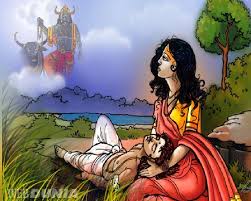
He smiled kindly at Savitri. “My errand is not for you, child!” he said to her, stooping at the same time and fixing his loop of rope around the soul of Satyavan. When the soul of her husband stood up to follow Yama, she also stood up, with her eyes shining and her hands clasped, prepared to go with Satyavan even into the realms of Death.
Conversation with Yama
Yama went down the forest-glades, but he could distinctly hear behind him the patter of Savitri’s feet. He grew uneasy as it was his duty to take the soul of Satyavan, but not that of Savitri. He wondered as to What she was doing? How could she be following him? Why had she been able to see him? What power had sharpened her hearing and cleared her sight?”. To most mortals, Death was invisible. He thought he would try to soothe her grief with his conversation and convince her to return.
Savitri gracefully clarified that her husband is her immediate guardian; he safeguards her and thus equivalent to a deity; if he were to be forcibly taken away, then she had no other alternative but to follow the husband.
Yama was pleased with her reply and was willing to grant her a boon, anything but not the life of Satyavan. She requested that King Dyumatsena got back his eye-sight and his Kingdom. Yama granted the boon and asked her to return as she will unnecessarily get tired following him. “How I can get tired if I follow you?” asked Savitri. “You are the most noble of all the gods. Is it possible to get tired if one follows the God of Dharma?”.
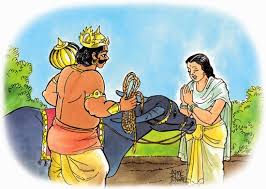
Yama had nothing to say against the argument, so he said ” Ask for another boon, but not the life of Satyavan”. “My father has no sons,” replied Savitri. “Please bless him with the boon of one hundred sons.” Yama granted her the second boon and insisted her to return to perform Satyavan’s funeral rites as a dutiful wife.
Still Savitri continued to follow and Yama himself could not shake her off. Lord Yama also noticed that the boons she had asked was for others and hence put forth a deal that he was ready to grant a third boon. He also commanded to ask something for herself, except her husband’s life. Savitri immediately asked a boon for a hundred sons for herself. Yama was delighted that she had asked for herself and without a thought, agreed to grant her wish. Savitri smiled and said that a widow does not remarry and to fulfill her wish, Yama has to give back Satyavan’s life.
Yama admired her and blessed Satyavan to live for another four hundred years. Satyavan awakens as though he was in a deep sleep and they reach home.
True to Yama’s words, the blind King regained his vision and Kingdom. Savitri and Satyavan lived a royal life. The hundred sons of Aswapati and Malavi, later became the powerful Malava kings.
Did you know?
The term Savitri is used to designate one of the most-important mantras in Hinduism, taken from the Gayatri, a verse in the Rigveda. The mantra is employed in several ritual contexts including the initiation ceremony (upanayana) traditionally incumbent upon boys to achieve success in their endeavor. The mantra is also featured in the morning prayers, that forms a part of the daily religious practice of millions of Hindus. Some scriptures recommend that prolonged recitation and repetition of the Mantra helped our ancestors attain long life, understanding, honor and glory.
Karadayan Nonbu or Savitri Vratham is a traditional festival celebrated in the southern states of Andhra Pradesh, Tamil Nadu, Kerala, and Karnataka, where married women pray to Goddess Gowri for the wellness and long life of their husbands. Historically, it is said that Savitri’s devotion towards the goddess gave her the strength and wisdom to win back her husband’s life. Savitri had offered durwa grass, peepal leaves to the deities, as well as prepared a dish made of wild rice and dal, aka Kara Adai in Tamil. Even unmarried girls keep the vrat to get an ideal life partner in future.
Savitri temple in Pushkar, Ratnagiri hill is a popular pilgrimage site for the Hindus dedicated to Lord Brahma’s wife Saraswathi or Savitri. This shouldn’t be confused with Satyavan Savitri. When Brahma performed yajna at Pushkar, due to some reason, Savitri could not reach the site of yajna at right time. Then Brahma performed yajna accompanied by a local girl, Gayatri – who became the second wife of Brahma. This annoyed the first wife Savitri and she went to the hilltop. Then the agreement was made Savitri will always be worshiped first and then Gayatri. Tradition still continues – first arti is performed at Savitri temple and then at Gayatri temple. The idols of both Savitri and Gayatri are now installed at the Savitri temple. Though the idols of Savitri supposedly dated back to the 7th century AD, the temple itself was built in the early 20th century.
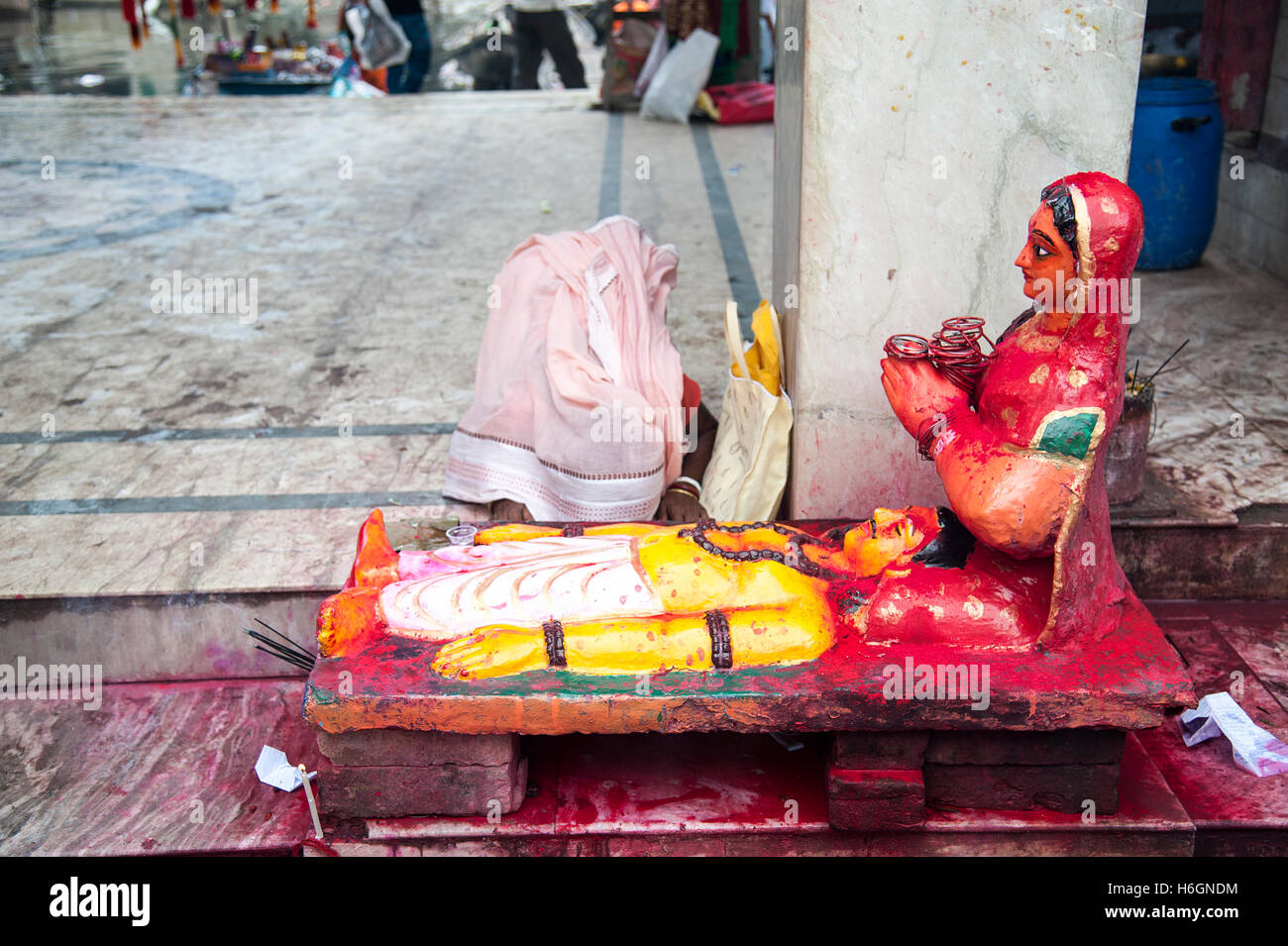
Though we don’t have any separate temple in favor of Satyavan and Savitri, we do have a separate shrine for them in Kali Ghat Temple in Kolkata, West Bengal. This temple is one of the Shakti Peeta located in the city of Kalighat. Married women offer bright red Kumkum and glass bangles to these idols and pray for the longevity and well-being of their husbands.
End-Note
Thanks for reading this post; please leave your feedback in the comment box below.
Check the Home page for the latest posts from our blog.
Browse the Blog page to find all the posts.
Visit the About page for the introduction to the blog.
Learn about the Research, Titbits, and Bliss sections of this blog.
To know the terms and conditions of this blog, please read the Norms page.
Go to the Contact page to message me and/or to find me on social media.
 DetectHistory.in