The vanaram (monkey) twin brothers – Vali and Sugriva are interesting characters in the epic Ramayanam, both questioning Rama’s portrayal as a divine avatar. Why was Vali, the elder twin killed by Rama in a hideous manner, against the war dharma? Why did Rama seek the help of the younger vanaram twin (Sugriva) to rescue Sita Devi from Lanka? Read along to know their fascinating story…
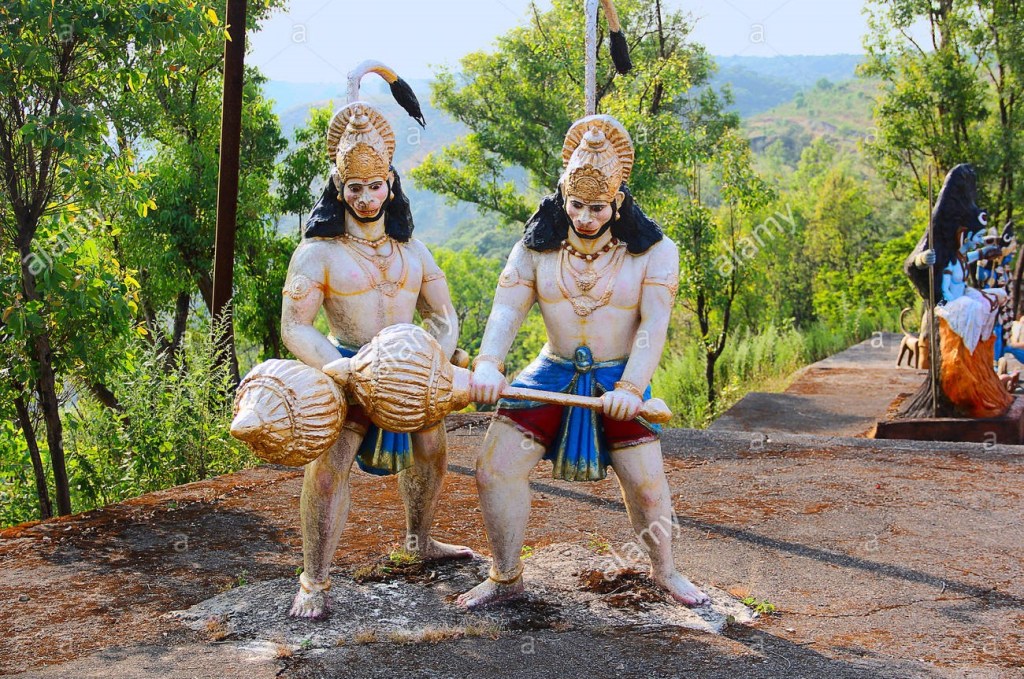
Viswasringa
Viswasringa was both the father and mother of the mighty vanaram twins. Once Lord Brahma summoned the divine architect, Vishwakarma; to create an isolated place for his meditation. Vishwakarma built a serene and beautiful place for the purpose and Lord Brahma, overwhelmed with the sight of the place, shed a drop of tear out of joy.
The tear drop fell on earth and transformed into a giant monkey. Lord Brahma named him Viswasringa and he served Brahma, when in meditation. Lord Brahma let Viswasringa to move freely in the secluded place but warned not to touch water from the crystal pond, as it had to be used only by Brahma. However, one day when Brahma was in meditation, Viswasringa ventured around the place and out of curiosity, jumped into the pond. When Viswasringa emerged out of the pond, he was transformed into a beautiful lady. Viswasringa (now in female form) was blessed with a son by both Lord Indra (Vali) and Lord Surya (Sugriva). Though their existence were through two gods, yet they had identical features.
Not knowing what to do, Viswasringa took the sons to Lord Brahma. Brahma transformed Viswasringa to his original form and gave the kingdom of Kishkinda to be ruled with his twin sons.
Power of Vali
Vali was extremely powerful and his strength matched 70,000 elephants. He meditated on Lord Brahma and acquired a special boon that he would get half the strength of his opponent in a duel, which made him invincible.
Ravana learnt about Vali and his strength through the celestial sage Narada. Ravana was extremely arrogant when he heard Narada’s praises and went to Kishkinda to prove his valor. When Ravana arrived in Kishkinda, Vali was in meditation. So, when Ravana challenged Sugriva for a duel and in the fight that pursued, Sugriva was defeated. Ravana then challenged Vali and they had a fierce battle. Finally, Vali defeated Ravana and tied him with his tail. Vali carried Ravana on his shoulders (in one version) or under his arm pit (in another version) for years. Ravana could not bear the humiliation. So, he apologized to Vali and sought his friendship. Immediately Vali released Ravana, after he established himself as the most powerful being on earth.
Marriage
Vali was married to Tara, daughter of the monkey physician Sushena. In certain texts, she is referred as an apasara emerging from churning of ocean and Indra arranged her to marry Vali. They had a son, Angada.
In the meanwhile, Sugriva fell in love with Ruma, but her father did not approve. Sugriva with the help of Hanuman, abducted Ruma and they were married.
Years passed after Vali fought with the rakshasa king, Ravana and life continued pleasantly in Kishkinda. Hanuman served as a minister in the kingdom.
Curse of Matanga
Vali would often disappear for days or weeks together, responding to challenges of a duel. During those times, Sugriva stayed and defended the kingdom. Sugriva praised Vali, as he was not only fighting for his reputation, but for the honor of the vanaram race in Kishkinda.
One morning, all the monkeys of Kishkinda heard a bellowing roar echoing through the kingdom, challenging Vali to fight. He was a demon bull named Dundubhi, fifteen feet tall and armored in rough brown fur. Dundubhi was a rakshasa from the world of the nagas, who had proven as the strongest of that world and now intended to prove mighty in earth too.
Vali was enraged and told Sugriva not to interfere in the fight with Dundubhi. Vali and Dundubhi lunged at each other and grappled. Soon, Vali started to have the upper hand and the demon bull was on his knees, pleading with Vali to spare his life. However, Vali killed Dundubhi, hurled the body and threw it far.
Hundreds of miles away, Sage Matanga was performing a yagna. Out of the sky, flew the body of the dead demon and landed next to the sage with the mouth gaped open over the holy fire. Sage Matanga was outraged and yelled a curse into the sky that whoever had desecrated his prayer would have his head explode, if he ever stepped foot onto the mountain that he resided.
Meanwhile in Kishkinda, Indra appeared and told them of Sage Matanga’s curse. He warned Vali never go to the Sage’s mountain (Rishyamukh parvat) and that no boon could ever overturn the sage’s curse.
Disagreement
A raging demon named Maayaavi came to the capital and challenged Vali to a fight. Vali accepted the challenge, but when he sallied forth, the demon fled in terror into a deep cave. Vali entered the cave in pursuit of the demon and told Sugriva to wait outside.
Vali did not return even after several days. In the meanwhile, Sugriva heard demonic shouts in the cave and saw blood oozing from the opening. Sugriva concluded that Vali had been killed and with a heavy heart, rolled a boulder to seal the cave’s opening to stop the demon emerging out. Sugriva returned to Kishkinda and assumed kingship over the vanarams.
Vali eventually emerged victorious in his combat and returned home to see. Vali was enraged and concluded that Sugriva had locked him in the cave to become the King of vanarams. Though Sugriva humbly attempted to explain himself, Vali would not listen. As a result, Sugriva was banished from the kingdom. Vali forcibly took Sugriva’s wife Ruma and the twin brothers became bitter enemies. Sugriva then went to live on Sage Matanga’s mountain (as Vali can’t enter the premise and cause any harm to Sugriva) with his loyal minister, Hanuman.
Hanuman
Sri Hanuman was Shiva’s Rudra Avatar and even, Vali’s boon of extracting half the opponent’s power cannot cause any harm to him. Being a minister, if Hanuman had single-handedly slain Vali, it would not have glorified Sugriva’s position as the future King. So, he was looking out for other ways to help Sugriva regain the kingdom and defeat Vali.
Rama and Sugriva
When Lord Rama was in pursuit of Sita, he meets rakshasa Kabandha. Rama kills the rakshasa and frees from its curse; it advises Rama to seek the help of Sugriva to reclaim Sita.
Rama and Sugriva, being princes of their respective kingdoms, meet and make a pact. Rama offered to help Sugriva regain his kingdom and in turn, Sugriva would help Rama find Sita devi.
Combat
Sugriva detailed Vali’s strength and how Vali had made a hole in a timber tree with a single shot. Rama demonstrated his power by shooting a single arrow that made holes in several such trees before striking and shattering a rock to pieces.
Sugriva had invited Vali for a combat, away from the kingdom as Rama cannot enter a city during his exile. Also, if Rama went into a war with Vali, he would eventually have to cause harm to the vanaram army. Initially, Rama was unable to differentiate between the twin brothers and so Hanuman eventually made Sugriva wear a garland. Rama could have won Vali effortlessly, he chose to hide and shoot the arrow. There are several reasons listed in Valmiki Ramayanam behind this incident. Couple of them are covered in this blog.
Rama being a royal Kshatriya had a duty to protect the virtuous and punish the vicious. Vali had attacked, exiled, insulted, threatened to take away the life of his faithful brother and also forcefully held Sugriva’s wife, Ruma against her will.
Vali was a monkey and Rama was currently living in the forest. Hence, the act is similar to that of a hunter who usually hides and attacks an animal.
Vali’s bad intentions towards his brother had melted down upon Rama’s arrow piercing his heart. Rama offered to give back his life, if Vali still believed he was harmed unethically by Rama. Also, Vali wore a necklace that symbolized his power and prevented him from dying too.
Vali replied to Rama that he might take several births and life, but to die in the presence and witnessing God in vision during the last breath, is rare and so, he chose to die.
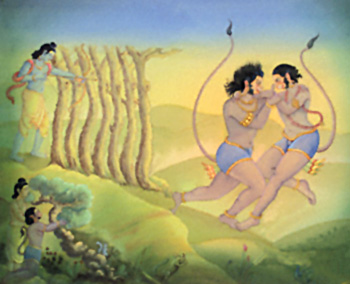
Vali called his Son and Wife and asked them to serve Sugriva and not bear hostility, as it was Vali’s mistake and Sugriva was noble. Vali’s handed over his necklace to Sugriva, who becomes the King of Kishkinda. Angada was crowned prince and following Vali’s wish, played an important role in Rama’s war against Ravana. Vali’s wife Tara was then married to Sugriva.
Rama’s karma
It is believed that Lord Rama accepted to face the karmic consequence of killing Vali. In his next avatar, Vali was born as a hunter. Krishna was struck with an arrow from a hunter in hiding, who mistook Krishna’s feet for a small animal. Krishna chose to end his life in that birth.
Did you know?
In the recent years, Pattanam excavation in Kerala has been in news and compared with the Keezhadi excavation of Tamilnadu. Let us read some interesting facts about Pattanam excavation and Kerala’s association with the rest of the world.
Pattanam is about one-and-a-half kilometres from Kodungallur in Kerala and the main objective of these excavations was to identify an early historic urban settlement and the ancient Indo-Roman port of Muziris on the Malabar Coast. Muzris finds mention in ancient Greek and Roman sources as well as in the Sangam literature dating back to the centuries before the Common Era.
Muziris was also known as Murachipattanam. In Ramayana, Murachipattanam is the place where Sugriva’s sleuths scurried through while looking for the abducted Sita.
Many artifacts have been unearthed through Pattanam excavations as part of the Muziris Heritage Project. Artifacts like human bones, storage jars, a gold ornament, glass beads, stone beads, utilitarian objects made of stone, copper and iron, typical pottery, early Chera coins, brick wall, brick platform, ring well, wharf with bollards and a six-meter-long wooden canoe parallel to the wharf structure indicate a vast ‘urban’ settlement.
The excavations suggest that the site was first occupied by the indigenous “Megalithic” (Iron Age) people, followed by the Roman contact in the Early Historic Period. It appears that the site was continuously occupied at least from the 2nd century BC to the 10th century AD. A seal ring with the carving of the Sphinx, which looks similar to the one worn by the Roman Emperor Augustus Caesar about 2,000 years ago was also excavated in Pattanam recently. Who could have made the ring with the Sphinx? how did it end up at Pattanam? Did one of the traders or perhaps an emissary of the emperor bring it with him or her? Or was it made in Pattanam itself, especially since there is evidence of people working there with precious stones? Several questions remain to be answered.
Proliferation of roulette ware probably made in the Bengal-Gangetic region signifies the site’s importance in the pan Indian context as well. However, bulk of the archaeological remains in the area is buried, unexplored and untouched.
Muziris was a key to the interactions between South India and Persia, the Middle East, North Africa, and the (Greek and Roman) Mediterranean region. The important known commodities exported from Muziris were spices (such as black pepper), semi-precious stones (such as beryl), pearls, diamonds, sapphires, ivory, Chinese silk, Gangetic spikenard and tortoise shells. When the Roman trade declined from the 5th century AD, the former Muziris attracted the attention of other nationalities, particularly the Persians, Chinese and Arabs, presumably until the devastating floods of Periyar in the 14th century.
In Egypt, the mummified body of Ramesses II (roughly 3300 years old), the nostrils, to be more precise, archaeologists found a handful of peppercorns. They had been placed there to hold the pharaoh’s aquiline nose in position and to ensure, that it was properly embalmed. Pepper, which was known as ‘black gold’ for its use as a preservative and in medicine throughout history, has its roots in Kerala, and the discovery of the peppercorn in a tomb going back to 1214 BCE indicates that this spice had been making its way as far as Thebes in Egypt even in the 13th century BCE.
An independent traveler to a village in Kenya’s Swahili Coast claims to have been served with chappatis and moong dal (cherupaiyar) cooked and flavored exactly his mother in Kerala cooks!
The latest controversy on Keezhadi and Pattanam erupted after R. Sivanantham, deputy director, Tamil Nadu state department of archaeology, officially facilitated a lecture on Pattanam by Dr. P.J. Cherian, titled ‘Reimagining Muziris-Pattanam/Muziris: The Ancient Port City of Tamilakam (300 BCE-500 CE)’, on Oct. 30, 2018. Delivering his lecture at Chennai, P.J. Cherian claimed that the excavated material from Pattanam and Keezhadi are similar and hence there is a common link of brotherhood (Deccan Chronicle, Oct. 31, 2018). However, he did not present either ceramics, metals or any other remains showing the cultural homogeneity between Pattanam and Keezhadi.
End-Note
Thanks for reading this post; please leave your feedback in the comment box below.
Check the Home page for the latest posts from our blog.
Browse the Blog page to find all the posts.
Visit the About page for the introduction to the blog.
Learn about the Research, Titbits, and Bliss sections of this blog.
To know the terms and conditions of this blog, please read the Norms page.
Go to the Contact page to message me and/or to find me on social media.
 DetectHistory.in