About the post:
The major sources of Indus inscriptions are the seals and tablets which were used by the Harappans for trade and administration purposes. As we know very well, the Mature Harappan Phase is characterized by extensive trade activities, whereas the Late Harappan Phase experienced a breakdown of long-distance trade. These factors got reflected in the use of seals/tablets, thereby creating an illusion of the disappearance of the Indus script during 1900–1300 BCE. Nonetheless, one can almost be sure that the Mature Harappan script did not vanish but instead got transformed into the Late Harappan script. This assumption is based on the discovery of the Bet-Dwaraka inscription dated circa 1500 BCE, which is comprised of what can be termed as an evolved form of the Mature Harappan script; this post is all about deciphering the Bet-Dwaraka inscription.
Sneak Peek:
Pottery carrying a seven-character inscription was discovered during an underwater excavation at the Late Harappan site of Bet Dwarka. What does the inscription say? Read on to know more………
Bet-Dwaraka Inscription:
Bet-Dwarka/Beyt-Dwarka is an inhabited island located at the mouth of the Gulf of Kutch; it is situated 3 kilometers off the coast of Okha and 30 kilometers north of the modern town of Dwaraka, in Gujarat (India). Bet-Dwaraka is also known as Shankhodhara; ‘THE LOST CITY OF DVĀRAKĀ’, authored by Dr.S.R.Rao, states that the name is appropriate for the island as the Gulf of Kutch in which it is situated is noted for the prolific yield of Śaṅka (Sanskrit word meaning ‘conch shells’) of good quality.
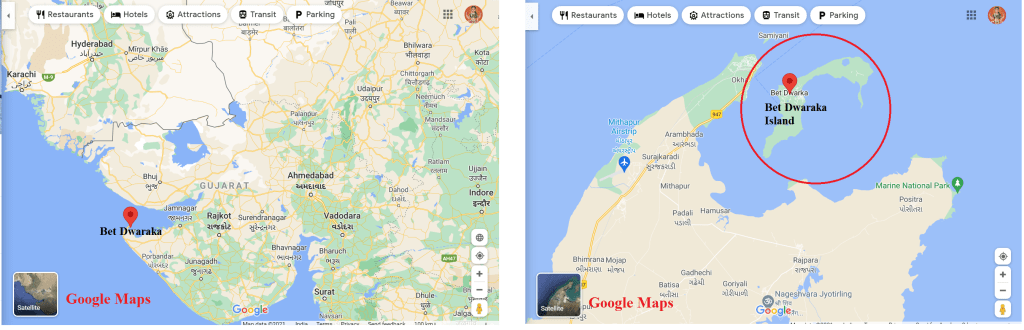
Bet-Dwarka is considered a part of the ancient city of Dvārakā, described in Mahabharata and many other ancient Indian texts; it was the abode of Lord Krishna and his people. Mausala Parva of Mahabharata declares that Krishna’s Dvārakā was submerged by the sea almost immediately after Krishna’s demise; according to the traditional belief and also as per my research conclusions, this event occurred around 3102 BCE. In search of the submerged Dvārakā, Dr.S.R.Rao conducted on-shore and off-shore explorations during the late 1900s; the process included archaeological surveys and excavations in and around the Bet-Dwaraka island also.
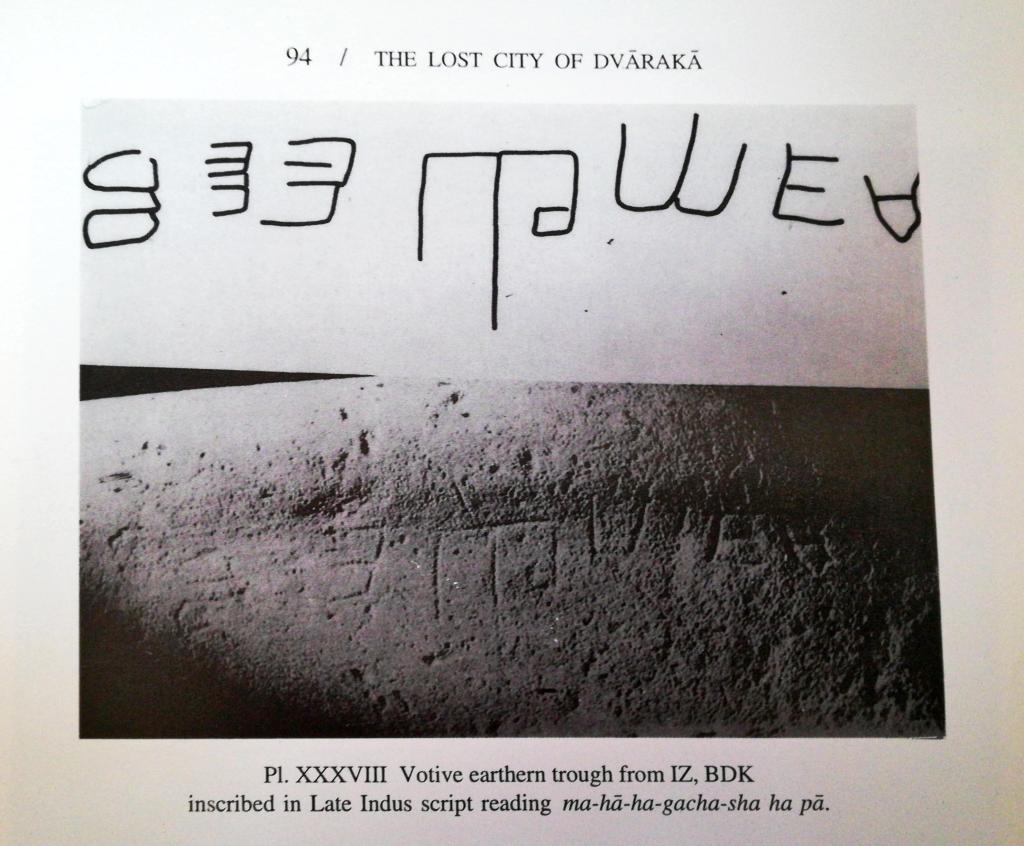
Bet-Dwaraka had yielded quite a few interesting artifacts, among which an earthen jar with a Late Harappan inscription is considered the most significant. The Bet-Dwaraka inscription comprises seven Late Harappan symbols/signs (refer to Image-20). Dr.S.R.Rao states that the letters (1 cm in height) are separated from one another and that the script runs from left to right; regarding the date, he says, “along with the votive jar the inscription under reference is assignable to the 15th-14th century BC”. According to Dr.S.R.Rao, certain signs show similarities with the Phoenician alphabet and Brahmi letters; he has even proposed a Sanskrit/Prakrit decipherment for the inscription (refer to Image-20) which conveys the meaning “Sea (or Sea God) King (or Ruler) protect”. Nonetheless, since my research proves Tamil to be the language behind the origin of the Indus script, I thought of interpreting the inscription in my own way.
At the first sight, the Bet-Dwaraka inscription looked quite challenging to me but then I realized that four out of the seven Bet-Dwaraka symbols resemble four respective Mature Harappan signs which have already been deciphered by me (refer to the Comparison Table given below).
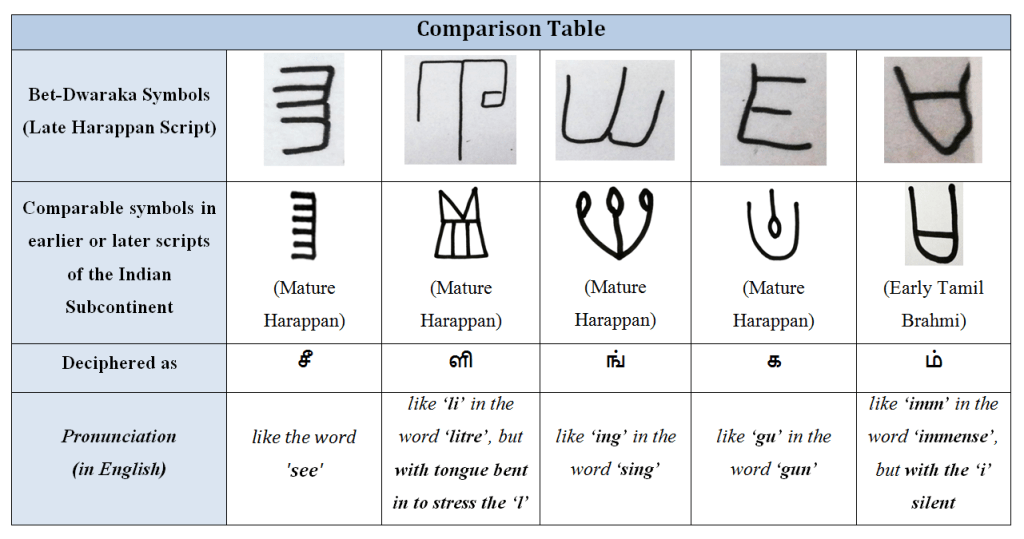

Though tried, I could not find a Mature Harappan counterpart for the remaining three signs. Interestingly, one of these three symbols (i.e. the rightmost Late Harappan symbol in the Comparison Table given above) resembles the letter ‘ம்’ of the early Tamil Brahmi script (refer to Image-21). This similarity is however unbelievable because the earliest date of the Tamil Brahmi script, as per the opinion of mainstream epigraphists, is circa 300–580 BCE whereas the date of the Bet-Dwaraka inscription is circa 1500 BCE. Nonetheless, since only ‘ம்’ or ‘ன்’ or ‘ர்’ can fit into the context, I deciphered the concerned symbol (i.e the Late Harappan symbol numbered S.No.7 in the Decipherment Table given below) as ‘ம்’ due to its striking resemblance to the ‘ம்’ of the Early Tamil Brahmi script. Hence, only the task of deciphering the symbols numbered S.No.1 and S.No.3 (in the Decipherment Table) was remaining; eventually, I identified them to be special/abstract characters prefixed to the second and fourth symbols respectively. After studying and understanding the concept of the two special characters, I finally deciphered the Bet-Dwaraka inscription as shown in the Decipherment Table given below.
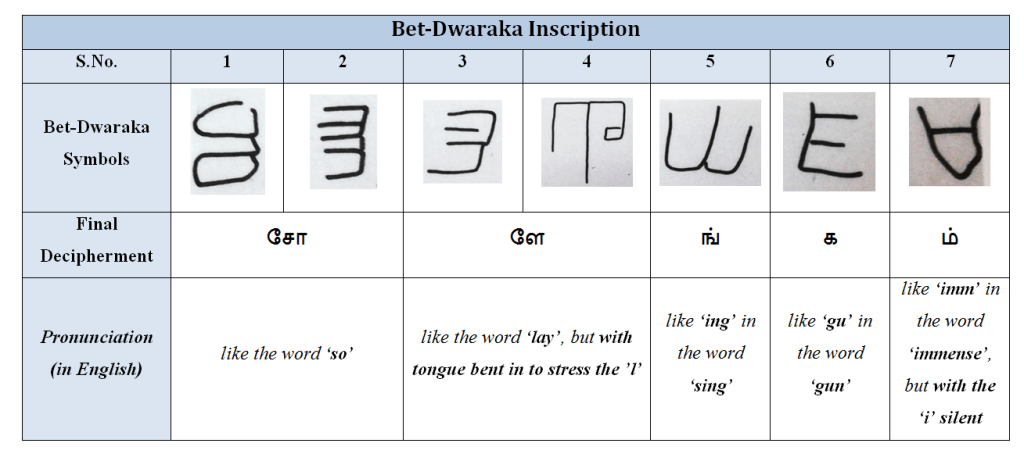
Thus, I have deciphered and read the Bet-Dwaraka inscription as “சோளேங்கம்”. Since the inscription is found on an earthen jar, “சோளேங்கம்” could probably be the name of the person to whom the jar belonged; incidentally, Google search results mention at least a couple of individuals named “Solengam”. However, I am not able to find out if the name existed 3500 years before the present. Moreover, I have no clue about the connection between the place Bet-Dwaraka and the name “சோளேங்கம்”. Hence, I shall be more than happy to receive input from the readers regarding this.
Closing Message:
I am planning to come up with at least one more sequel on this topic. So I hope to meet you all soon in part 9.
End-Note:
Thanks for reading this post; please leave your feedback in the comment box below.
Check the Home page for the latest posts from our blog.
Browse the Blog page to find all the posts.
Visit the About page for the introduction to the blog.
Learn about the Research, Titbits, and Bliss sections of this blog.
To know the terms and conditions of this blog, please read the Norms page.
Go to the Contact page to message me and/or to find me on social media.
 DetectHistory.in