God possesses immense power and we fantasize a world with fictional characters and super heroes. Needless to say, with great power comes great responsibility! Have we ever given a thought about responsibilities of God? Let us read incidents from Mahabharata to see how Lord Krishna went from pillar to post to protect and safeguard his believers…
Task in Hand
Every Vishnu avatar has certain purpose to fulfill. For instance, in Rama avatar, (apart from slaying rakshasas) was to set an example for a man’s life – to be truthful, obedient and chaste. For Krishna avatar, we could state that the mission was to restore balance in the world and to protect dharma. Adharma had to be rooted out and in this process, the cause justifies the means.
Frog in Water
Before we see how Krishna protected the Pandavas, let us see how he took care of all beings on earth.
One day, Lord Krishna visited the Pandavas during their forest exile. Draupadi (wife of Pandavas) fetched water from a nearby lake, but unknowingly a frog had gotten into the pot. She kept the pot on a wood-fire stove for Krishna to freshen up and whenever she touched the water; she found it always cold. She kept adding the wood to the fire, however there was no effect on the pot or the water.
She was confused and informed Krishna. He instructed her to take the pot from the fire and keep it on the ground. When she placed the pot, the frog jumped out and hopped back to the lake. Lord Krishna explained that the frog was scared and kept praying to Krishna to save its life. Krishna had a duty to protect, so he stopped the natural transmission of heat from the fire-wood to the pot. Such was his kindness to all beings who surrendered to his holy feet!
Protecting the Pandavas
Krishna took care of Pandavas, as they adhered to dharma and were soulfully devoted. When Kauravas refused to give any part of the Kingdom that Pandavas rightfully entitled, Krishna tried to reason with the eldest Kaurava, Duryodhana.
Duryodhana wasn’t ready to give back anything to Pandavas. As the attempts failed, a war had to be fought for justice. Krishna promised not to use any of his divine powers in the war as he can destroy the whole army in the blink of the eye.
Pragmatic Choice
Once war was declared, Pandavas and Kauravas sought help of neighboring and friendly kings to fight on their sides. Duryodhana and Arjuna, both went to Dwaraka to seek Krishna’s support. Duryodhana was first to arrive and Krishna who was asleep, waited to open his eyes, until after the arrival of Arjuna. Arjuna, the meek and humble, chose to sit at the feet of Krishna and when Krishna opened his eyes, he happened to see Arjuna first and hence, gave the choice to choose between Krishna and his powerful army – Narayani Sena. Knowing that Krishna’s grace can only help win the war, Arjuna chose Krishna and Duryodhana was rejoiced that the mighty Yadava army will fight for him. (It is believed that a part of Krishna’s army fought for Duryodhana in the Kurukshethra war and not the entire Narayani Sena)
Kauravas outnumbered Pandavas and so were their armies. Also, the undefeatable Beeshma, their gurus Dronacharya and Kripacharya were fighting for the Kauravas. In spite of the imbalance, Krishna had the duty to protect Pandavas, as Dharma was on their side and helped them attain victory in the war.
Krishna’s Curse
Ashwattama, the only son of Dronacharya (teacher/guru of both Pandavas and Kauravas), was cursed by Lord Krishna during the Kurukshethra war.
Being the son of Guru Dronacharya and the grandson of the sage Bharadwaja, Ashwattama was one of the seven Chiranjeevis (immortals), who had been granted a boon of immortality from Lord Shiva. Along with being granted immortality, Ashwattama, at his birth, also received a gemstone that was placed at the center of his forehead. The gemstone gave him the power over all living beings lower than humans, and it also protected him from hunger, thirst and fatigue.
In order to defeat Dronacharya, a plot was laid to deceive that Ashwattama was slayed in the war (an elephant named Ashwattama was only killed). When Dronacharya checked with Yudhishtra, Krishna blew his conch and Drona could not hear the word, “elephant”. Believing that Ashwattama was dead, out of paternal affection, he laid down his weapon and eventually got killed. To seek revenge, Ashwattama decided to kill the Pandavas.
Ashwattama infiltrated the camp of the Pandavas at night and killed five of Draupadi’s children who were asleep. On returning to camp, the Pandavas and Krishna were left devastated and rushed to avenge the deaths caused by Ashwattama.
When both the forces came face to face, Ashwattama invoked the Brahmastra, a weapon of immense destruction, to fulfill his oath of killing all the Pandavas. Krishna in turn asked Arjuna to use the Pashupatastra, another lethal weapon, to protect them. The gods asked them to take their weapons back, as they could destroy the entire universe.
While Arjun knew how to recall his weapon, Ashwattama did not and when Krishna suggested that he redirect the weapon to an uninhabited place, he instead aimed it towards the womb of the pregnant Uttara, who was carrying the grandson of Arjun. Arjuna’s son Abhimanyu had already been killed in the war. Krishna intervened and revived the stillborn baby, and Ashwattama was made to give up his source of power – the gemstone in the middle of his forehead for his cruelty. Due to his immortality, he was cursed to live forever till the end of time with the gaping wound on his forehead.
Annihilation of the Yadavas
The Divine has a quality to forgive all living beings as a mother does to her child. Lord Krishna even went a step ahead and accepted the curse of Gandhari. She was in anger and grief over the death of her sons. Gandhari cursed Krishna with the destruction of Yadavas (Krishna’s lineage) in a manner similar to the death of her one hundred Kaurava sons.
Thirty-six years had passed since Gandhari cursed the Yadava race to total annihilation, blaming Krishna for the Mahabharata war. The chain of events leading to disaster and destruction of the race started from a prank, indulged in by the Yadava youth.
The sages – Viswamitra, Kanva and Narada arrived on a visit to Dwaraka. Their senses fogged by fate, some of the Yadava youth approached the distinguished rishis to play a prank on them. One of the youths, Samba, was dressed like a pregnant woman. They asked the sages, “Revered noble ones!, Could you tell if she would be blessed with a Son or Daughter?”
The rishis immediately understood the mischief being played upon them. They cursed the youth, “This scion of the Vasudeva family, Samba, would bring forth an iron rod which would cause the destruction of the Yadavas. All of them, excepting Balarama and Krishna, would perish due to this curse.”
After few years, intoxicated by drinking alcohol, Yadavas’ argued and started a fight amongst themselves. A spree ensued and whatever weapons could be found, was used to attack and kill another. Whoever could not find a weapon took blades of grass, which turned into iron rods.
Knowing that the Yadavas’ hour of destruction had arrived, and remembering Gandhari’s curse, Krishna did not interfere in the fight. In fact, Krishna himself killed many of his kinsmen, using the rod. All the Yadava men, except Krishna, his charioteer Daruka and Balarama, were killed.
Did you know?
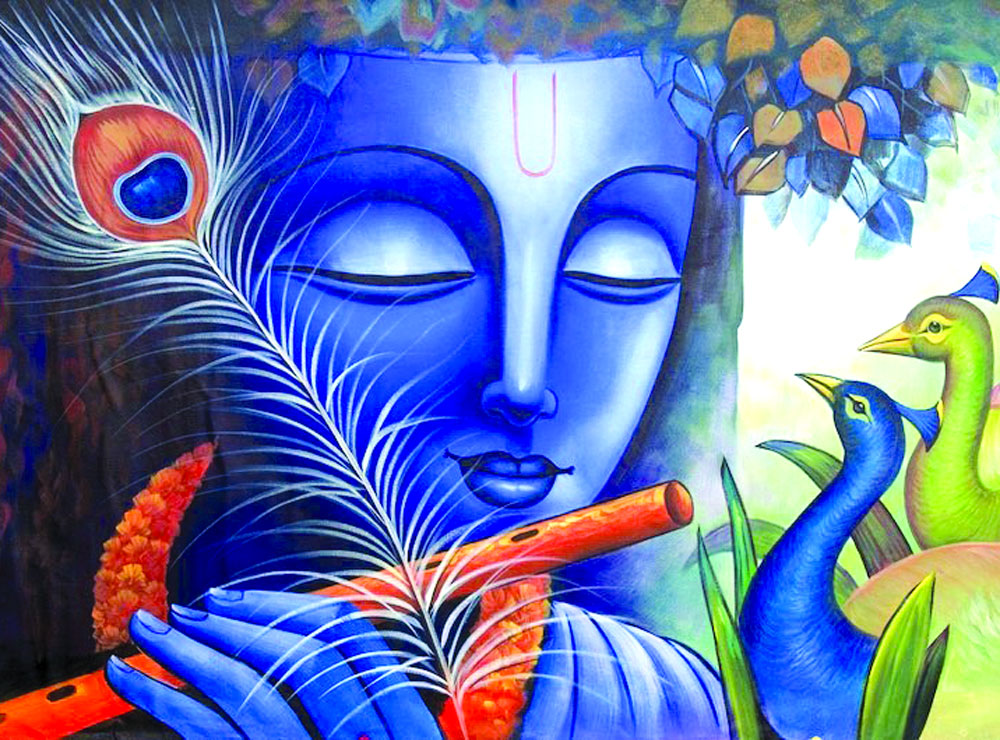
The world has depicted Lord Krishna to have a blue color skin. The question as to why his skin looked different from ours, must have nudged you? The legends tell us that Lord Krishna had drunk poisoned milk given by a demon when he was a baby and that had caused the bluish tinge in his skin. The same theory is floated to explain blue throat (neelakand) of Lord Shiva, who is believed to have drunk the poison to save the world from destruction at the time of Churning of Ocean.
Religious interpretation of blue
Etymologically speaking, the Sanskrit word ‘Krishna’ means black or dark. At times, it is also translated as “all attractive”. Hindu religion believes in symbolisms and the blue color is a symbol of the infinite and the immeasurable. Just like the cloudless summer sky appears blue to the physical eye, Lord Krishna is beyond our perception and it seemed apt to attribute this color to him.
Blue is the color of aura
Some are of the opinion that the bluish tinge in Lord Krishna’s skin is not the color of the material body but the eternal spiritual body of the Lord that emits blue aura. According to Bhagavad Gita, the blissful form of Lord Krishna is visible only to pure devotees. He may have bewildered the non-devotees, but those who offered pure devotional service to him had always seen his blue blissful form.
Science of blue skin
But in real life, can people actually have that skin color? James Cameron, drew inspiration from the Krishna Avatar to name his film and showed Na’vi having blue skin to imply otherness. However, there is nothing alien about being born with a blue skin.
Blue-tinged skin is the result of methemoglobinemia—a condition wherein hemoglobin, the molecule in red blood cells that distribute oxygen to the body, is unable to release oxygen effectively to body tissues. As the blood doesn’t get oxygenated, it makes the skin look blue, lips purple, and blood chocolate-colored. Most of us have less than 1 per cent of methemoglobin. The skin gets the bluish tinge when that level rises to 10-20 per cent.
Famous Fugate family of Kentucky
Six generations of the Fugate family, who lived in the hills of Kentucky (USA) from 1800 to 1960, had blue skin. The blue lineage began in the early 1800s when Martin Fugate, a French orphan, settled on the banks of the Troublesome Creek. He married a red-haired American lady who had a very pale complexion. Their genetic chemistry resulted in a mutation and they unknowingly carried the recessive gene that resulted in their descendants being born with blue skin.
Blue Baby syndrome
Methemoglobinemia may be passed down through families or can be caused by exposure to certain drugs and chemicals. Uranium toxicity from contaminated water is also believed to have the potential to cause ‘blue baby syndrome’. Indiscriminate use of chemical fertilizers in Punjab villages saw a surge in blue baby syndrome in 2009. Cases of blue baby syndrome were reported in villages in Romania and Bulgaria that faced sanitation problem and high level of nitrates in groundwater.
Spotting Ashwattama
Considering the beliefs that people hold about mythology, many have stated to have seen a man with a gaping wound on his forehead and a doctor has even revealed that he tried to heal him without success. Reports have been doing rounds, that a man fitting the description of Ashwatthama has been visiting Shiva temples all over India, attempting to be released from the curse.
A doctor from Madhya Pradesh had revealed that a man had come to him for treatment of an unusual wound on his forehead. The doctor said that no matter the treatment, with medicines or stitching up the wound, it just did not heal. During one such treatment, the doctor jokingly asked the patient if he was Ashwattama. As he turned around to address the man, the doctor said that he was nowhere to be seen and nobody outside his cabin had seen him either.
The doctor also gave a description of the wound, saying it looked so horrific that it was as if his brain had been pulled out from the front of his head. Whether the stories are true or not, most seem to think that Ashwattama is still very much alive.
End-Note
Thanks for reading this post; please leave your feedback in the comment box below.
Check the Home page for the latest posts from our blog.
Browse the Blog page to find all the posts.
Visit the About page for the introduction to the blog.
Learn about the Research, Titbits, and Bliss sections of this blog.
To know the terms and conditions of this blog, please read the Norms page.
Go to the Contact page to message me and/or to find me on social media.
 DetectHistory.in