“Whenever righteousness wanes and unrighteousness increase, I send myself forth. For the protection of the good and for the destruction of evil, and for the establishment of righteousness, I come into being age after age” – verses of Gita are the only hope for people who can still believe that truth triumphs eventually. Let us read about the ten avatars of Lord Vishnu and some amazing facts linked to it…
Number of Avatars
Vishnu is generally held to have ten incarnations, but the number ten is much less ‘traditional’ than is commonly believed. The Matsya Purana (47.32-52), for instance, enumerates twelve avatars, while the Garuda Purana (1.12-35) mentions twenty-two. The Bhagavata Purana likewise mentions twenty-two incarnations, but after enumerating them, it adds: “The incarnations of Vishnu are innumerable, like the rivulets flowing from an inexhaustible lake. Rishis, Manus, gods, sons of Manus, Prajapatis, are all portions of him.” We will take up the popular Dasavatharam (10 Avatars) and discuss the significance in this blog.
Variation in list
Amongst the 10 list of avatars of Vishnu, we have two versions – a list that includes Balarama as one of the avatars and another version that includes Gautama Buddha as one of the incarnations.
We will consider the first list with Balarama. Though there are two concern areas highlighted for this list. First being that Balarama is an avatar of “Adishesha” (King of snakes that serves as a bed over which Lord Vishnu rests in his Vaikuntha). Second being that Krishna is popularly referred as the “eighth avatar” and if we place Balarama in the list prior to Krishna (as he was the elder brother of Krishna), Krishna then becomes the ninth avatar.
In order to authenticate and to provide a realistic theory, we can put forth the following explanation supporting our list:
Adishesha is considered as an extension of Lord Vishnu himself and hence can be considered as Vishnu avatar. The reference to number eight and Krishna is that he was the eighth son of Devaki and does not necessarily refer to the avatar sequence.
As conclusive evidence, we can take reference from our ancient temple carvings and sculpture, which depicts Balarama as an avatar. In some instances, Krishna is depicted prior to Balarama, however the avatar list remains the same.

Dasavathars
- Matsya
- Kurma
- Varaha
- Narasimha
- Vamana
- Parashurama
- Rama
- Balarama
- Krishna
- Kalki
Matsya Avatar
Matsya is the half-fish and half-human form. According to Matsya Puran, Matsya informs Manu, the leader of the humans, of the great flood and helps him save all forms of living beings, Vedas and the seeds of all plants.
Kurma Avatar
Kurma is the half-tortoise and half-man form. During the churning of the ocean (Samudra Manthan), he balances Mount Mandara on his shell to assist devas and asuras in the churning process. He is also believed to have supported the weight of the cosmos on his back.
Varaha Avatar
Varaha is the half man and half boar avatar. In Hindu dharma, he slays the demon Hiranyaksha to save Bhudevi, the personification of earth and restores her back to the surface from sinking, using his tusks.
Narasimha Avatar
Narsimha is the half-lion and half-human avatar. He was born to end the reign of the demonic king Hiranya Kashyap and establish peace, order and righteousness on earth.
Vamana Avatar
The 5th avatar of Vishnu, Vamana, was a dwarf human. This avatar of Lord Vishnu comes to check the growing power of the demonic king Mahabali, which he does by tricking him during a sacrificing ceremony and sending him to the underworld.
Parashurama Avatar
Parshurama is a Brahmin Kshatriya avatar of Lord Vishnu. He is depicted as a sage with an axe in his hand. He was born to end the tyranny of the evil Kshatriyas, who misused their powers and made others’ lives miserable, and bring them to justice.
Rama Avatar
Lord Rama is one of the most significant and powerful deities of Hindu dharma and the lead character of the epic Ramayana. He kills the evil King Ravana to end his terrorizing rule and free his wife Sita, whom Ravana had kidnapped.
Balarama Avatar
Balarama is the elder brother of Krishna. He is particularly significant in the Jagannath tradition, as one of the triad deities. He has strong associations with farming and farmers and referred as the deity who used farm equipment as weapons when needed.
Krishna Avatar
Lord Krishna is yet another major form of Lord Vishnu. He is known to end the reign of his tyrannical maternal uncle Kansa and his role as the advisor or the Pandavas and guide of Arjuna in Mahabharata.
Kalki Avatar
Kalki is the only avatar of Vishnu that is yet to be born. He will end all evil by defeating the demon Kali and start a new Satyayuga. Kali is all the negative emotions and elements personified into one. Kalki is depicted as a warrior riding a white horse and holding a shining sword.
Did you Know?
Having read about the different avatars, let us now touch upon some interesting facts and relevance.
Darwin’s evolution theory
Though there is no concrete evidence of the Avatars to have happened in a certain sequence, our ancestors have compiled and handed over a remarkably ordered list to pass over generations that matches with Charles Darwin’s theory of Evolution.
According to Monier Monier-Williams (an Oxford professor born in India and who taught Asian languages of Sanskrit, Persian and Hindustani),
“Indeed, the Hindus were Spinozists 2,000 years before the birth of Spinoza, Darwinians centuries before the birth of Darwin, and evolutionists centuries before the doctrine of evolution had been accepted by the Huxleys of our time, and before any word like evolution existed in any language of the world”.
Darwin’s Theory of evolution claims that the world evolved from life in water and then adapted characteristics and evolved to more complex living organisms. Similarly, Vishnu’s first avatar is the fish followed by amphibian (life living in both water and land), then the mammals (wild boar). The Narasimha (half animal- half human) will indicate the transition from animals to humans. Vamana Avatar indicates primitive humans who were short. Parashurama was an avatar who lived in forest, followed by Rama, who can be considered to be a person in civilized society and leadership. Balarama Avatar indicates life depending on farming and agriculture. Krishna Avatar indicates a society that has politically coalition and also animal husbandry.
Finally, Kalki avatar is considered to be the destructive power and weapons of mass destruction and nuclear power, it seems quite relevant as well.
Noah’s Ark
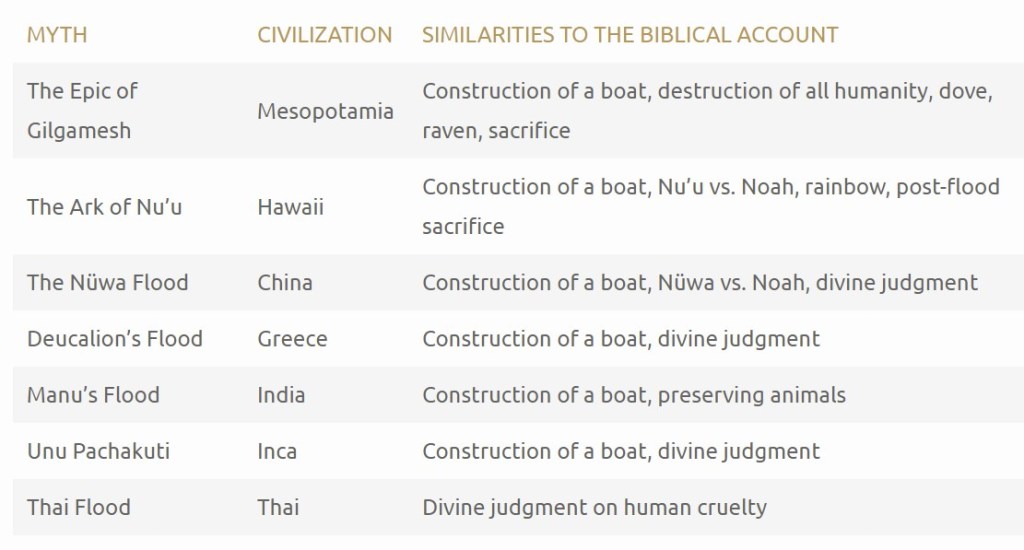
Noah’s ark was a massive ship, built at God’s command, that saved Noah, his family, and representatives of every kind of land-dependent, air-breathing animal from the global flood that took place thousands of years ago. This concept of global flood and giant boat as the savior in Christianity is present in several other cultures around the world.
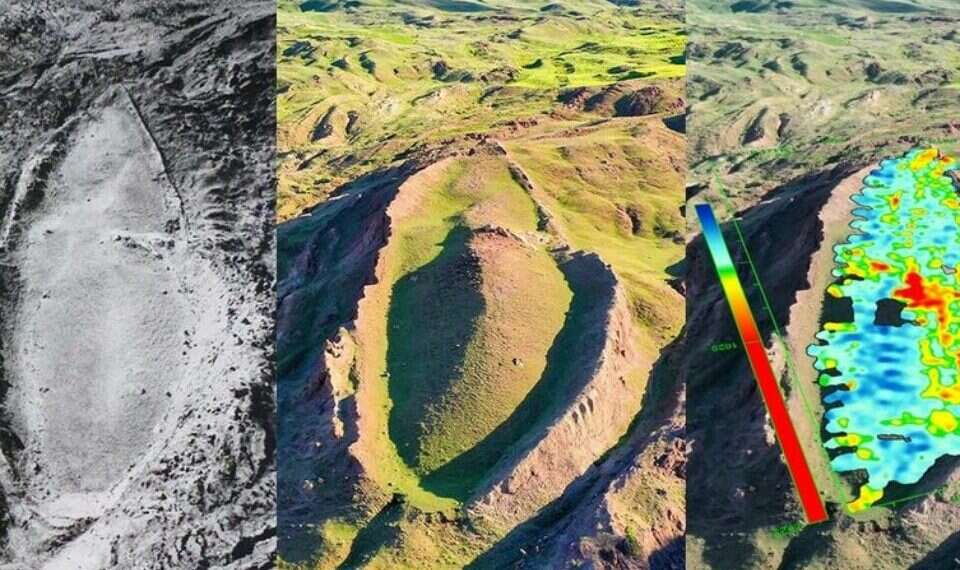
Archaeologists claim to have found true location of Noah’s Ark. The discovery was made using advanced 3D scans of an area in eastern Turkey, believed to be the location of Mount Ararat – the mythical resting place of Noah’s Ark, as described in the Book of Genesis. “Such angles below the surface is something you would not expect to see in a natural, geologic formation,” researcher says. Though Archaeologists claim to have found a giant shape in the Turkish mountains that matches the shape and dimensions of the iconic biblical craft (a formation of the exact length of the ark, detailed in the bible as being around 150 meters, or 300 cubits in Biblical terms), geologists insist that this mountainous formation is only a rock. Historical records show that the hunt for the ark dates back to the time of Eusebius of Caesarea (275–339 CE), but no physical proof of the Ark has ever been found yet.
Data Sources: detechter.com, vedicfeed, Israel-Hayom, arkencounter
End-Note
Thanks for reading this post; please leave your feedback in the comment box below.
Check the Home page for the latest posts from our blog.
Browse the Blog page to find all the posts.
Visit the About page for the introduction to the blog.
Learn about the Research, Titbits, and Bliss sections of this blog.
To know the terms and conditions of this blog, please read the Norms page.
Go to the Contact page to message me and/or to find me on social media.
 DetectHistory.in