Our ancient scriptures have stories in abundance to answer several natural phenomena. One such significant narration is the churning of ocean by the devas and asuras that addresses the occurrence of eclipses. Lord Vishnu manifests in two avatars for this event to protect and preserve the virtuous. In this article, we will cover the events, implications and relevance to other religions and culture…
Curse of Indra
Once the King of devas, Indra was riding on his elephant and Sage Duruvasa, offered him a special garland as a token of honor. Indra (some scripture mention as an act of arrogance and some as an act of negligence) kept it on his elephant ride. Airavata (Indra’s elephant) annoyed by the bees attracted to the garland, threw the garland on the ground and stamped with its humongous feet. The enraged sage cursed that the devas will lose their power and wealth.
Remedy
As a consequence of the curse, the devas lost their fortune and the heaven to the asuras, who exploited the opportunity. The devas were advised to churn the ocean to regain their wealth and obtain Amrutha (elixir) to attain immortality.
But this task could not be accomplished by themselves and they had to work alongside their arch enemies, asuras. After deliberations, both agreed to churn the ocean together and share the proceeds.
Churning
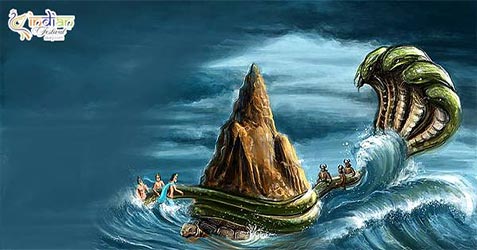
Mount Mandhara was used as the stick and Vasuki snake was used as the rope. Asuras were tricked to hold the head of the snake as the devas anticipated the impact of venom from multi hooded head.
As the churning action was unstable, Vishnu in the form of tortoise (Kurma avatar) offered support.
The first item that evolved was Halahala (ultimate poison) and it began to engulf the entire universe. Lord Shiva came to aid, collected the poison and consumed it. Goddess Parvathi touched Lord Shiva’s throat and stopped the poison from being swallowed. Lord Shiva thus got the name of Neelakandan – person with a blue throat.
After having dealt with the poison, asuras and devas continued to churn the ocean. Asuras also had to face the heat and venom oozing out from the snake – Vasuki’s head.
Ratnas
It is believed that the act of churning the ocean (Paar kadal) went on for millions of years and precious things began to emerge onto the surface.
Kamadhenu (the wish fulfilling cow), Ucchaisrava (the white horse), Airavata (the white elephant), Kaustubhamani (a rare diamond), Kalpavriksha (the wish fulfilling tree), Lakshmi (the goddess of wealth), and Sura or Varuni (the goddess of wine). The devas and Asuras divided the objects among themselves. Lakshmi was gifted to Vishnu who was supporting them all along as the tortoise. Finally, Dhanvantari (the divine physician) appeared with the vessel of Amrutha in his hands.
Mohini Avatar
Once the Amrutha emerged, there was a feud between asuras and devas. The gods wished only the devas to consume the Amrutha as asuras will begin havoc acquiring immense power. Lord Vishnu appeared as Mohini (avatar of a beautiful maiden) and offered to play fair to distribute the Amrutha between devas and asuras.
Rahu and Ketu
Mohini fed the devas with the Amrutha and deceived the asuras. Realizing the plot, one of the asura (named Svarbhanu) in disguise, consumed the Amrutha. The sun and moon gods pointed out this deceit to Mohini. The enraged Lord Vishnu, sent out his discus (Sudarshana Chakra) that cut the asuras head from its body.
However, the head and torso had attained immortality by consuming the Amrutha. Rahu is the severed head and Ketu is the body without a head. In visual descriptions of the navagraha, Rahu is typically depicted as a figure with a human head and a serpent body. Ketu is depicted as a serpent head with a human body. A blessing from Lord Brahma helped Rahu and Ketu to be included in the nine planetary system that influences a person’s life on earth (vedic astrology).
Rahu, in an act of revenge is believed to swallow the sun and moon to cause eclipse as per Hindu mythology.
Angkorwat
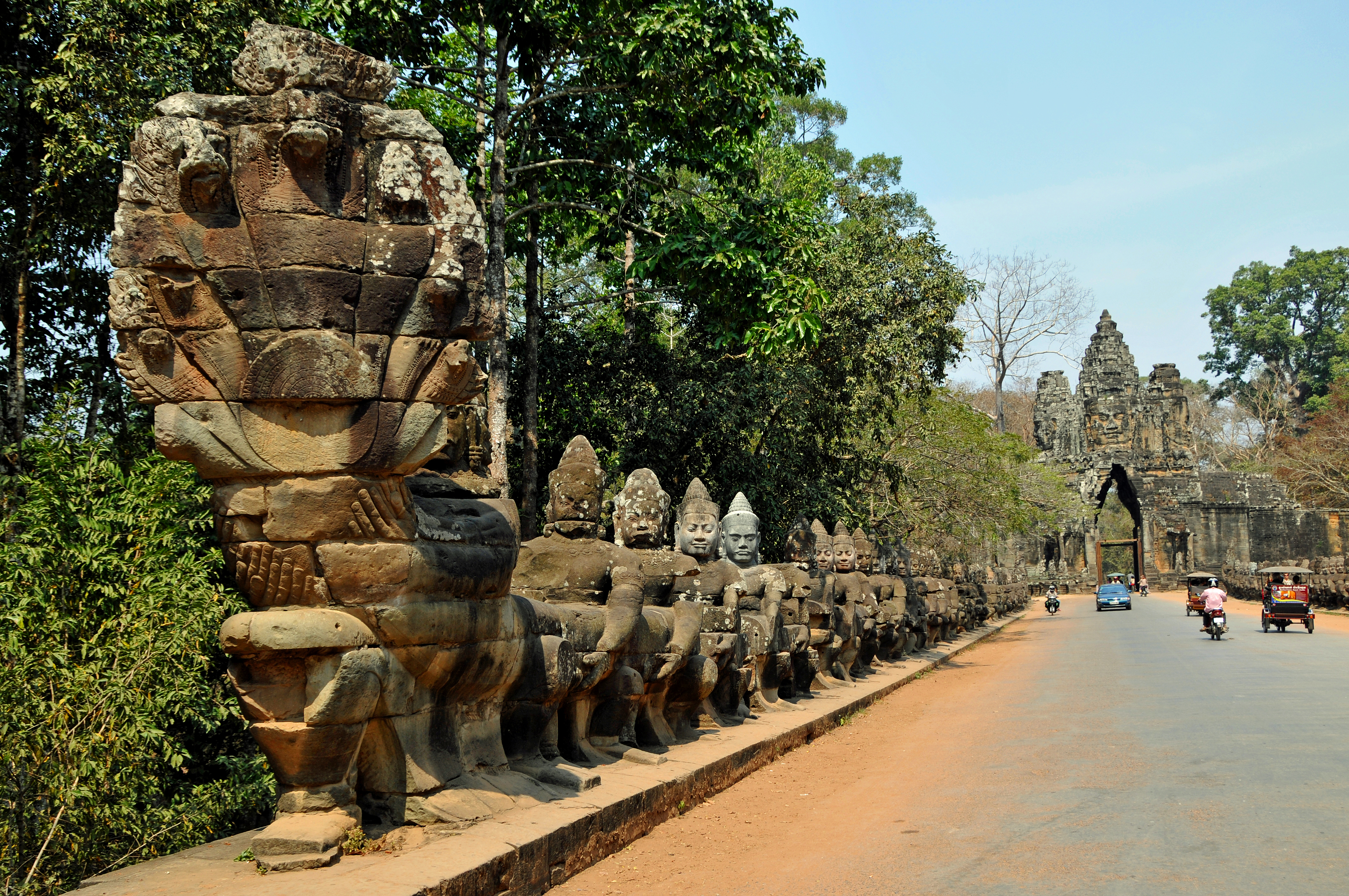
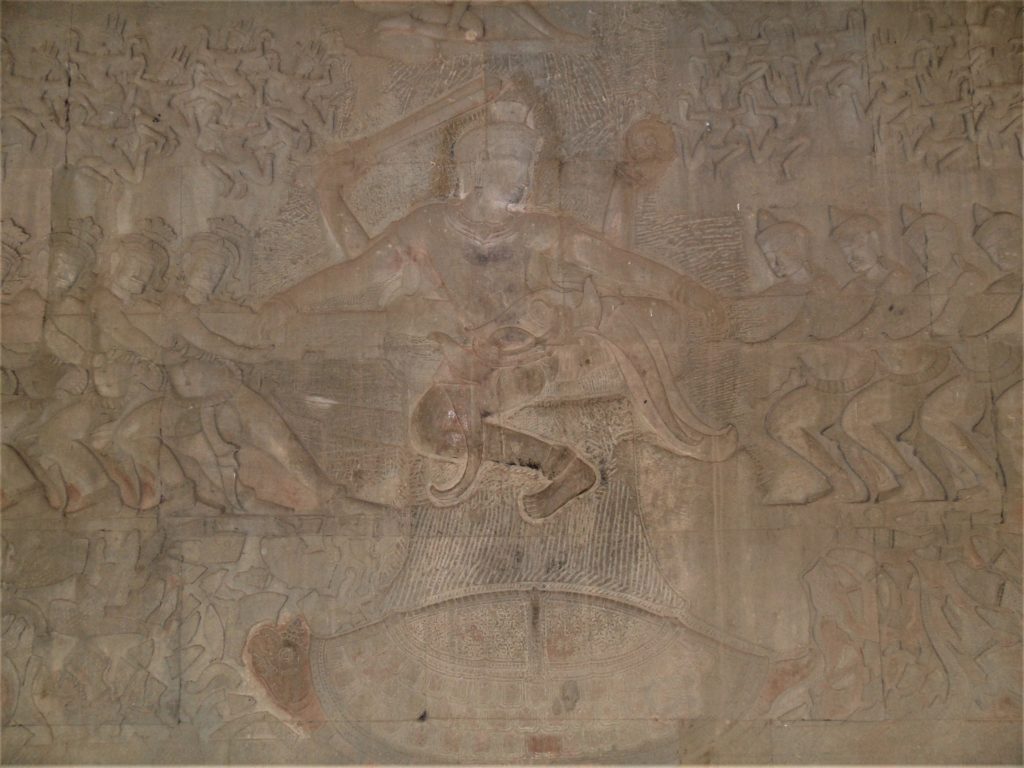
This mythological tale is very popular in Khmer iconography. The most famous architectural rendition of this legend is shown among the 13000 square feet in a dedicated gallery at the Angkor Wat temple in Cambodia. The grand causeway entrances at the ancient city of Angkor Thom also depict the scenes from the churning of the ocean in sculptural form.
Symbolism
The Churning of ocean also has a spiritual significance and parlance. The mind with its complex facets, emotions and intelligence can be compared to the ocean. Our goodness and evilness are the devas and asuras that constantly oscillate and bring out thoughts. Lord Shiva and Vishnu help us by taking away the evil and provide stability to our mind to gain immortality or moksha.
Mount Mandara
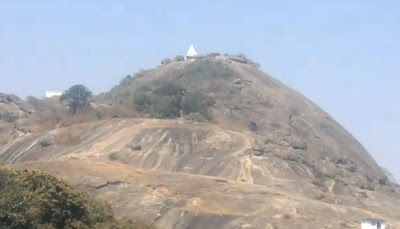
Mandar Parvat, also known as Mandar Hill is a small mountain situated in Banka district under Bhagalpur division of state of Bihar. It is about 700 ft high and approximately 45 km south of Bhagalpur city off Bausi, a place located on the state highway between Bhagalpur and Dumka. It is believed that he marks in the mountain are a result of the snake’s imprints caused during the churning process.
Eclipse and Science
In astronomy, complete or partial obscuring of a celestial body by another is referred as eclipse. An eclipse occurs when three celestial objects become aligned. From the perspective of a person on Earth, the Sun is eclipsed when the Moon comes between it and Earth, and the Moon is eclipsed when it moves into the shadow of Earth cast by the Sun.
Did you know?
Let us now see how other cultures and religions depicts eclipses in their beliefs.
Norse
In the Norse mythology ascribed, the Vikings of Northern Europe believed that, during a total solar eclipse, the Sun was being eaten by two wolves known as Skoll and Hati. According to legend, these two wolves were hungry for celestial bodies, with Skoll having an acquired taste for the Moon and Hati partial to the Sun. During an eclipse, they believed that the wolves had caught up to their prey. Back on earth, the Vikings would hoot and holler in an effort to scare Skoll and Hati away –– and allow the Moon to pass by the Sun. It’s a good thing it worked, too, because the Vikings also believed that if Skoll and Hati were ever able to successfully eat the Moon and the Sun, it would indicate the pending apocalypse, known as Ragnarok.
Chinese
In ancient China it was commonly held that solar eclipses occurred when a celestial dragon attacked and devoured the Sun. Chinese eclipse records are some of the oldest in the world and go back more than 4,000 years; which simply states “the Sun has been eaten.” To frighten away the dragon and save the Sun, people would bang drums and make loud noises during an eclipse. Since the Sun always returned after this ruckus-making, it is easy to see how the tradition was perpetuated. Interestingly, it seems the ancient Chinese were not particularly bothered by lunar eclipses, and one text from about 90 BCE dismisses them as “a common matter”.
Incan
The Inca of South America worshiped Inti, the all-powerful sun god. Inti was generally believed to be benevolent, but solar eclipses were understood to be a sign of his wrath and displeasure. Following an eclipse, spiritual leaders would attempt to divine the source of his anger and determine which sacrifices should be offered. Fasting was also common and the emperor would often withdraw from public duties during and following an eclipse.
Native American
According to Choctaw legend, a mischievous black squirrel gnawing on the Sun is the cause of eclipses. Like the Chinese dragon, the squirrel must be frightened away by the clamor and yells of the event’s human witnesses. Ojibwa and Cree peoples have a story that a boy (or sometimes dwarf) named Tcikabis sought revenge on the Sun for burning him. Despite the protestations of his sister, he caught the Sun in a snare, causing an eclipse. Various animals tried to release the Sun from the trap, but only the lowly mouse could chew through the ropes and set the Sun back on its path.
West African
The Batammaliba are an ancient people of northern Togo and Benin. According to their legend, human anger and fighting spread to the Sun and the Moon, who began to fight with each other and caused an eclipse. The legendary first mothers, Puka Puka and Kuiyecoke, urged the villagers to demonstrate peace to the Sun and Moon to convince them to stop their brawl. During an eclipse, Batammaliba people make amends for old feuds and peacefully come together to encourage peace between the celestial bodies.
Egyptian
Surprisingly, ancient Egyptians did not leave any explicit records detailing solar eclipses, though such an event would undoubtedly have been observed by these astronomy-savvy sun worshippers. Some scholars have suggested that perhaps eclipses were highly distressing and were deliberately left unrecorded so as to not “endow the event with a degree of permanence” or tempt the sun god Re (Ra). One Egyptologist has suggested that various references to an apparently metaphorical form of blindness align with historical eclipse dates and may be symbolic records of these events. Or perhaps papyrus records were simply lost to time.
Christianity
It seems there is no general consensus on how people of the Christian faith view this eclipse, as perspectives range from viewing it as a sign of Jesus’ return to a warning for the people.
Islam
Muslims recognize eclipses as a sign of the majesty and power of Allah, and therefore they are humble before Him. Instead of viewing it as a bad omen, they view it as a reminder of Allah and of the Day of Judgment. There are certain prayers that can be done in congregation during the eclipse.
Buddhism
Tibetan Buddhists view the eclipse as an inauspicious event, where the energy of the sun is cut off from sentient beings. Buddhists all over the world will be doing special practices on this day.
Judaism
The Talmud declares: “An eclipse of the sun is a bad omen for the world. Why? It’s like a king who made a huge banquet and set up a lantern to illuminate the party. Similarly, this world is a beautiful banquet which God has prepared for us. If the lantern is covered, as in a solar eclipse, it diminishes our enjoyment of the world.’ Therefore, the eclipse can be seen as a bad omen”.
Source: npr.org, rainbowsymphony.com
End-Note
Thanks for reading this post; please leave your feedback in the comment box below.
Check the Home page for the latest posts from our blog.
Browse the Blog page to find all the posts.
Visit the About page for the introduction to the blog.
Learn about the Research, Titbits, and Bliss sections of this blog.
To know the terms and conditions of this blog, please read the Norms page.
Go to the Contact page to message me and/or to find me on social media.
 DetectHistory.in