About the Post:
According to the ‘Sankalpam‘ uttered during Hindu rituals, the ongoing era is the 28th Kali-Yuga of Vaivasvata-Manvantara of the Shveta-Vārāha-Kalpa; the Hindu Purānas also say the same. So, shall we find out how old the ongoing Kali-Yuga is?
Sneak Peek:
It is widely believed that the ongoing Kali-Yuga is 5,125 years old as of 2024 CE. Well, is that correct? Continue reading this post to learn what the VISHNU PURĀNA says about the current Kali-Yuga and its age………
The Concept of Yugas:
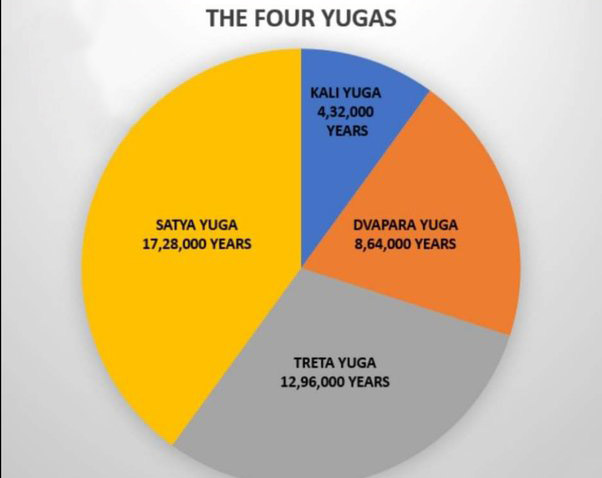
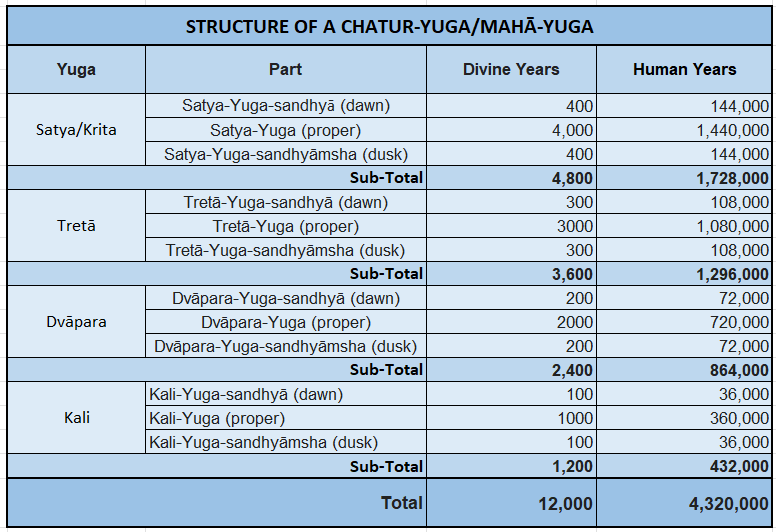
In the context of creation and dissolution explained by the Purānas of the Hindu Religion, the word ‘Yuga‘ commonly refers to an epoch or an era. As per the Hindu Purānas, a Human Year consists of 360 days (24 hours per day) and a Divine Year comprises 360 Human Years. Thus, 1,200 Divine Years equals 432,000 Human Years. A total of 4,320,000 Human Years (i.e. 12,000 Divine Years) is termed a Chatur-Yuga aka Mahā-Yuga which is constituted by the sequence of a Krita-Yuga (aka Satya-Yuga), a Tretā-Yuga, a Dvāpara-Yuga, and a Kali-Yuga.
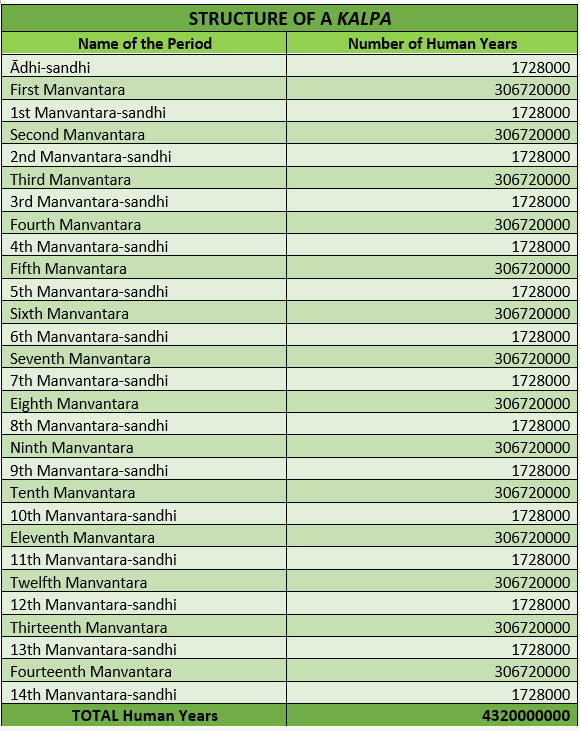
According to the Hindu Purānas, time, which is infinite, witnesses recurring cycles of creation. Every two subsequent cycles of creation are punctuated by a period of dissolution. Creation and sustenance of the universe and its 14 Lokas happen during a Mahā-Kalpa. Every Mahā-Kalpa lasts for 311.04 trillion Human Years and is followed by a Mahā-pralaya, of the same length, during which everything gets absorbed into the source of creation. A Mahā-Kapla consists of 36,000 Kalpas and 36,000 Naimittika-pralayas, each lasting 4.32 billion Human Years. All 14 Lokas of the universe are dissolved during a Mahā-pralaya whereas only the bottom 10 of the 14 (including the earthly realm) are destroyed during a Naimittika-pralaya. Every Kalpa is divided into 14 Manvantaras. Each Manvantara comprises a set of 71 consecutive Chatur-Yugas. A Manvantara-sandhi lasting for 1,728,000 Human Years bridges two subsequent Manvantaras. A period of the same duration, called Ādhi-sandhi, precedes the first Manvantara of every Kalpa. The universe is partially destroyed during every Manvantara-sandhi and is restored at the beginning of the following Manvantara; this partial destruction is termed Manvantara-pralaya.
Structure of Chatur-Yuga:
A Chatur-Yuga (aka Mahā-Yuga) = a Krita-Yuga + a Tretā-Yuga + a Dvāpara-Yuga + a Kali-Yuga
A Krita-Yuga (aka Satya-Yuga) = 1,728,000 (i.e. 432000 x 4) Human Years; it is full of virtues.
A Tretā-Yuga = 1,296,000 (i.e. 432000 x 3) Human Years; it witnesses more virtues than sins.
A Dvāpara-Yuga = 864,000 (i.e. 432000 x 2) Human Years; it witnesses virtues and sins equally.
A Kali-Yuga = 432,000 (i.e. 432000 x 1) Human Years; it is almost full of sins but for the trivial virtues.
The 3102 BCE:
Owing to certain details in Āryabhatiya(m)—an astronomical treatise by Āryabhata—and some inscriptions relevant to the Kali-Yuga, it is widely believed that the ongoing Kali-Yuga began circa 3102 BCE. Therefore, the general notion is that about 5,125 years of the current Kali-Yuga have elapsed as of 2024 CE. However, VISHNU PURĀNA seems to state that the era that commenced about 5,000 years before the present was the ‘proper’ Kali-Yuga, preceded by its dawn period of 36,000 years; not to forget that ‘one year’ here means 360 days.
VISHNU PURĀNA’s Statements:
Here is an excerpt from pages 484–487 of THE VISHNU PURANA, translated by Horace Hayman Wilson. The excerpt forms a part of the prophecies by Maharishi Parāshara revealed to his disciple Maitreya during an interaction between them that took place sometime after the Kurukshetra War when Lord Krishna of Yadu Dynasty had passed away, and Parikshit—the grandson of Arjuna—had become the monarch of Kuru Kingdom:
“When the two first stars of the seven Rishis (the great Bear) rise in the heavens, and some lunar asterism is seen at night at an equal distance between them, then the seven Rishis continue stationary in that conjunction for a hundred years of men. At the birth of Paríkshit they were in Maghá, and the Kali age then commenced, which consists of 1200 (divine) years. When the portion of Vishńu (that had been born from Vasudeva) returned to heaven, then the Kali age commenced. As long as the earth was touched by his sacred feet, the Kali age could not affect it. As soon as the incarnation of the eternal Vishńu had departed, the son of Dharma, Yudhisht́hira, with his brethren, abdicated the sovereignty. Observing unpropitious portents, consequent upon Krishńa’s disappearance, he placed Paríkshit upon the throne. When the seven Rishis are in Purváshád́há, then Nanda will begin to reign, and thenceforward the influence of the Kali will augment. The day that Krishńa shall have departed from the earth will be the first of the Kali age, the duration of which you shall hear; it will continue for 360,000 years of mortals. After twelve hundred divine years shall have elapsed, the Krita age shall be renewed.”
My Interpretations:
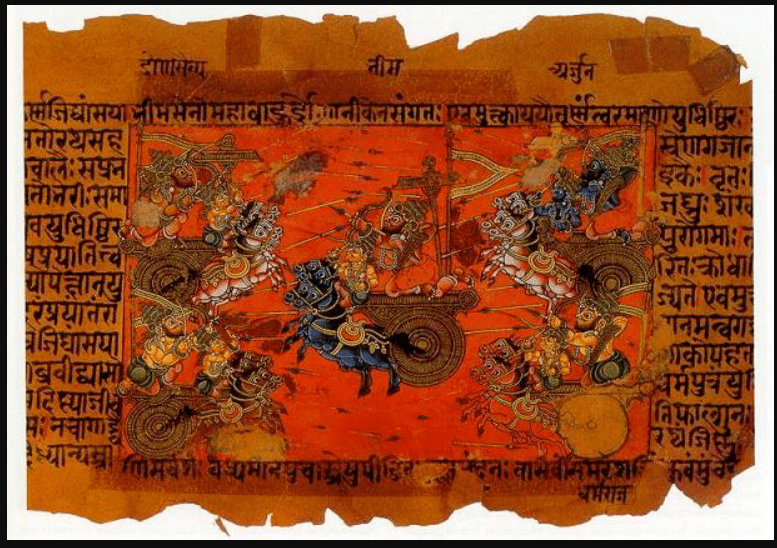
From the Sankalpam part of Hindu rituals and from pages 204, 205, 211, 438, and 439 of THE VISHNU PURANA, translated by Horace Hayman Wilson, it can be understood that the above excerpt refers to the current Kali-Yuga. Thus, according to THE VISHNU PURANA, the current Kali-Yuga began when Parikshit, the grandson of Arjuna, was born. But it also says that the day Lord Krishna left his mortal body was the first day of the ongoing Kali-Yuga. These two statements seemingly contradict each other because, according to MAHĀBHĀRATA, Parikshit was born soon after the Kurukshetra War whereas Lord Krishna passed away about 36 years after the Kurukshetra War. However, THE VISHNU PURANA declares that as long as Lord Krishna was alive, the impacts of Kali-Yuga were not felt. So, we can assume that the current Kali-Yuga began sometime around Parikishit’s birth, but its influence started only after Lord Krishna’s demise.
Here, Maharishi Parāshara states that the Kali-Yuga which commenced on the day Krishna left his mortal frame, would continue for 360,000 Human Years. He also informs that once 1200 Divine Years (i.e. the total number of Divine Years comprised by a Kali-Yuga) of the ongoing Kali-Yuga shall have elapsed, the Krita-Yuga of the next Chatur-Yuga will begin. Therefore, considering the structure of Chatur-Yuga, I interpret that the excerpt from THE VISHNU PURANA apparently refers to the commencement of ‘proper’ Kali-Yuga comprising 360,000 Human Years. Thus, the dawn period (i.e. the 36,000-year-long Kali-Yuga-sandhyā) of the current Kali-Yuga seems to have elapsed already.
The traditional belief is that Lord Krishna lived about five thousand and odd years before the present. Incidentally, my research inferences regarding the connection between Mahabharata and the Harappan Civilization also largely corroborate this notion. Therefore, I infer that out of the total 432,000 Human Years of the current Kali-Yuga, more or less 41,000 years have passed as of 2024 CE and roughly 391,000 years are yet to elapse before the beginning of the 29th Chatur-Yuga of the ongoing Vivasvata-Manvantara.
Closing Message:
After reading this post, one might wonder whether Lord Krishna’s incarnation happened during the dawn period of the current Kali-Yuga. I shall address this question in Part 2 of this discussion.
End-Note:
Thanks for reading this post; please leave your feedback in the comment box below.
Check the Home page for the latest posts from our blog.
Browse the Blog page to find all the posts.
Visit the About page for the introduction to the blog.
Learn about the Research, Titbits, and Bliss sections of this blog.
To know the terms and conditions of this blog, please read the Norms page.
Go to the Contact page to message me and/or to find me on social media.
 DetectHistory.in