About the Post:
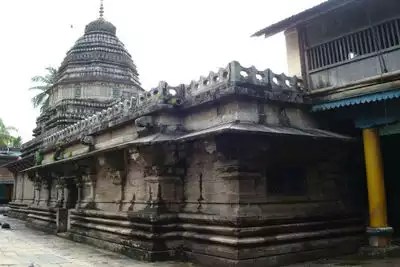
Gokarna, a temple town in the Indian State of Karnataka, is renowned for the Mahābaleshwara Temple, where the Ātma-Linga—gifted by Lord Shivā to Rāvana—is believed to be enshrined. However, according to VĀYU PURĀNA, Gokarna was originally located on the same island as the great city of Lankā, the abode of the noble Rākshasas. This intriguing claim has inspired my research into the true location of the Puranic Gokarna, which I explore in this blog post. I am especially delighted that this article is being published in February 2025, as Mahā Shivarātri—the most significant festival celebrated at Gokarna—falls on 26–27 February 2025 as per the current Hindu Year Krodhī Samvatsara (2024–2025).
Sneak Peek:
The story of the Shiva-Linga called Mahābaleshwara is largely associated with the sacred town of Gokarna in the Indian State of Karnataka. However, some ancient literary accounts suggest a different location for Gokarna, challenging this popular belief. Intrigued by this contradiction, I embarked on a research journey to trace the true Gokarna. Continue reading to explore my fascinating discoveries………
Gokarna in Ancient Scriptures:
SHREE GURU CHARITRA:

As per Chapter 6 of Ashok’s translated and simplified English version of SHREE GURU CHARITRA, Gokarna is a sacred site where Lord Ganesha established the Ātma-Linga—a powerful and soulful Shiva-Linga—gifted by Lord Shivā to Rāvana. This Linga came to be known as Mahābaleshwara. The name Gokarna originates from the shape of the Mahābaleshwara Ātma-Linga, which resembles a cow’s ear; Go means “cow” and Karna means “ear”, in Sanskrit.
According to SHREE GURU CHARITRA, in ancient times, Rāvana went to Kailāsa Mountain—the abode of Lord Shivā—with the notion of relocating the entire mountain to his island, Lankā, to honour his mother who was a great devotee of Lord Shivā. When Rāvana attempted to lift the Kailāsa Mountain, Lord Shivā pressed it down, trapping Ravana beneath. Humbled Rāvana prayed for forgiveness and expressed his devotion to Lord Shivā through extraordinary feats. Pleased by his sincerity, Lord Shivā freed Rāvana and gifted him the Ātma-Linga, assuring that whoever possessed it would attain eternity. However, He cautioned Rāvana not to place the Linga on the ground until he reached Lankā, as once set down, it would become immovable. So, Rāvana embarked on his journey back to his city of Lankā, carrying the Ātma-Linga with great care.
Rāvana, already feared for his ruthlessness, would become even more powerful and dangerous if he possessed the Ātma-Linga. To prevent this, Lord Vishnu and Nārada Maharishi sought Lord Ganesha’s help to stop Rāvana from taking the Ātma-Linga to his city of Lankā. Together, they devised a plan and tricked Rāvana into requesting a Brahmachāri—Lord Ganesha in disguise—to hold the Ātma-Linga for a while so he could perform his evening prayers on the nearby seashore. Though the Brahmachāri consented, He warned Rāvana that He would set the Ātma-Linga down if it became too heavy to hold anymore. Rāvana agreed to the condition. However, despite the Brahmachāri calling for him more than once, Rāvana could not return in time. The Brahmachāri waited briefly and then placed the Ātma-Linga on the ground, thus making it immovable from that spot. Enraged, Rāvana tried to lift the Ātma-Linga with all his strength but failed utterly. As he attempted to pull it up by twisting it, the Linga took the shape of a cow’s ear, giving the place its name Gokarna. Since Rāvana had to exert immense force in his efforts, the Linga came to be known as Mahābaleshwara, meaning “God of great power.”
SKANDA PURĀNA:
According to G. V. Tagare’s English translation of the SKANDA PURĀNA (Section 3, Chapter 2), once upon a time, Sage Gautama, on his way to Mithilā, unexpectedly encountered King Kalmāshapāda of Ayodhyā. During their conversation, Sage Gautama revealed the following details about Gokarna:
Gokarna is a well-established holy place where the presence of Shambhu (Lord Shivā) is always certain. Anyone who visits Gokarna is instantly purified and absolved of all sins. Lord Shiva resides there as Ātma-Linga named Mahābala (Mahābaleshwara), obtained by the Rākshasa-king Rāvana through intense penance. The Linga was soon installed at Gokarna, on the shores of the Western Sea, by Gaṇanāyaka (Lord Ganesha). Among all the tīrthas (holy water bodies) in Gokarna, Kotitīrtha is the most significant. In different Yugas (epochs), Mahābala manifests in different colours: he appears white in Krita-Yuga, intense red in Tretā-Yuga, yellow in Dvāpara-Yuga, and black in Kali-Yuga. Although Mahābala extends across the seven Pātālas (netherworlds), he becomes soft/even when the terrible Kali Age sets in.
VĀYU PURĀNA:
Chapter 48 of Dr G. V. Tagare’s English translation of VĀYU PURĀNA (Part 1) provides the following insights into the ancient Gokarna and Lankā:
There is a great city called Lankā on the beautiful ridge and peak of the Trikūta Mountain, decorated with different minerals. The mountain is many Yojanas in height. Its variegated precipices and caves resemble houses. The city has gold ramparts and archways. There are many mansions and palaces with turrets and gables of variegated colours. It is a hundred Yojanas long and thirty Yojanas broad. It is flourishing and the people there are happy and gay. It is the abode of noble Rākshasas who can assume various forms as they please. They, the enemies of Devas, are proud of their strength. Free from all harassment, this city is inaccessible to human beings. On that island, on the eastern shore of the sea, there is Gokarna, the great shrine of Shankara (Lord Shiva).
Tracing the Actual Gokarna:
Interpretation No. 1:
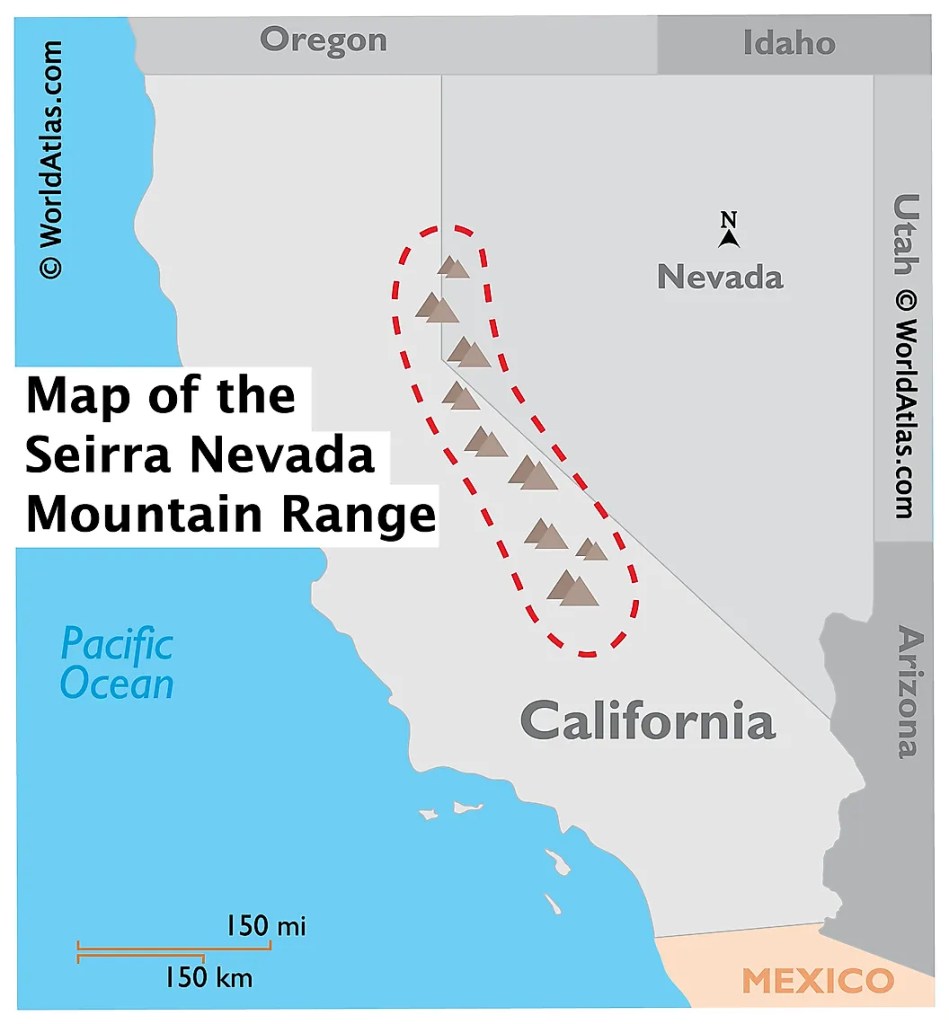
Just as SHREE GURU CHARITRA describes Rāvana’s attempt to lift Mount Kailāsa, Helen M. Johnson’s English translation of the Jain scripture TRISHASHTI SHALĀKĀ PURUSHA CHARITRA (Book 7, Chapter 2, Part 5) states that Rāvana tried to lift Ashtāpad Mountain. Interestingly, in my previous post, ĀDINATH AND THE ASHTĀPAD, I identified the Sierra Nevada Mountain Range in North America as the Ashtāpad, alias Kailāsa or Himālaya/Himāvat, mentioned in ancient scriptures.

From SHREE GURU CHARITRA, we learn that after receiving the Ātma-Linga from Lord Shiva, Rāvana set out for his city of Lankā, intending to install it there. Interestingly, in my article, THE REAL LANKA OF RAMAYANA, published in 2021, I logically deduced that Rāvana’s Lanka was most likely located in what is now Antarctica. Furthermore, I have since identified the plausible location in present-day Antarctica where Lankā once stood, and I plan to publish a post about it soon.
Thus, according to my interpretation, Rāvana received the Ātma-Linga from Lord Shiva at Kailāsa Mountain in North America, from where he headed towards his Lankā City in Antarctica.
Interpretation No. 2:
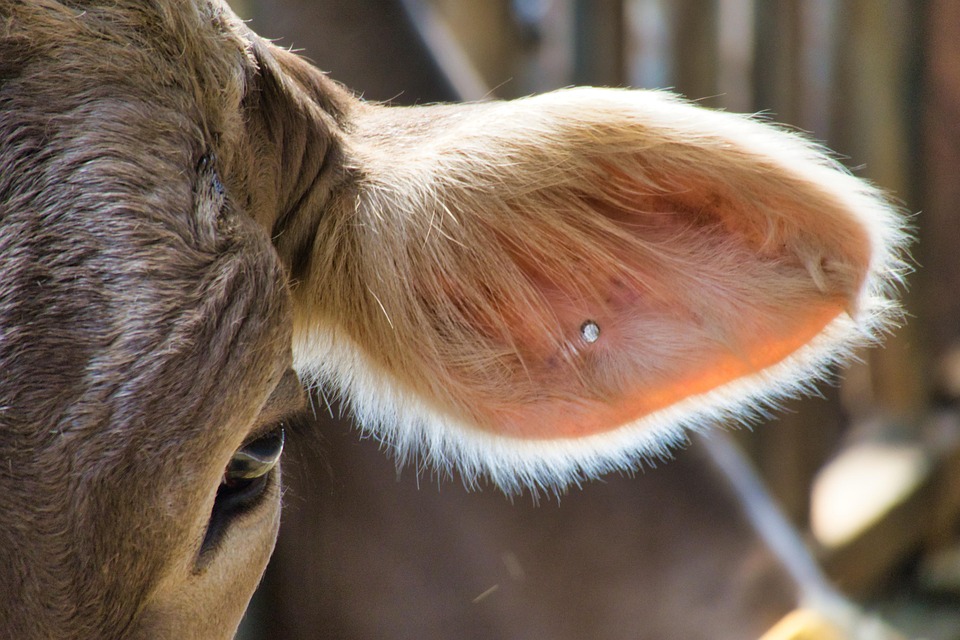
From SHREE GURU CHARITRA, we know that the Mahābaleshwara Ātma-Linga resembled a cow’s ear. Interestingly, I learnt about the ‘Sacred Rock of Machu Picchu’ in Peru, South America, which has a shape resembling an inverted cow’s ear. Given that South America lies between North America and Antarctica, it is highly plausible that Rāvana may have passed through what is now Machu Picchu while travelling from Kailāsa (in North America) to Lankā (in Antarctica).
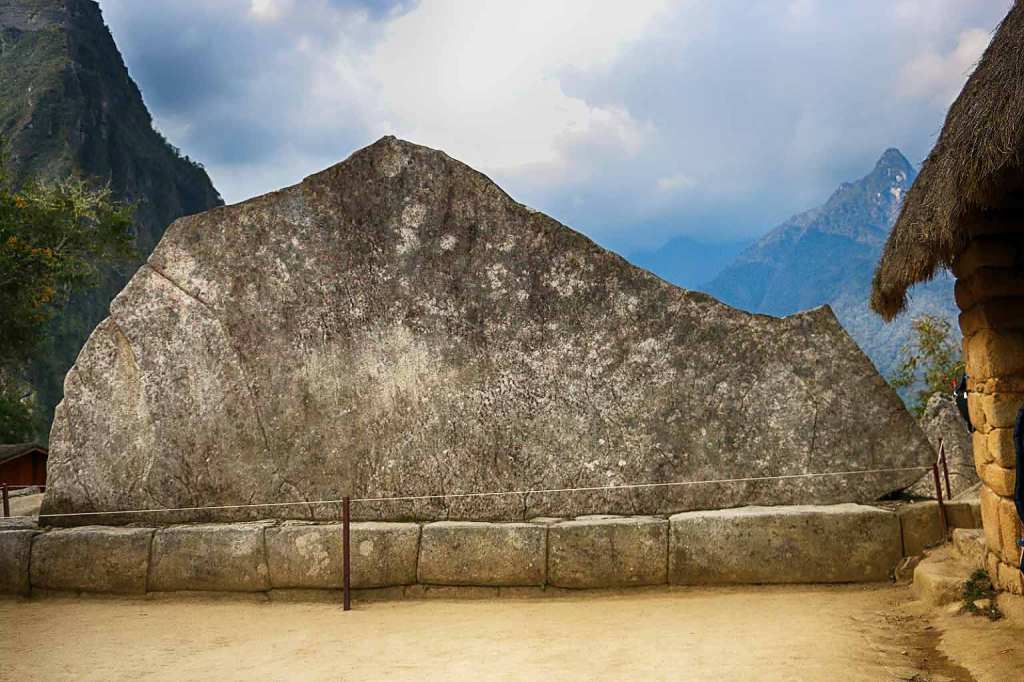
The following excerpt is from the book ‘Machu Picchu – Exploring an Ancient Sacred Center‘ (pages 71–73) by American anthropologist and archaeologist Johan Reinhard. It discusses the Sacred Rock of Machu Picchu:
There is another boulder that some investigators believe replicates the shape of a mountain, a particularly prominent boulder found at the north end of the site. It has come to be called the Sacred Rock by some authors, although there are, of course, many other sacred rocks at Machu Picchu. This one has been singled out because of its large size, its demarcation by a stone platform on one side of an open square, its similarity in shape to the contours of one of the mountains in the background, and its location between two stone buildings with the third side open. The main entry to the Sacred Rock complex via this open third side does seem to indicate that the stone was meant to be viewed with the mountains in the background. An exact fit with any one of these mountains is difficult, however, to discern, the mountain Yanantin coming closest. The anthropologist Robert Randall noted that if a person turned to look out the one open side of the Sacred Rock complex, he or she would be facing Pumasillo, which does indeed replicate the shape of the Sacred Rock. We may also have another example of reflexivity involving sacred mountains on opposite sides of a carved boulder, as noted above. Although it is not firmly established whether the Sacred Rock was worshipped as representing a mountain, given the above and my interpretation of Machu Picchu as a whole, this explanation seems reasonable.
From the above paragraph, it is evident that the true history and purpose of the Sacred Rock of Machu Picchu remain unknown to modern scholars and researchers. Based on this fact, I infer that the Sacred Rock of Machu Picchu could plausibly be the actual Mahābaleshwara Ātma-Linga.
Interpretation No. 3:
I feel compelled to elaborate on the following three points from the ancient scriptural accounts of Gokarna, discussed earlier in this article:
(1) SHREE GURU CHARITRA states that Lord Ganeshā, in the disguise of a Brahmachāri, installed the Ātma-Linga at Gokarna, thereby preventing Rāvana from taking the Linga to his city of Lankā.
(2) VĀYU PURĀNA claims that Gokarna, located on the same island as the city of Lankā, was on the eastern shore of the sea.
(3) SKANDA PURĀNA informs that Gokarna was on the shores of the Western Sea.
At first glance, these three points may appear contradictory, but with careful research and analysis, it becomes clear that each statement holds true within its own context.
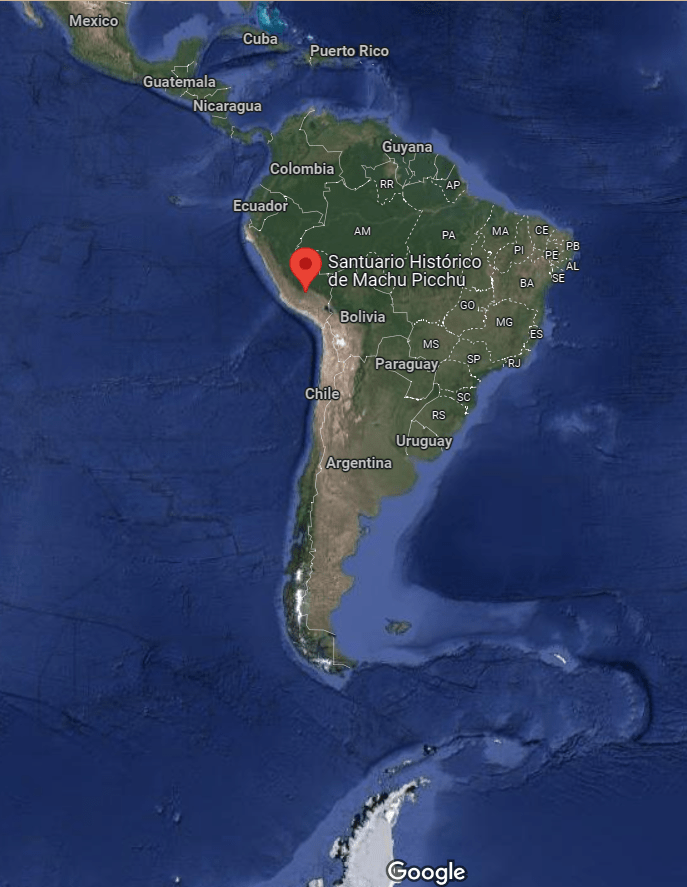
Firstly, it is important to recognize that ‘Lankā’ refers not only to the city of the Rākshasas but also to the island on which it was located. As mentioned earlier, my research suggests that Antarctica was the Lankā Island described in the VĀLMIKI RĀMĀYANA. Secondly, I came across the story of Kulakkottan and Ādaga-Soundary, which closely parallels the tale of Tadātagai and Soundara Pāndyan in TIRUVILAYĀDAL PURĀNAM. From these accounts, I inferred that at least part of South America—if not the entire continent—was also referred to as ‘Lankā’ in ancient times. I may elaborate on this in a future article but, for now, I recommend reading my post ARCHAEOLOGICAL REMAINS OF ĀLAVĀI-MADHIL? for a preliminary insight into this interpretation. Besides, as I interpreted from some ancient Indian Puranas, Ramayana happened in the 24th Treta-Yuga of the ongoing Vaivasvata-Manvantara. If this is a fact, it implies that Rāvana lived about 18 million years ago. Interestingly, according to some geologists, Antarctica and South America were physically connected about 17 million years ago, which could explain why, in my analysis, the Purānas refer to both regions as ‘Lankā’. Therefore, I understand that Gokarna, where Lord Ganesha installed the Ātma-Linga, was indeed part of the island of Lankā (which I identify as Machu Picchu in South America) but was located far from Rāvana’s Lankā City on the ‘same’ island (which I associate with a location near the center of East Antarctica).
Following is an excerpt from Chapter 4 (Kishkindha Kanda) of Bibek Debroy’s English translation of THE VĀLMIKI RĀMĀYANA (Volume 2, Page 250–251):
There is a region that is thirteen yojanas to the north of those tasty waters. The extremely large mountain with a golden peak, named Jatarupa, is there. The thousand-hooded god, Ananta, attired in blue garments and worshipped by all creatures, is seated on the summit of that mountain. The great-souled one’s standard is a three-headed palm tree. It has been established, with its foundation, on the summit of that mountain and is radiant. The gods have created this as a mark of the eastern direction.

The Paracas Candelabra, a well-known pre-historic geoglyph located in Peru, South America, has been accurately identified by some researchers—especially Nilesh Oak—as ‘the three-headed palm tree standard of Ananta’, mentioned in the excerpt above. Furthermore, in the footnotes on page 251, Bibek Debroy, referring to the last sentence of the excerpt, states: “The eastern direction ends beyond this.”
So, contrary to the modern notion that the Americas are in the West, the Paracas Candelabra in South America marked the easternmost boundary in ancient times. This, in turn, suggests that the “Eastern Sea/Ocean” and “Western Sea/Ocean” mentioned in ancient scriptures likely correspond to the Pacific Ocean and the Atlantic Ocean, respectively. This perspective also clarifies why Sage Gautama, while traveling to Mithilā (located in Afro-Eurasia), informed King Kalmāshapāda of Ayodhyā that Gokana was situated on the shores of the Western Sea.
Based on the inferences drawn so far, it is likely that South America was regarded as the northeastern extension of Antarctica during the Puranic eras. This perspective may further clarify why SKANDA PURĀNA states that Gokarna—situated on Lankā Island—was “on the eastern shore of the sea.”
Thus, all these logical interpretations collectively demonstrate that points (1), (2) and (3) are not contradictory.
Closing Message:
On the one hand, the present-day Mahābaleshwara Temple at Gokarna in South India is believed to enshrine the Ātma-Linga, gifted by Lord Shivā to Rāvana. On the other hand, scholars and researchers hold differing opinions regarding the history and purpose of the Sacred Rock of Machu Picchu. Nevertheless, I stand firmly by the conclusions drawn from my research. Given the potential need to present additional evidence in the future to further support my interpretation, I have labelled this article as Part 1, anticipating one or more sequels.
End-Note:
Thanks for reading this post; please leave your feedback in the comment box below.
Check the Home page for the latest posts from our blog.
Browse the Blog page to find all the posts.
Visit the About page for the introduction to the blog.
Learn about the Research, Titbits, and Bliss sections of this blog.
To know the terms and conditions of this blog, please read the Norms page.
Go to the Contact page to message me and/or to find me on social media.
 DetectHistory.in