About the Post:

Pashupati Seal is one of the most famous artefacts of the Harappan Civilisation, labelled by archaeologists as ‘Indus Seal No. 420’ and dated to circa 2500–2400 BCE. It was discovered during 1928–29 at Mohenjo-daro, currently located in Pakistan. Since the meditative figure depicted on the seal is surrounded by animals, archaeologist Sir John Marshall interpreted it as the proto-form of Lord Shiva, who is also known as Pashupati—the lord of animals—and hence the name. As an independent researcher, I have decoded the Pashupati seal from a different perspective, and this post delves into the decipherment process in detail.
Sneak Peek:
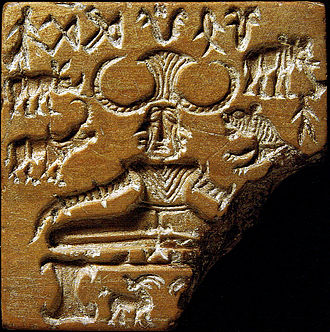
Can you imagine a connection between the magnificent Harappan Civilisation and the magnum opus Mahabharata?
Would you believe it if I told you that the central figure in this Harappan seal is a popular character in the Mahabharata?
Read this post to discover the true identity of this mysterious man…
Purpose of Indus Seals:
Archaeologists discovered Harappan seals in Mesopotamia, providing evidence of Harappan–Mesopotamian trade. Furthermore, a large building—identified as a warehouse—at the Harappan site of Lothal in Gujarat, India, has yielded sixty-five sealings (i.e. impressions of seals on clay), among which some still bore the marks of ropes tied around bundles of goods. These facts strongly suggest that the Indus seals were primarily used for trade purposes. Hence, the inscriptions and images found on Indus seals and tablets are believed to contain information relevant to trade activities.
Description of Pashupati Seal:
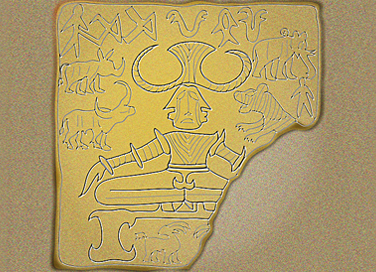
The Pashupati Seal, made of steatite (i.e. soapstone), depicts a manly figure at the centre, seated on a throne/platform in a yogic posture known as Mulabandhasana. The figure is opined to be three-faced or four-faced (with a possible fourth face at the back). and is richly adorned with various ornaments. The yogic figure is surrounded by a few animals: an elephant and a tiger to his right, a water buffalo and a rhinoceros to his left, and two ibexes under the dais; as the seal is partially broken, the ibex found beneath his right leg can be figured out only by its visible horns. Six Indus symbols are present at the top. According to some scholars, the small human figure sandwiched between the elephant above and the tiger below is also a part of the inscription found on the seal.

However, I am not sure about the correctness of this perception because, if it was part of the inscription, the seal-maker would have probably tried to accommodate it also at the top, along with the set of 6 signs, by shrinking the size of at least the last few symbols, which was evidently a common practice, as seen in some seals with slightly longer script.
Need for a Fresh Probe:

While it is widely believed that the meditative man on the Pashupati Seal is Lord Shiva, the Lord of animals, the NEPALA MAHATMYA states that the name Pashupati denotes Lord Shiva himself in the form of an animal. Also, the divine bull Nandi—Lord Shiva’s vehicle cum emblem—is notably absent on the seal. Furthermore, the central figure of the Pashupati Seal is richly adorned with many ornaments, whereas, according to religious texts and hymns, Lord Shiva generally wears holy Rudraksha beads and snakes as ornaments on his body smeared with ashes and covered with tiger skin. Moreover, the Pashupati Seal figure wears a horned head-dress, while Lord Shiva is usually depicted with a crescent moon adorning his piled-up matted locks, from which River Ganga pours forth. Furthermore, according to the sacred Tamil hymns Tirumurai or Tevaram, Lord Shiva adorns his head with Kondrai flowers. Due to these numerous discrepancies, I felt the need for a fresh investigation into the Pashupati Seal.
Systematic Approach:
Dr S. Balusamy, a renowned Tamil scholar, has credibly interpreted the Arjunan Tapas rock relief panel of Mamallapuram in light of clues from ancient scriptures and literature. Impressed by his methodology, I adopted the same approach to decode the Pashupati Seal. In the process, I realised that every animal depicted on the Pashupati Seal—Indian Elephant, Bengal Tiger, Indian Rhinoceros, Himalayan Ibex, and Wild Water Buffalo—is surprisingly associated with the Himalayan Mountains and/or their surroundings. Thus, I understood that the Pashupati Seal depicts a story or incident connected with the Himalayas.
Debugging the Default Notion:

Then, I considered checking whether the meditative figure on the Pashupati Seal truly has three or four faces, as commonly believed. So, I downloaded images of ancient Indian sculptures of deities possessing three or more heads. In them, I noticed the clear visibility of the prominent features of each head, such as the forehead, eyes, nose, cheeks, headdress or crown, etc. In contrast, when I zoomed in on the yogic figure of the Pashupati Seal, I could not find any such clear-cut details. Hence, I concluded that what appears to be his additional heads is actually the front view of his tapering headgear and his ear-ornaments.
Guessing the Person:
Since a horned headdress is usually associated with gods and elites, I inferred that the meditative figure on the Pashupati Seal is most likely a deity or a king. As I couldn’t find any deity whose characteristic features are comparable to those of the yogic figure, my task narrowed to identifying a king who performed penance or austerities in the Himalayan ranges. At this point, I could only think of Jayadratha, who is one of the prominent characters in the MAHABHARATA. According to the epic, he was the mighty ruler of the Sindhu Kingdom. The neighbouring dominions—Souvira and Shibi/Sivi—were also under his sway. Dushala, the only sister of the Kaurava brothers (i.e. Duryodhana and his ninety-nine younger brothers), was married to him.
Once, Jayadratha was severely punished by the five Pandava brothers for his attempt to abduct their wife, Draupadi. Consequently, the extremely humiliated Jayadratha decided to seek a boon from Lord Shiva to vanquish the Pandavas in battle. To propitiate Lord Shiva, Jayadratha performed great austerities at Gangadvara, identified with present-day Haridwar, located in the Himalayas. Pleased with Jayadratha’s penance, Lord Shiva promised Jayadratha that though he would not be able to defeat the invincible Pandavas, he would restrain four of them, excluding Arjuna, once during the battle.
Confirming the Identity:
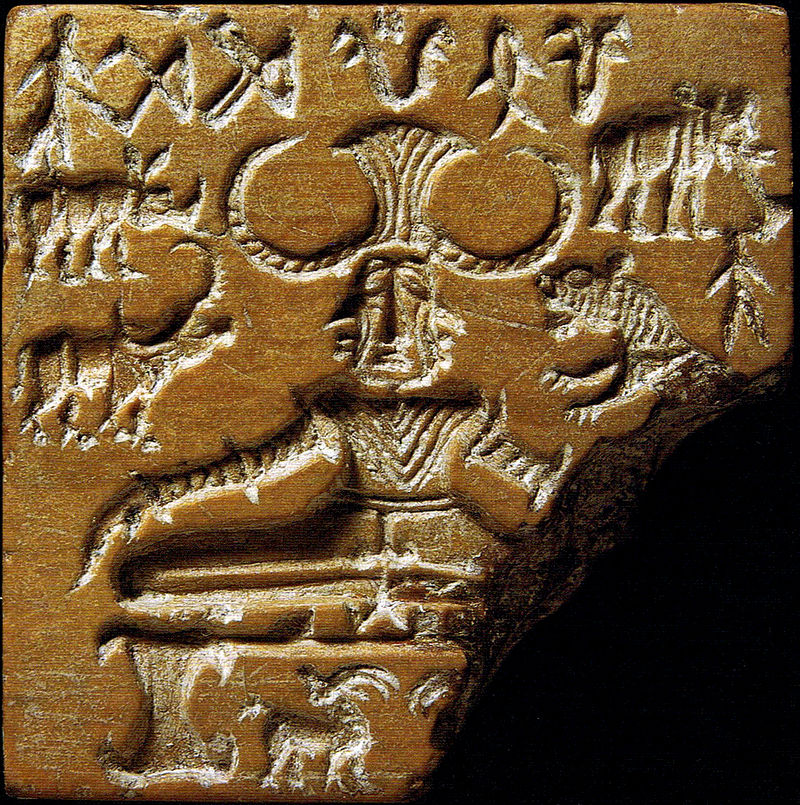
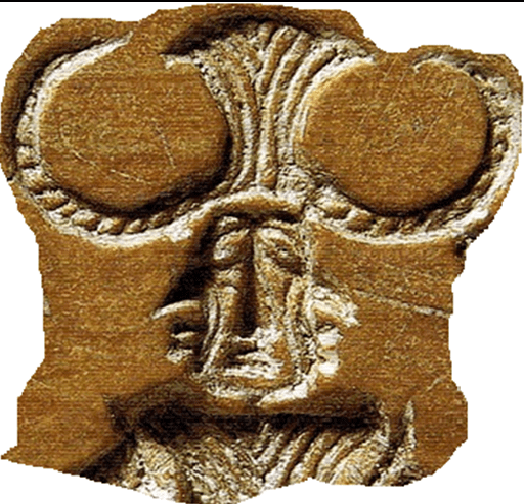
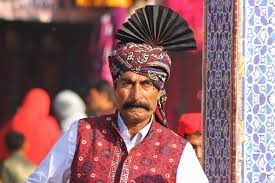
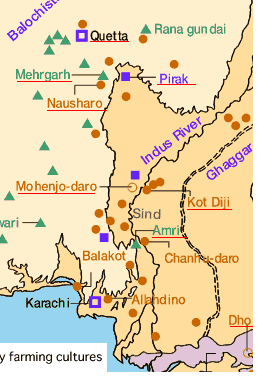
Mohenjo-daro, where the Pashupati Seal was discovered, is located in the Sindh Province of Pakistan. Notably, the MAHABHARATA refers to Jayadratha as the ruler of the Sindhu Kingdom. Moreover, the sharp fingernails of the Pashupati Seal’s yogic figure corroborate the MAHABHARATA’s statement about the ability of the Sindhus and the Souviras to fight best with their nails and lances. Furthermore, the fan-shaped feature of the yogic figure’s headdress resembles the fan-like pleat in a traditional Sindhi Turban. All these factors compelled me to identify the meditative man depicted on the Pashupati Seal as Jayadratha, who, according to the MAHABHARATA, was an ancient ruler of Sindh.
Image Courtesy:
A man wearing a traditional Sindhi-turban
Map showing the location of Mohenjo-Daro
Debunking the Discrepancies:
You might wonder how to accept my theory connecting an archaeological artefact with a mythological story. Hence, I would like to point to the archaeological discovery of a submerged city near modern Dwaraka, in Gujarat, by archaeologist Dr S. R. Rao, and his claim that it corroborates the scriptural accounts of Lord Krishna’s Dvaraka in the MAHABHARATA.
Based on thermoluminescence test results, Dr S. R. Rao had suggested circa 1700–1500 BCE, a Late Harappan period, as the date of Lord Krishna’s Dvaraka. However, the traditional belief is that Lord Krishna lived about 5000 years ago, from circa 3228 BCE to 3102 BCE. Regarding the discrepancy between the conventional and scientific dates of Dvaraka, Dr S. R. Rao himself had stated that it is better to explore the deeper waters of Bet-Dwaraka.
Dr S. R. Rao’s scientific dating of Dvaraka differs markedly from the archaeological dating of the Pashupati Seal (circa 2500–2400 BCE), an artefact of the Mature Harappan Phase. This discrepancy raises the question of whether the seal could depict Jayadratha, who, according to S. R. Rao’s chronology of the Mahabharata, would belong to the Late Harappan Phase. Nonetheless, Michel Danino’s maps of Harappan Settlement patterns in the Sarasvati River basin, when compared with the MAHABHARATA’s descriptions of the river’s condition during Lord Balarama’s pilgrimage, suggest the plausibility of assigning the Mahabharata to circa 2600–1900 BCE, if not earlier. This argument shall be explored in detail in a subsequent article.
Closing Message:
From the points discussed so far, it is evident that Jayadratha’s penance, as narrated in the MAHABHARATA, aligns closely with the details of the Pashupati Seal. This credible correlation suggests that clues to unravel the mysteries of the Harappan Civilisation may well be embedded within the Mahabharata and other ancient scriptures.
By the way, I will soon publish my interpretation of the Pashupati Seal inscription on this blog. Meanwhile, please check out my next post, which explores the plausible connection between the Tamilians and the Harappans.
End-Note:
Thanks for reading this post; please leave your feedback in the comment box below.
Check the Home page for the latest blog posts.
Browse the Blog page to find all the published posts.
Visit the About page for an introduction to the blog.
Explore the Research, Titbits, and Bliss sections of the blog.
Go through the Norms page for the blog’s terms and conditions.
Click Contact to send me a message or to find me on social media.
 DetectHistory.in


WONDERFUL POST. Please consider another idea; published ON YOUTUBE and academia.edu by DGHC 2021 Harappan code ; that TRIMURTI of ELEPHANTA CAVES is tradition depicting seed or composite or conglomerated powers of all three Hindu Vedic Deities namely Brahmaa, Vishnu and Mahesh ; the TRIMURTI is called SAGUN BRAHM in VEDAS and Datta-trya in Tantra culture. Also published is that the POSTURE adopted by TRIMURTI in TANTRA tradition of ancient India is called GORAKSH or siddha asan that is classically depicted in PASHUPATI SEALS OF Mohen-jodaro as well as Mehrgarh.
LikeLiked by 1 person
Thanks for your encouraging and informative feedback to my post, Mr. Gupta.
LikeLike