Mahabharata, the greatest epic of Hindu mythology revolves around the center character – Lord Krishna. Cities of significance associated with the birth and life of Lord Krishna include – Mathura, Gokul, Vrindavan and Dwaraka.
We know Dwaraka has been submerged under the ocean. All cities can be visited even in current time period, except Dwaraka. Have you ever wondered why Dwaraka has been consumed by water?
Read more about Dwaraka and the reason for its devastation…
Slaying of Kamsa:
The primary purpose of Vishnu’s eighth avatar (Krishna) was to slay Kamsa and Shishubala.
King Jarasandha of the Magadha Kingdom attacked Mathura, which was ruled then by King Ugrasena (Kamsa’s father). Kamsa exhibited his valorous war skills and single-handedly defended the attack. This impressed the powerful King Jarasandha, who got his two daughters -Asti and Prapti, married to Kamsa.

Later on, as prophesized by the asiriri (divine voice from heaven), Krishna the eighth son of Devaki and Vasudeva had killed Kamsa in a wrestling duel. King Jarasandha was upset about his daughters and vowed to seek revenge on Kamsa’ slayer.
King Jarasandha’s Mathura attack:
Lord Krishna remained in Mathura as Prince after slaying Kamsa and reinstating Ugrasena as the ruler.
Jarasandha attacked the Mathura kingdom with the sole purpose of seeking revenge on Krishna. His powerful army invaded Mathura for eighteen times. Each time Krishna and his elder brother, Balarama defended the attack successfully.
It was destined that King Jarasandha had to die in the hands of mighty Bheema, the strongest of the Pandavas. So, Lord Krishna or Balarama could not kill him in the battle.
Building a new City:
Though King Jarasandha’s army was retreated successfully, thousands of lives were lost during each attack. Hence, Krishna decided to move his capital city and migrate his people to a safe place, where King Jarasandha’s army cannot reach.
Krishna summoned the divine architect, Vishwakarma to build a new place that would be safe from attacks. Upon requesting the Samudra deva (Sea God), water receded and a land mass was cleared within the ocean waters.

Vishwakarma built the magnificent city of Dwaraka with temples, gardens and palaces, where Krishna moved his citizens and made his capital city. Due to its location, it was impossible for King Jarasandha to have any more attacks.
Queen Gandhari’s curse:
In the Mahabharatha war in Kurukshethra, Gandhari lost her one hundred Kaurava sons and considered Lord Krishna responsible for her losses. She cursed Krishna that his clan be completely destroyed.
End of Dwaraka:
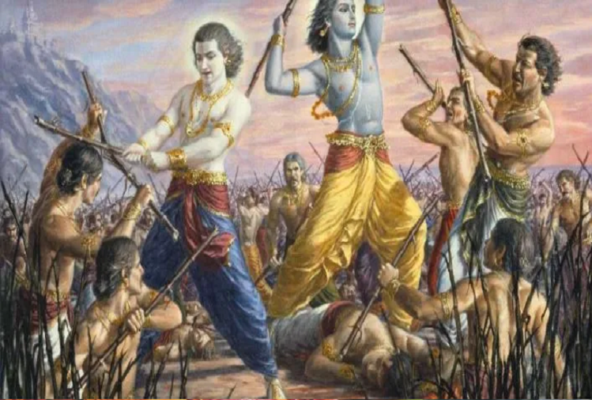
The Yadavas fought amongst themselves, eventually leading to their death. Lord Krishna was also killed mistakenly by a hunter’s arrow.
After the citizens in the unconquerable land were completely wiped out, the Samudra Deva came and reclaimed its territory, flooding the magnificent city and submerging the landmass under water.
Did you know?
The Indian marine archaeology department has conducted several excavations in the coastal town of Gujarat since 1963. The objective of the excavation was to know the antiquity of the site, based on material evidence in the offshore excavation.
Explorations yielded structures such as bastions, walls, pillars and triangular and rectangular stone anchors. A semi-spherical single-hole stone which might be the base for flagpost, L-shaped edges of stones for proper grip and arresting wave action on bastions were found. Artifacts are dated approximately to 1500 BC.
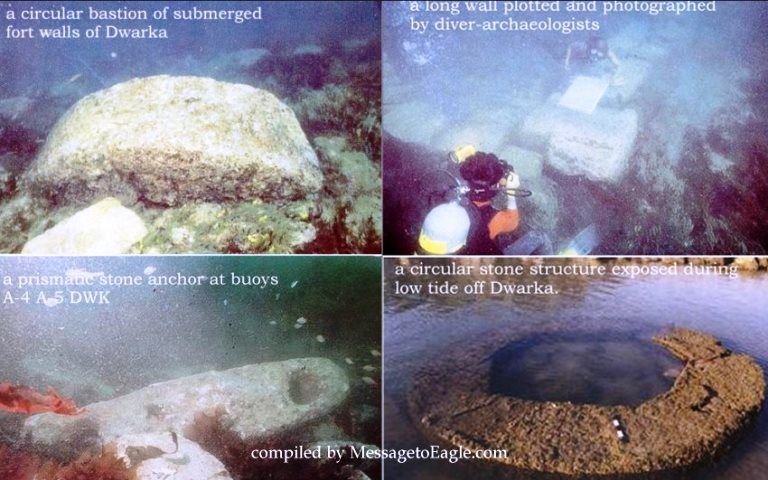
The layout of the excavated city, the spread and the location of fort walls and bastions match the descriptions mentioned in Harivamsha, a prologue to Mahabharata. Harivamsha described the city of Dwarka in minute details. According to it, the area of Dwarka was 12 yojanas (one yojana is roughly 12 – 15 km). It was connected to the mainland by a strip, which is visible even now, in low tide. The city excavated is of the same size.
Harivamsha, detailing the security arrangements, says that there were seals, without which one could not enter the city. Seals of a particular description were found on the seabed. Certain coins were found during excavations underwater having inscriptions similar to details found in Mahabharata.
For an Indian, Dwarka is not a mere archaeological site nor serves as a proof. However, the excavations are a national heritage, a symbol of pride, an honor to share with the world.
News Source and Photo Courtesy: The Mahabharata Research
End-Note
Thanks for reading this post; please leave your feedback in the comment box below.
Check the Home page for the latest posts from our blog.
Browse the Blog page to find all the posts.
Visit the About page for the introduction to the blog.
Learn about the Research, Titbits, and Bliss sections of this blog.
To know the terms and conditions of this blog, please read the Norms page.
Go to the Contact page to message me and/or to find me on social media.
 DetectHistory.in
Please do a blog on ” Are Hindu gods aliens???.
As you know the statues / animals on temple vimana does not match with any living being in earth.
There are also proofs that alien devices are found in the mahabharatha war ground. It is also said that Lord vishnu can manipulate a reality through his dreams (yoga nitra). The world we are living now can be a virtual reality
LikeLiked by 1 person
Thanks for your suggestion, Sir. I will surely write about aliens in our ancient epics as one of the topics scheduled for next week.
LikeLike
Very interesting and informative.
Good write-up.
LikeLike
Thanks for your valuable feedback, Priya!
LikeLike
Hello Sir, Hope you had chance to read my blog on your suggested topic “God and Alien”. Thanks!
LikeLike