About the Post:
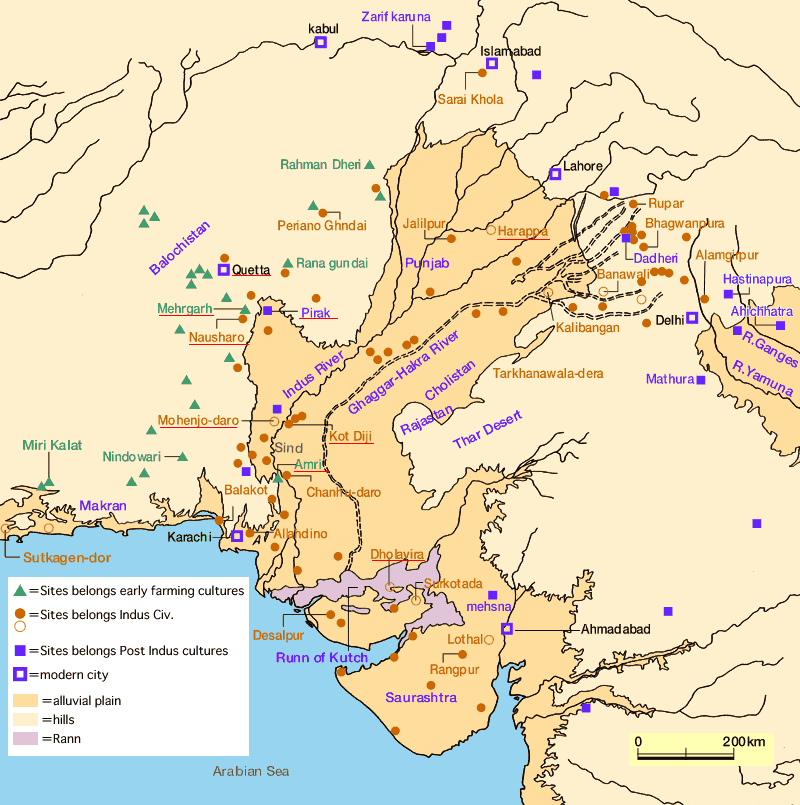
On one hand, we have the traditional Indian conviction claiming the story of Mahabharata to have occurred about 5000 years ago. On the other hand, we have the archaeological sites of the Harappan Civilization (circa. 3300–1300 BCE), discovered at almost all the places associated with the Kurus of the Mahabharata period viz. Hastinapur (Ganga-Yamuna Doab, India), Kurukshetra (Haryana, India), Sindhu Kingdom (Sindh, Pakistan), Dvaraka/Anarta Kingdom (Gujarat, India), Matsya Kingdom (Rajasthan, India) and the like. Nevertheless, the scholarly documents of the modern era invariably classify the people of the Mahabharata Age as a civilization of the post-Harappan period; this (mis)conception, in my humble opinion, should be attributed to the factor called ‘time’. People usually say “time heals” but, in the context of archaeology, it would be appropriate to state “time steals”; yes, ‘time’ steals away the truth (about the ancient past) by slowly burying the evidence, altering the facts, confusing the concepts and sometimes even by swallowing a good chunk of the reality. However, at least a few fragments of proof are left behind here and there; this post aims at connecting those fragmental dots, for the sake of re-establishing the link between the intangible Kurus and the tangible Harappans.
Sneak Peek:

The first three parts of this sequel series gave an overview of the legendary Kuru Dynasty and the historical Harappan Civilization besides throwing some light on the plausible link between the two. This part-4 shall disclose the hitherto unknown history of Harappa, which is one of the famous Indus Civilization sites of Pakistan, thereby exposing the evident connection between the Kurus and the Harappans. Continue reading to explore the true story of Harappa……
The Mahabharata Age:
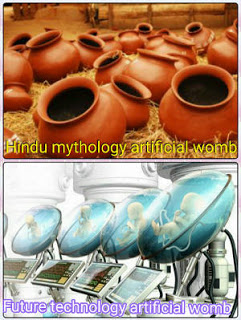
Out of the five Pandavas, Yudhishthira and Bheema were elder to their maternal cousin Krishna; Arjuna and Krishna were of the same age, while the twins Nakula and Sahadeva were younger to Krishna. From the information available online, we understand that the gap between the birth of the first Pandava (Yudhishthira) and that of the last two (twins Nakula and Sahdeva) is more or less only ten years. The Kauravas (Duryodhana and his ninety-nine brothers) and their only sister Dussala, were born through an artificial method. Duryodhana, who was equal to Bheema in age, was the first Kaurava to be born; then within a month, all of his siblings were born.
Based on the relevant archaeological facts, we have already deduced the plausible date of Mahabharata to be 3300–2600 BCE. Moreover, it is a well-known fact that the ancient Indian texts indicate circa 3102 BCE as the date of Lord Krishna’s passing away, at his age of over 100 years; based on certain clues found in Puranas, it is inferred that Krishna lived for about 115 to 125 years. Thus it is logically perceived that the core events of Mahabharata took place between circa 3250 BCE and 3100 BCE, which is a period that pertains to the Regionalisation Era/Mature Harappan Phase of the Harappan Chronology.
Migration of Dvaraka Citizens:
Mausala Parva of Mahabharata states that Arjuna, after the sudden demise of Lord Krishna (along with many of his kinsmen) during an intra-clan conflict (caused by a curse), gathered the people of Dvaraka and proceeded with them to the land of Kurus. Meanwhile, as prophesied by Krishna, Dvaraka got submerged (by the sea) right in front of its citizens who had by then reached a safe zone, under Arjuna’s guidance. The rich people of Dvaraka were looted, on their way to the Kuru Kingdom, by a gang of robbers who took away many of their women and a lump sum of their wealth. In spite of his sincere efforts, Arjuna (the great warrior) could not prevent this calamity; he had to cheerlessly accept it as the work of destiny and march forward with the remnant people and riches of Dvaraka. Arjuna brought the citizens of Krishna’s country to Kuru-kshetra, assorted them into groups, and got them established at different places; here one has to note that Arjuna got the immigrants settled in a few of the already existing cities of the Kuru dominion.
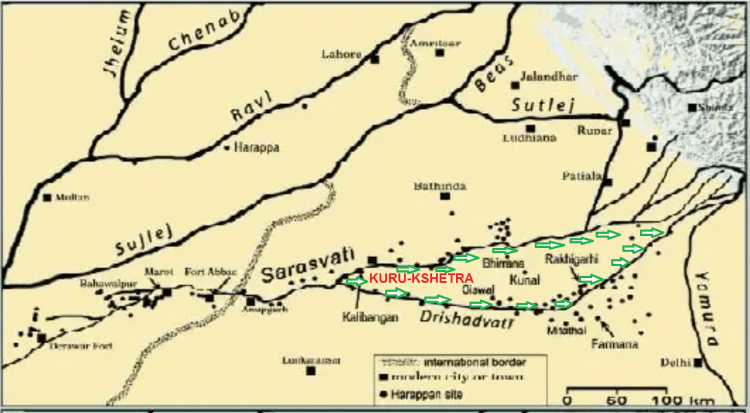
According to Mahabharata, Kuru-kshetra was a sacred plain region sandwiched between the divine waters of River Sarasvati (in the north) and River Drishadvati (in the south); it was located just above the confluence of these two holy rivers (see Map-4). Kuru-kshetra of the Mahabharata period was an entity that was vaster than the present-day Kurukshetra town, in India; its boundaries correspond roughly to the central and western parts of Haryana and southern Punjab, in modern India.
Kritavarma was a contemporary of Lord Krishna; he belonged to Krishna’s clan, and he served as a chieftain in Krishna’s army (Narayani Sena). Since Lord Krishna had promised military support to the Kauravas, in their war against the Pandavas (Kurukshetra War), Kritavarma (along with his regiment) had to ally with Duryodhana, while Krishna himself extended his personal support to the Pandavas; Kritavarma survived the war, but later succumbed to the curse incurred by Krishna’s clan. Krithavarma’s son was one among the people of Dvaraka, who had migrated to the land of Kurus. Arjuna instated Kritavarma’s son at the city named Martikavat (in Kuru-kshetra), and left the remaining wives of Kritavarma there.
Arjuna then collected all those who had no one to protect them, and made them reside in Indra-Prastha; Arjuna gave the kingdom of Indra-Prastha (refer to part-1) to Vajra, who was one of the grandsons of Lord Krishna.
Satyaki alias Yuyudhana was a dear friend of Krishna; he too belonged to Krishna’s clan and was one of the Atirathis of the Narayani Sena. Satyaki allied with the Pandavas and hence fought against the Kauravas, in the Kurukshetra War; like Kritavarma, Satyaki also survived the Kurukshetra war only to become a victim of the intra-clan conflict that caused the death of Krishna and his kinsmen. The son of Yuyudhana was one among those survivors who had followed Arjuna to the Kuru dominion. Arjuna made the beloved son of Satyaki reside along the banks of River Sarasvati, with a company of old men and children and women of Dvaraka (most probably the family members and relatives of Satyaki).
The Harappa:

The Karna-Vadha Parva of ‘The Mahabharata’—translated by Bibek Debroy (volume-7, pages 142–143)—contains the following statement:
“…………….There is a forest of pilu trees in the spot where the five rivers flow – Shatadru, Vipasha, Iravati as the third, Chandrabhaga and Vitasta. As the sixth, Sindhu flows outside that region. There is a country named Aratta there,…………………”
As known to many of us, the modern names of the rivers Shatadru, Vipasha, Iravati, Chandrabhaga, Vitasta, and Sindhu are respectively Sutlej, Beas, Ravi, Chenab, Jhelum, and Indus. Excluding Indus, the remaining five are the rivers of the Panchanada region (land of ‘the five rivers’), mentioned in Mahabharata; this region later came to be known as ‘Punjab’ (meaning ‘five rivers’, in the Persian language), which eventually got divided into two portions (the Indian Punjab and the Pakistani Punjab), owing to the India-Pakistan partition that came into effect in 1947.
The Dig-Vijaya Parva of ‘The Mahabharata’ (volume 2, page 151) mentions “the land of the five rivers” as the entity/territory of one of the clans defeated by Nakula (fourth of the five Pandava brothers) during his conquest of the West, in the context of Yudhishthira’s Raja-suya Yajna. Moreover, the Mausala Parva also mentions the “land of the five rivers” as the spot where Arjuna and the citizens of Dvaraka were attacked by the robbers, on their way to the Kuru Kingdom.
I was wondering why Mahabharata uses two different terms – ‘Aratta’ and ‘Panchanada’ – to refer to the land of the five rivers; luckily one of the online sources clarified my doubt by providing the following information:
(P. 183). “ARATTII. This is a Prakrit form of the Sanscrit Arashtra, who were a people of the Punjab; in fact the name Aratta is often synonymous with the Panjab in Hindu literature.”
(Quoted from Schoff, The Periplus of the Erythræan Sea, pp. 41, 183, 189.)
The Drona-Vadha Parva of ‘The Mahabharata’ (volume-6, page 466) mentions Arattas as one of the divisions of Kritavarma’s military forces (during the Kurukshetra War). Since Kritavarma himself was a Maharathi of the Narayani Sena, we understand that the Arattas constituted a part of the Narayani Sena (Lord Krishna’s army of 10 billion fighters).

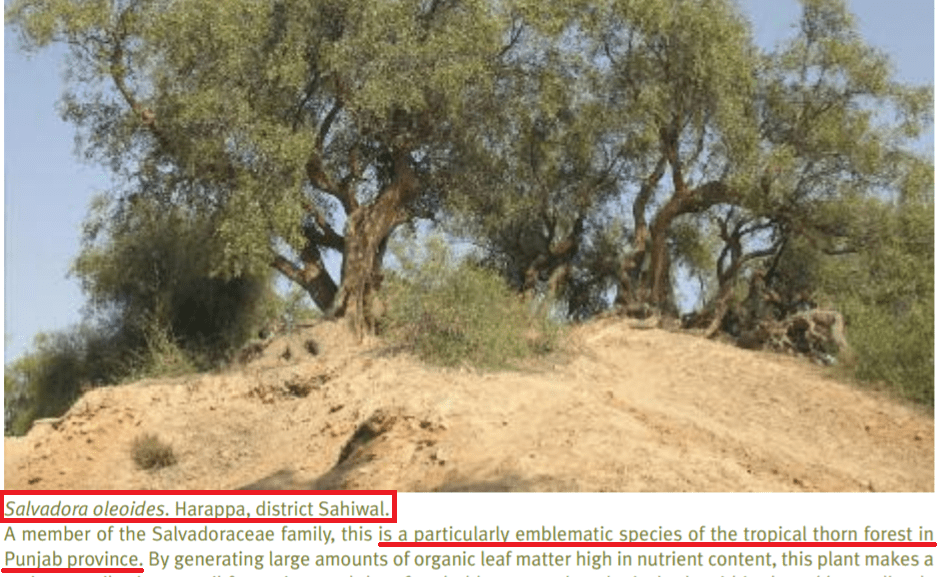
Based on the estimated date of Mahabharata (circa 3250–3100 BCE), we understand that the Aratta country (mentioned in Mahabharata) had existed since at least circa 3250 BCE. As Harappa (situated on the bank of a former bed of River Ravi) is the only major urban site of the Punjab region, that pertains to the bronze-age (circa 3300–1300 BCE) civilization of India, I had no difficulty in guessing that the archaeological mounds of present-day Harappa (located in the Sahiwal District of Pakistan) are comprised of the dilapidated remains of ancient Aratta’s capital; however, the critical edition of Mahabharata does not seem to mention the name of the capital city of Aratta country. Nevertheless, I thought of verifying the authenticity of the information (found in Mahabharata) which portrays a forest of pilu-trees as the landmark of Aratta, and hence I browsed online to find out if there really was/is a forest of pilu trees, in or around Harappa. To my sweet surprise, I spotted a document titled ‘DRY WOODLANDS IN PAKISTAN’S PUNJAB PROVINCE’, which stated that Salvadora oleoides (pilu tree) is an emblematic species of the tropical thorn forest in Punjab province; this information is found (in the concerned document) just below a photo (of pilu trees), which is captioned “Salvadora oleoides, Harappa, district Sahiwal” (see the picture below).
Though the critical edition of Mahabharata does not provide details about Aratta’s capital, we find clues embedded in other sources. According to certain versions of Mahabharata, Arjuna established Ushneek (one of the grandsons of Krishna) in the kingdom of Kashyapur (near modern Multan, Pakistan), after the submergence of Dvaraka. It seems Ushneek’s maternal uncle was the ruler of Kashyapur Kingdom at that time, and later Ushneek became his successor.

Modern Multan is a city, located on the bank of River Chenab; it is the capital of the Multan Division, which in turn is an administrative sector of the Punjab Province, in Pakistan. Present-day Harappa is located about 162 km away from modern Multan; incidentally, nearly 100 miles (160 km) of railway track between Multan and Lahore, laid by the British (in the 1850s), was supported by loads of 5000-year-old bricks (turned into ballast) from the ancient mounds of Harappa.
Multan’s history stretches deep into antiquity; the ancient city was the site of the renowned Multan Sun Temple. According to Samba Purana, Ushneek’s father Samba—son of Lord Krishna and Jambavati (one of Krishna’s eight principal consorts)—worshipped Surya (Sun-god) in a temple built by him in Mitravana, on the bank of River Chandrabagha; scholars have identified modern Multan to be the site of ancient Mitravana.
Wikipedia gives the following etymological explanations for the name ‘Multan’:
1) According to Hindu tradition the ancient name of Multan was Kashep Puri and the town was built by Raja Kashep. After Hurnakas his son Parhilaad succeeded the throne and the town was then named after him as Parhilaad Puri. The current name Multan was possibly associated with the Mali people who were defeated by Alexander the Great.
2) The city of Multan may get its name from the Sanskrit name for the Sun idol and Sun temple, Mulasthana.
3) The origin of Multan’s name is unclear. Multan may derive its name from the Old Persian word mulastāna, meaning “frontier land,” or possibly from the Sanskrit word mūlasthāna (the root place), which itself may be derived from the Hindu deity worshipped at the Multan Sun Temple.
Nonetheless one cannot dismiss the hypothesis of ‘Mulasthana’ having been the name of the capital city of Kashyapur Kingdom; more so because, in the Sanskrit language, the common meaning of the word ‘mula’ is ‘root’/’base’/’foundation’, and the general meaning of the word ‘sthana’ is ‘place’/’station’/ ‘position’. Hence the name ‘mula-sthana’ could have referred to the ‘root-place’/’base-station’/’foundation-position’ (plausible synonyms of ‘capital-city’) of the Kashyapur Kingdom. There is a possibility that the capital (Mulasthana) of Kashyapur Kingdom was located at the present-day Indus site of Harappa, during the Mahabharata days. Probably much later, due to some unknown reason, the people of Kashyapur Kingdom deserted their old capital city and founded their new capital at Mitravana (perhaps a wood-land within/close by the Kashyapur Kingdom); however the name ‘mula-sthana’ (capital-city) supposedly continued to prevail even at the new location, only to eventually get corrupted as ‘Multan’.
We do not know for sure, whether the above hypothesis is correct; suppose the case was so, in the reality of the ancient past, then it could mean that the bronze-age archaeological mounds of Harappa are nothing but the ruins of the capital city (named ‘Mulasthana’) of Kashyapur Kingdom, that had existed since at least the Mahabharata days (circa 3250 BCE) until about 1600 BCE, in the Aratta/Panchanada region (land of the five rivers).
Closing Message:
When the people of the ancient past had to leave behind their long-time habitat, in search of a new abode, they had invariably carried the name of their good old city/town along and implanted the same in their new habitat. This particular phenomenon is probably the only reason why archaeologists always end up obtaining material evidence that points to a post-Harappan period, by conducting excavations at sites that currently possess names associated with Mahabharata. Anyway, there is still a lot more to be discussed and hence the topic shall be continued in the upcoming part-5.
End-Note:
Thanks for reading this post. Please leave your feedback in the comment box below.
Check the Home page for the blog’s latest posts.
Browse the Blog page to find all the posts.
Visit the About and the Research pages for the introduction about me and the blog.
Learn about the Titbits and Bliss sections of this blog by co-author Geeta.
To know the terms and conditions of this blog, read the Norms page.
Go to the Contact page to message me and to find me on social media.
 DetectHistory.in
Congratulations, Gayathri Ma’am. This is very interesting/educative. Thank you for your hard work in researching so much information.
LikeLiked by 1 person
Much obliged to you Sir, for your unwavering interest in our blog and for all the feedbacks and suggestions that you have been sharing since day one. Thank you so much 😊🙏🏻🙏🏻🙏🏻
LikeLike