About the Post:
Jean-François Champollion, the man who made the complete decipherment of Egyptian Hieroglyphs wrote in his Lettre à M. Dacier (1822), “It is a complex system, writing figurative, symbolic, and phonetic all at once, in the same text, the same phrase, I would almost say in the same word.”; perhaps the same description applies to the Harappan script also. Though I have made only a little advancement in my research about the Indus script, I can say for sure that the short and sweet Harappan inscriptions hold a lot of valuable data. So without any further delay, let me start presenting my methodology of decipherment, and my interpretation of a selected Harappan inscription, in this post.
Sneak Peek:
A signboard was hung by the bronze-age Harappans, at Dholavira. It contains information in Tamil; what is it? Read on to know more………
The Methodology:
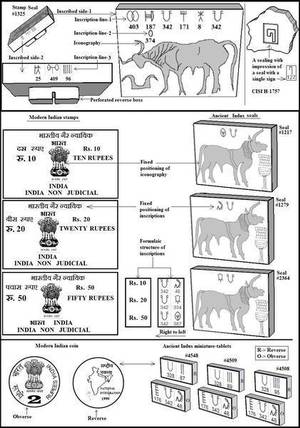
I am not a mainstream scholar, and hence I am not aware of the conventional methods/set of rules pertaining to the decipherment of paleo-scripts. My research regarding the Harappan script started in 2010; from the beginning, I had a firm conviction that Tamil was the underlying language of the Indus script. Since the Harappan script belonged to the bronze age, I initially tried to interpret the script using classical Tamil; this approach of mine however failed to yield any fruitful result, despite my sincere efforts for about seven years. In 2017, I was prompted by my intuition to try deciphering the Harappan inscriptions using the contemporary spoken Tamil; to my great surprise, this method turned out to be effective. I was completely bewildered by this shocking revelation because this meant that spoken Tamil has not undergone any major change for at least the past 5000 years.
Now, coming to the methodology, my formula for the decipherment of the Indus script is comprised of the following procedure:
1) First identify the object depicted by each of the individual Indus signs that constitute the given Indus inscription.
2) List out all plausible Tamil words associated with the various objects denoted by the concerned Harappan symbols.
3) Based on the prepared list of Tamil words, assign the apt phonic sound for each of the concerned Indus symbols by the means of trial and error method; this process involves verification of the consistent correctness of the assigned phonetic values.
4) If any of the concerned Indus symbols includes special-character/abstract sign (e.g. quotation-like mark/apostrophe-like mark/stroke-like mark etc.), interpret them to infer the actual/final sound represented by that particular Harappan symbol.
5) When all of the concerned Indus symbols are thus deciphered, determine the direction of the inscription.
6) Check if the final decipherment makes sense when referred to its context.
Dholavira Sign-Board:
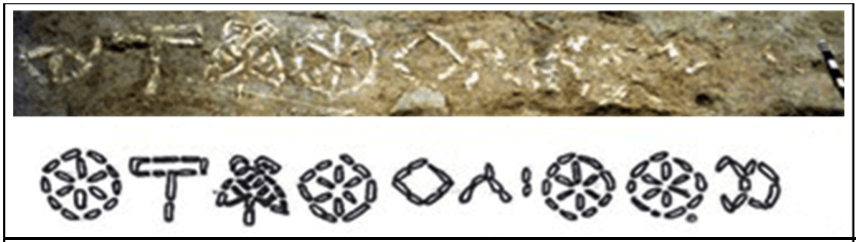
The most fascinating among the various surprises thrown by the Harappan site of Dholavira is the so-called “Dholavira Signboard”. It actually is a set of ten large Harappan symbols embedded using white crystalline material (gypsum), presumably on a wooden plank of about 3 meters in width (which obviously got decayed over time); each symbol measures about 37 cm in height and 25–27 cm in width. This ‘sign-board’ was found lying on the floor of the western chamber of the northern gate to the citadel/castle (refer to the site map given below). According to Harappa.com, these symbols are indicative of use in Stage IV of Harappan Culture (i.e. a period pertaining to the Mature Harappan Phase).
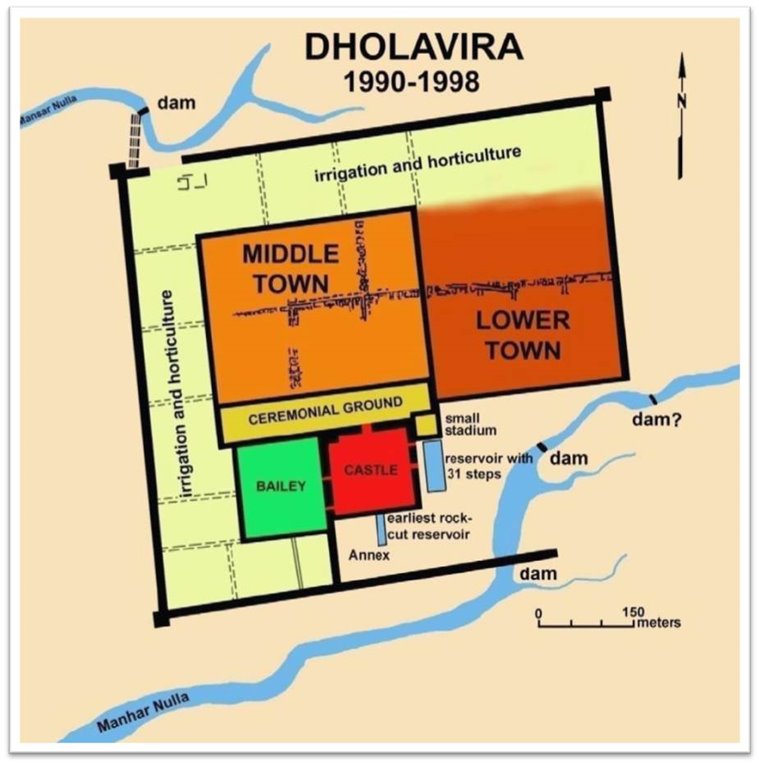

Based on its location near the gate, this large inscription has been called a “signboard,” suggesting that it could have had some sort of instruction/information that the visitors to the city saw before or as they entered. The general opinion of researchers is that this bronze-age signboard was probably hung above the northern gate from where, later at some point, it fell flat on its face and got buried in the spot at which it was discovered by the archaeologists during 1990–2005 CE/AD.
Let us now decipher the inscription in order to find out the actual purpose of the Dholavira Signboard:
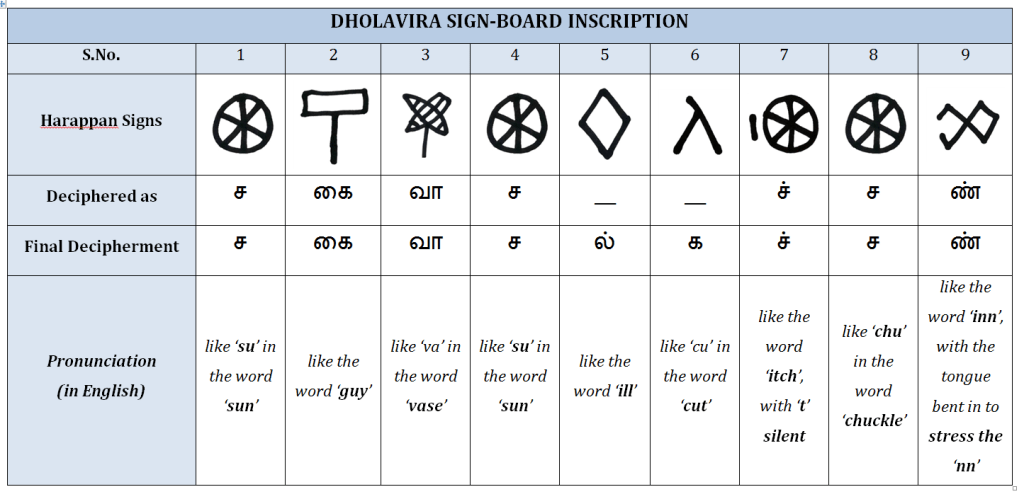
One might ponder on why two separate symbols are put-together and numbered as S.No.7 in the decipherment table; one might also wonder why these two symbols represent a single phonic sound in my decipherment. Well, I interpreted the symbols in this way because the size of the short-stroke-like-symbol (which precedes the wheel symbol) is smaller when compared with that of any other Indus sign on the sign-board; this makes it clear that it is not a separate symbol but an abstract sign/special character that accompanies one of its neighbouring symbols. The special character appears visually closer to the wheel symbol (at S.No.7) than to the previous symbol which looks like an inverted-V/Y like (at S.No.6), thereby indicating that the special character together with the wheel symbol constitutes a single Indus sign and hence represent a single phonic-sound.
I was able to decipher only eight out of the ten symbols; unless the other two are also interpreted, it is impossible to know what the Harappans conveyed through this signboard at Dholavira. So I thought of decoding the remaining two Harappan signs using logic/common sense. In that way, I couldn’t think of any letter other than ‘ல்’ to fill the blank at S.No.5, as it gave the meaningful word ‘வாசல்’, which is the Tamil word for ‘front entrance to a building’; it sounded very apt as the sign-board was discovered near the northern gate of the castle. Similarly only the letter ‘க’ seemed suitable for the blank at S.No.6 because the resultant word ‘கச்சண்’ offered the meaning ‘Kutch’/’of Kutch’. Perhaps this Harappan city was named after the region to which it belonged; not to forget that the Dholavira Harappan site is located in the Kutch District of Gujarat.
My intuition strongly suggested that ‘சகை’ must be the old/original Tamil word for ‘assembly’/‘assembly-hall’; the currently used word is ‘சபை’ where ‘பை’ is pronounced like the English word ‘buy’. Ever since the decipherment of the Dholavira Signboard in November 2017, I kept on looking for some evidence in support of my conception of the word ‘சகை’ and finally, I found one in October 2018; the proof that I was looking for was available in a YouTube video uploaded by the Tamil Heritage Trust. The content of the video was a talk by Mr. Shashwath, about water management in ancient Tamil Nadu; between 48:39–48:59 mins of the video, Shashwath mentions an inscription (dated circa. 795–846 AD/CE) about the Vayiramegha tank at Uttiramerur, in which the word ‘சகை’ appears instead of ‘சபை’. Thus I got convinced with my decipherment of the Dholavira Signboard inscription.
Hence, as per my interpretation, the Dholavira signboard says “சகைவாசல்கச்சண்”; it has to be split and interpreted as “சகை” (assembly), “வாசல்” (front entrance) and “கச்சண்” (Kutch/of Kutch)”. Thus it can be inferred that the signboard was put-up by the Harappans at the northern gate of Dholavira’s castle, in order to let the people know that it was the entrance to the royal/public assembly hall of the city. This decipherment, proposed by me, may or may not be the correct interpretation of the Dholavira Signboard (God only knows). Nonetheless, I am happy that it makes some sense out of what is otherwise a perplexing set of giant Harappan symbols.
Supposing my decipherment is correct, it is enthralling to observe the Dholavira signboard conveying its message in the Tamil language; does it mean that the Harappans of Dholavira were Tamilians? Well, in my humble opinion, we cannot answer this question unless we know whether the sign-board was meant for the residents of the city or for the non-residents like the royal guests, traders, official visitors, etc from other places.
Closing Message:
I hope you find this decipherment of the Dholavira signboard convincing. We will be interpreting a few more Harappan inscriptions in the upcoming sequels; see you all soon in part-4.
End-Note:
Thanks for reading this post; please leave your feedback in the comment box below.
Check the Home page for the latest posts from our blog.
Browse the Blog page to find all the posts.
Visit the About page for the introduction to the blog.
Learn about the Research, Titbits, and Bliss sections of this blog.
To know the terms and conditions of this blog, please read the Norms page.
Go to the Contact page to message me and/or to find me on social media.
 DetectHistory.in
Very well done, Ma’am! Congratulations once again…. I had no idea that you have been researching for such a long time.
LikeLiked by 1 person
Thanks a lot for your wishes Sir. The encouraging response from readers like you keeps me going 😊🙏🏻🙏🏻🙏🏻
LikeLike
Great work, well done.
The deciphering looks correct, but how can/who can help further and confirm..
LikeLike
Immense thanks for your response.
If scholars have to approve my decipherment, I should be able to decipher atleast half of the over 4000 Harappan inscriptions; moreover the phonetic values that I assign should be correct at every given instance. Only the grace of almighty can bless me with success 😊🙏🏻
LikeLike