About the Post:
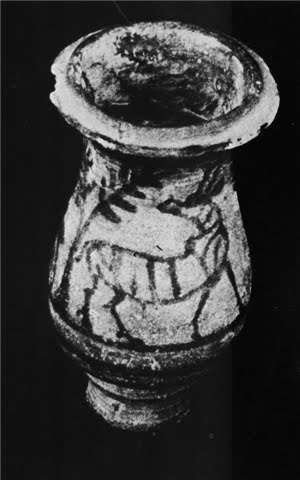
The sites of the Harappan Civilization have yielded numerous fascinating artifacts. At Lothal (Gujarat, India), archaeologists have unearthed a large vessel that depicts birds with fish in their beaks, resting in a tree, while a fox-like animal stands below; this scene bears resemblance to the story of ‘The Fox and the Crow’ in the Panchatantra. On another artifact which is a miniature jar from Lothal (see Image-7), the story of ‘The thirsty crow’ is portrayed; it is shown how the crow succeeded in drinking from the narrow-mouthed jar by dropping stones into it while a deer looks on. Similarly, a clay tablet obtained from the Harappan site of Ganweriwala (Cholistan, Pakistan) seems to illustrate an age-old anecdote from Ramayana. In this post, let us interpret the iconography and the inscription found on this peculiar Harappan tablet.
Sneak Peek:
The previous sequel series of this blog proved that the Harappan Civilization was actually the Indian civilization mentioned in Mahabharata. In one of my earlier blog posts, I mentioned that the story of Ramayana took place about 18 million years before the present. Now, through this post, we are going to learn about a Harappan tablet that depicts an event of the Ramayana days……..
Ganweriwala Clay-Tablet:
Ganweriwala, located deep in the Cholistan Desert of southern Punjab (Pakistan), is identified to be one of the major urban sites of the Indus-Sarasvati/Harappan Civilization. This Harappan site is roughly equidistant between Harappa and Mohenjo-Daro and is situated on the dry river bed of the Ghaggar-Hakra. Ganweriwala has not yet undergone a formal excavation; probably it is the site’s proximity to the India-Pakistan border line that prevents the archaeologists from exploring its bronze-age mounds. However, Harappa.com provides ‘Glimpses of Ganweriwala’ by quoting excerpts from Farzand Masih’s article ‘Ganweriwala – A new Perspective’, published in ‘Walking with the Unicorn’ (2018).
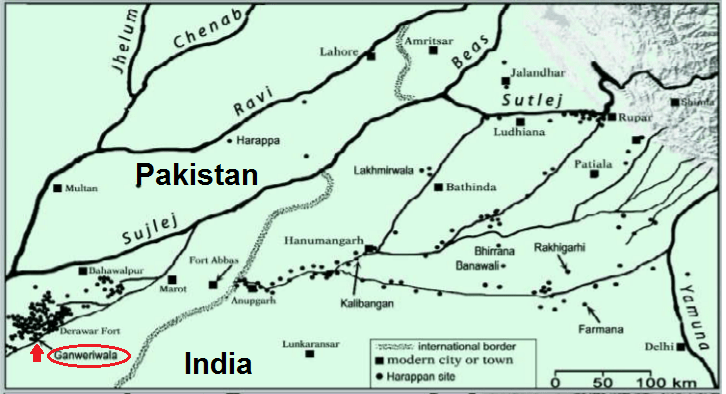
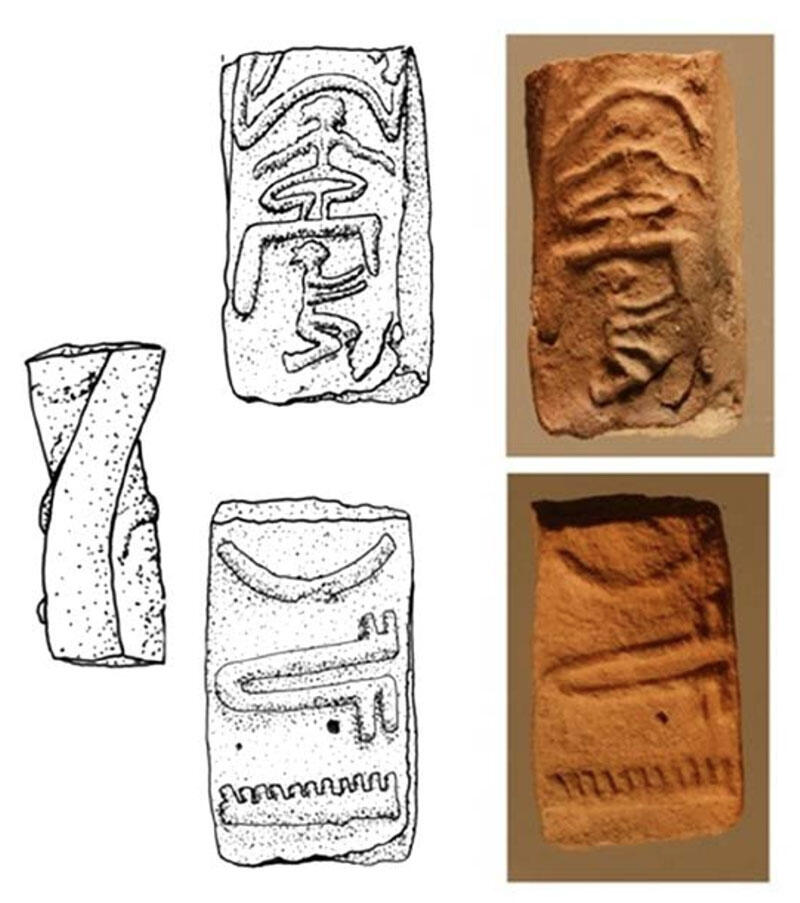
Ganweriwala was discovered in the late 1980s by Rafique Mughal, who had estimated its area to be over 80 hectares; a survey ten years later had it at about half that size. Regarding this dreadful discrepancy, Farzand Masih comments, “it is possible that some areas of the site are now covered by sand dunes and, perhaps, will be located during future explorations”. Despite being the least excavated of the five large known ancient Indus cities, Ganweriwala has yielded interesting artifacts; the meager treasure includes a clay Harappan tablet (see Image-8), which happens to be the subject of this post.
The Iconography:
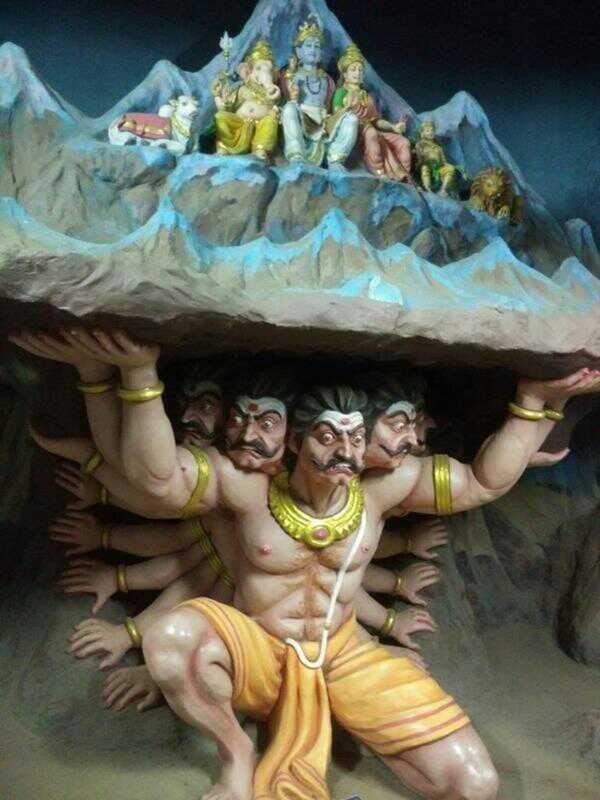
I am not aware whether the archaeologists have already expounded on the iconography of the Ganweriwala clay tablet (see Image-8). However, in my humble opinion, the iconography portrays the scene of Ravana lifting the Kailash Mountain, the abode of Lord Shiva (see Image-9).
Uttara-Kanda of the ancient Indian epic Ramayana narrates the following incident:
The ten-headed Ravana, who was the king of Lanka, defeated and looted Alakapuri – the city of his step-brother Kubera – situated near Mount Kailash (the abode of Lord Shiva). After the victory, Ravana was returning to Lanka in the Pushpaka Vimana (the flying chariot stolen from Kubera), when he spotted a beautiful place; however, the chariot could not fly over it. Ravana met Nandi (the divine attendant of Lord Shiva) at that charming place and inquired the reason behind his chariot’s inability to pass over the place. Nandi informed Ravana that Lord Shiva and Parvati were enjoying dalliance on the mountain and no one was allowed to pass. Ravana mocked Shiva and Nandi; enraged by the insult to his lord, Nandi cursed Ravana that monkeys would destroy him. Ravana, infuriated by Nandi’s curse and his inability to proceed further, in turn decided to uproot Kailash. He put all his twenty arms under Kailash and started lifting it; as Kailash began to shake, the terrified Parvati embraced Shiva. However, the omniscient Shiva realized that Ravana was behind the menace and pressed the mountain into place with his big toe, trapping Ravana beneath it; Ravana gave a loud cry in pain. Advised by his ministers, Ravana sang hymns in praise of Shiva for a thousand years. Finally, Shiva not only forgave Ravana but also granted him an invincible sword.
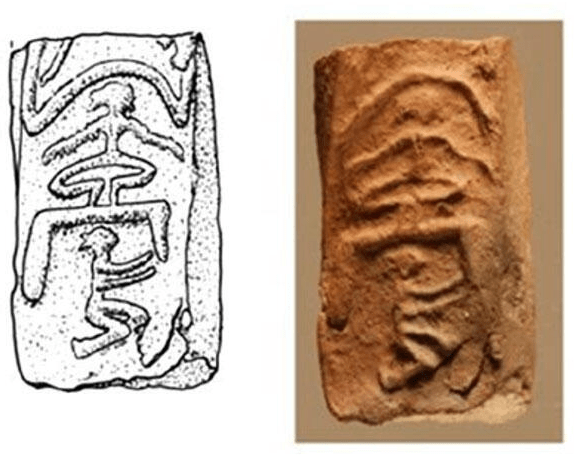
In the Ganweriwala clay tablet, the kneeling figure appears to be lifting or holding the dais-like object, along with the person who is seated upon it in a yogic/meditative posture. Hence I interpreted the meditative figure seated on top as Lord Shiva, the kneeling figure at the bottom as Ravana, and the dais-like thing (upon which the yogic figure is seated) as Mount Kailash.
The Inscription:
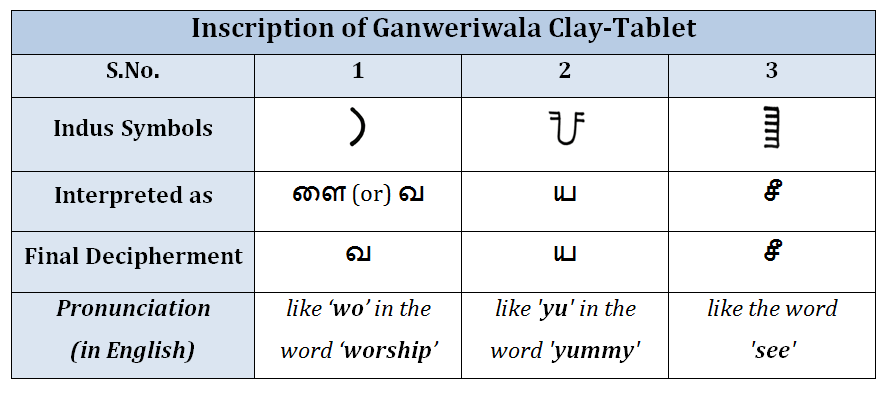
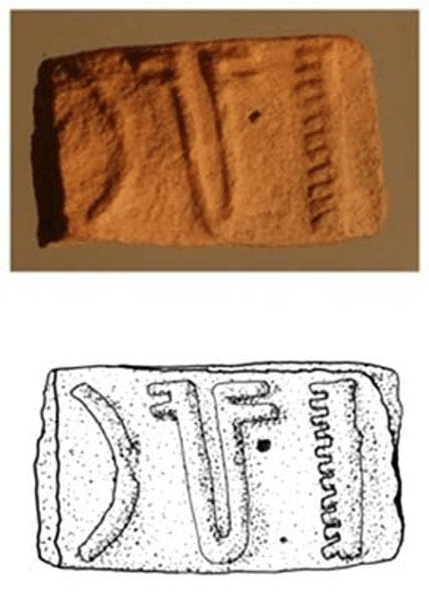
The iconography is depicted on one side of the clay tablet in a vertical manner, while the Harappan symbols are inscribed on the reverse in a horizontal fashion. The tablet does not give any clue about the direction of the inscription. So without determining the direction, I just numbered the symbols in the left to right order.
While deciphering the concerned Harappan symbols, I was pretty sure regarding my interpretation of the symbols numbered 2 & 3 (in the decipherment table) as ‘ய’ and ‘சீ’ respectively; however, I had doubts about the first symbol, as to whether it represents the sound of the contemporary Tamil letter ‘ளை’ or that of ‘வ’. Nonetheless, since I had already inferred that most of the Indus seals and tablets carried the names of places involved in the trade/administrative activities of the bronze-age Harappans, I was confident that, with the help of Google, I would be able to decipher the first symbol also. So I tried to find out if there is/was any place named “ளையசீ” (‘’ļaiyasī” – the ‘word’ obtained on reading the inscription from left to right) or “சீயளை” (“sīyaļai” – the ‘word’ obtained on reading the inscription from right to left); Google did not show any place with such names. Hence I next tried my luck with “வயசீ” and “சீயவ”; this time Google informed me about a village called “Siyava“/”Siyawa“, located in the Sirohi District of the Jodhpur Division of Rajasthan (in India). Thus, I deciphered the first symbol as “வ” and determined right-to-left to be the direction of the concerned inscription.
Siyava and Ravana:

The iconography and the inscription of any given Harappan seal/tablet are usually relevant to each other. Since I had interpreted the iconography of the Ganweriwala clay tablet as the scene of Ravana lifting Kailash Mountain along with Lord Shiva, I wanted to check if the Siyava/Siyawa village had any connection with the demon-king Ravana. As per Google search results, neither the modern Siyava village nor the contemporary Sirohi city/district seems to have any connection with Ravana.
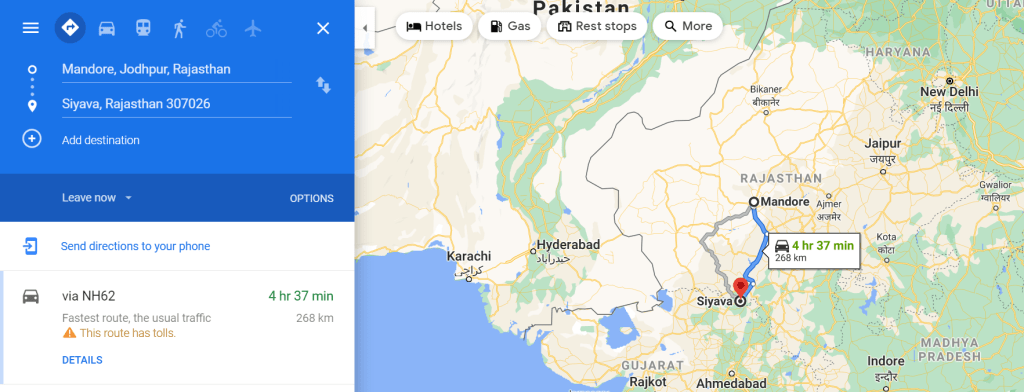
Nonetheless, I learnt that Ravana has been worshipped by generations of certain sects of people who belong to Mandore (a suburb historical town), situated 9 km north of Jodhpur city in Rajasthan; they claim to be the descendants of Ravana. The modern Siyava village (belonging to Jodhpur Division) is situated about 260 kilometres southwest of the present-day Mandore (see Map-5). However, there is a plausibility that the Siyava of Harappan times was populated by the community that adored Ravana. Moreover, we cannot deny the possibility that the Siyava of Harappan times was situated near the geographical location of modern Mandore (Part 5 might help to understand this statement).
Ganweriwala and Siyava:
Since Ganweriwala remains unexcavated to date, not much information is available to us about it. Moreover, owing to my limitations, I could not find out if there are any Harappan/Harappan-era sites in or around the present-day Siyava Village of Rajasthan. Hence, I find myself unable to prove the credibility of my interpretation.
However, mainstream researchers confirm the trade contacts of Harappans with the chalcolithic people of what is now known as the copper-ore-rich regions of Rajasthan. Moreover, my previous post revealed the plausible bronze-age trade contact between Harappa (now in Punjab Province of Pakistan) and Molyasi (now in Rajasthan of India). Thus, there is a great chance that a trade/royal relationship existed between Ganweriwala and the Siyava of the Harappan times.
Closing Message:
I hope my interpretation of the Ganweriwala clay tablet makes sense. We will be soon deciphering another Harappan inscription, in Part 7 of this sequel series.
End-Note:
Thanks for reading this post; please leave your feedback in the comment box below.
Check the Home page for the latest posts from our blog.
Browse the Blog page to find all the posts.
Visit the About page for the introduction to the blog.
Learn about the Research, Titbits, and Bliss sections of this blog.
To know the terms and conditions of this blog, please read the Norms page.
Go to the Contact page to message me and/or to find me on social media.
 DetectHistory.in
Interesting perspective. Thank you.
LikeLiked by 1 person
Glad that you are interested in my blog. Immense thanks for your positive feedback.
LikeLike
Great to see your perspective! Went through all your bog notes. We are at part 5 now – another 1995 to go 🙂 Looking forward to them all.
LikeLiked by 1 person
Thanks a lot Mr. Fred for your interest and appreciation. I hope you find my previous sequel-series ‘Truth behind the decline of Harappans’ (totally 7 parts) also interesting and convincing. Thank you.
LikeLike
excellent research
LikeLiked by 1 person
Glad that you are interested in my research. Thanks for your appreciation 😊🙏🏻
LikeLike