About the Post:
The Indus Civilization site of Mohenjo-Daro, located in the Sindh Province of Pakistan, has yielded numerous fascinating artifacts; one among them is the Divine Adoration Seal; this post is all about decoding the inscription and iconography of the same.
Sneak Peek:
The Harappan seal M-1186A alias ‘Divine Adoration seal’ depicts the worship of the Mother Goddess and carries some Indus symbols; continue to read this post to see what the inscription says…….
Harappan Tablet M-1186 A:
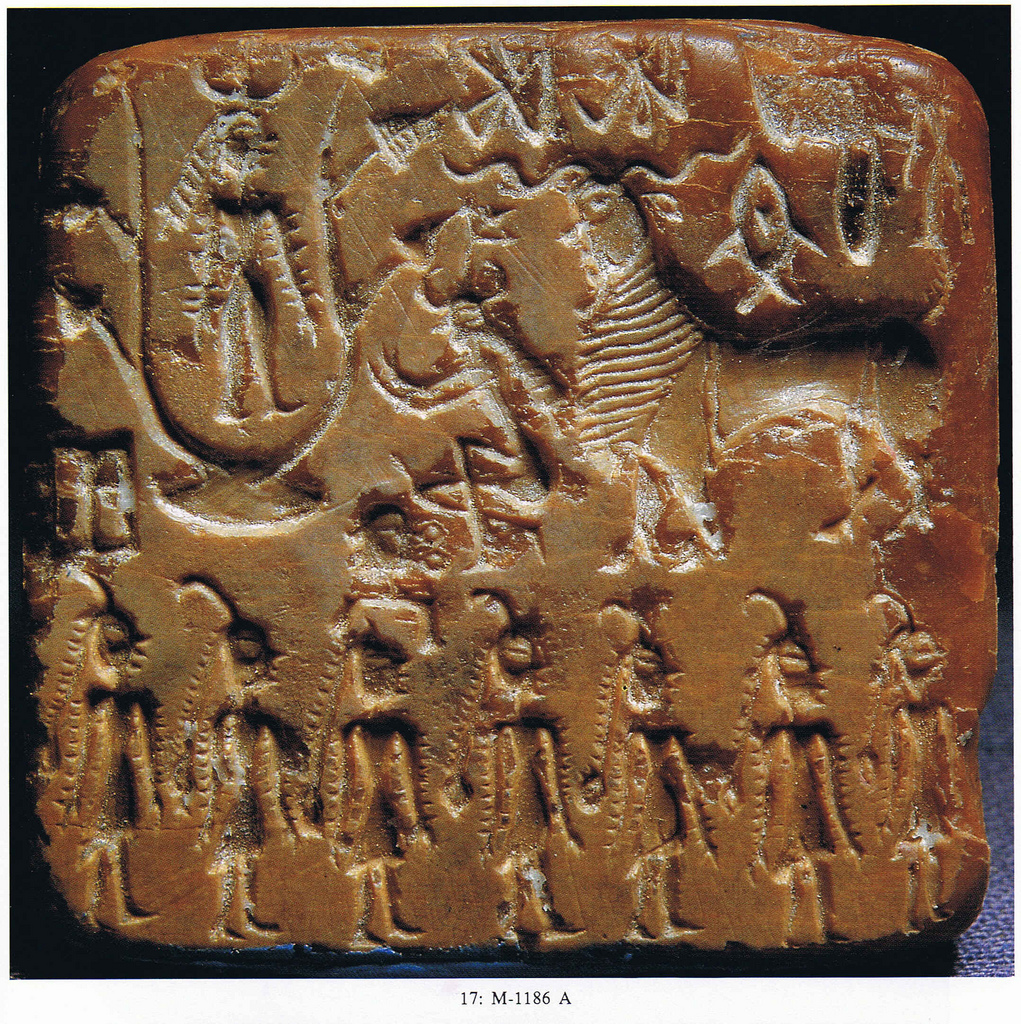
I am borrowing Kenoyer’s words to describe the Harappan Seal M-1186A:
In a famous seal from Mohenjo-Daro, the pipal tree is divided into two main branches, each with three leaves, and the deity wears a horned headdress with a curved branch emerging from the center. The face is shown in profile, and a long braid hangs to the back; both arms are covered with bangles. In front of the deity is a kneeling worshiper offering what appears to be a human head placed on a stool. The worshiper also wears a horned headdress with a branch that has three pipal leaves, which mirrors the triple leaves on each branch of the tree itself. Behind the figure is a giant ram and along the top is a series of script signs that may identify the ritual or the deity. in the lower register is a procession of seven robed figures with long braids, short curved head ornaments, and arms covered with bangles.
The iconography of M-1186 A:
The Kneeling Figure:
Except for the kneeling figure, all other human personalities depicted in the seal are wearing bangles. This seems to imply that a female deity, who is the leader of a group of seven divine ladies, is being worshiped by a male who is evidently a king or demi-god (as denoted by his horned headdress). He is wearing pipal-tree leaves on his crown; perhaps this practice existed among the bronze-age people of some particular clan/community.
Goddess Chamunda:
Chamunda, also known as Chamundi, Chamundeshwari, Chamundika, and Charchika, is a fearsome aspect of the Divine Mother, in the Hindu faith; the name is a combination of Chanda and Munda, two monsters killed by goddess Chamunda. She is closely associated with Kali, another fierce aspect of the Divine Mother; she is sometimes identified with goddesses Parvati, Chandi, or Durga (other avatars of the Divine Mother) as well. Wikipedia states that goddess Chamunda is often portrayed as residing in cremation grounds or around holy fig trees; obviously this is what is depicted by the Harappans in M-1186A.
Ramakrishna Gopal Bhandarkar says that Chamunda was originally an indigenous goddess worshipped by the Munda people of the Vindhya range of central India. These tribes were known to offer an animal as well as human sacrifices along with ritual offerings of liquor to the goddess; these methods of worship were retained in Tantric worship of Chamunda, after assimilation into Hinduism.
The Seven ‘Matrikas’:
The Harappan seal M-1186A depicts a group of seven female deities, similar to the Saptamatrika. Matrikas are a group of mother goddesses who are always depicted together in Hinduism. The Matrikas are often depicted in a group of seven, the Saptamatrika(s); however, sometimes they are also depicted as a group of eight, the Ashtamatrika(s). In South India, Saptamatrika worship is prevalent whereas the Ashtamatrika is venerated in Nepal, among other places. Generally, the Saptmatrika are said to be Brahmani, Vaishnavi, Maheshvari, Indrani, Kaumari, Varahi, and Chamunda; the additional one in the case of Ashtamatrika is Narasimhi.
The Matrikas assume paramount significance in the goddess-oriented sect of Hinduism, Tantrism. In Shaktism, they are described as “assisting the great Shakta Devi (goddess) in her fight with demons.” Thus, the Matrikas are goddesses of the battlefield. Generally, they are described as assistants of Durga having sinister as well as propitious characteristics. Chamunda is one of the Saptamatrika; she is sometimes referred to as the leader of the group. She is also the only Matrika who enjoys independent worship of her own; all other Matrikas are always worshiped together.
The Markhor:

The animal depicted in M-1186A is a Markhor; a male markhor to be specific. The markhor (Scientific Name: Capra falconeri), is a kind of goat native to Central Asia, Karakoram, and the Himalayas; their alarm call closely resembles the bleating of domestic goats. Markhors are adapted to mountainous terrain and can be found between 2,000 and 11,800 ft in elevation.
Markhor happens to be the national animal of Pakistan, where it is also known as the “screw horn” or “screw-horned goat”. It is listed on the IUCN Red List as Near Threatened since 2015.
The Inscription:
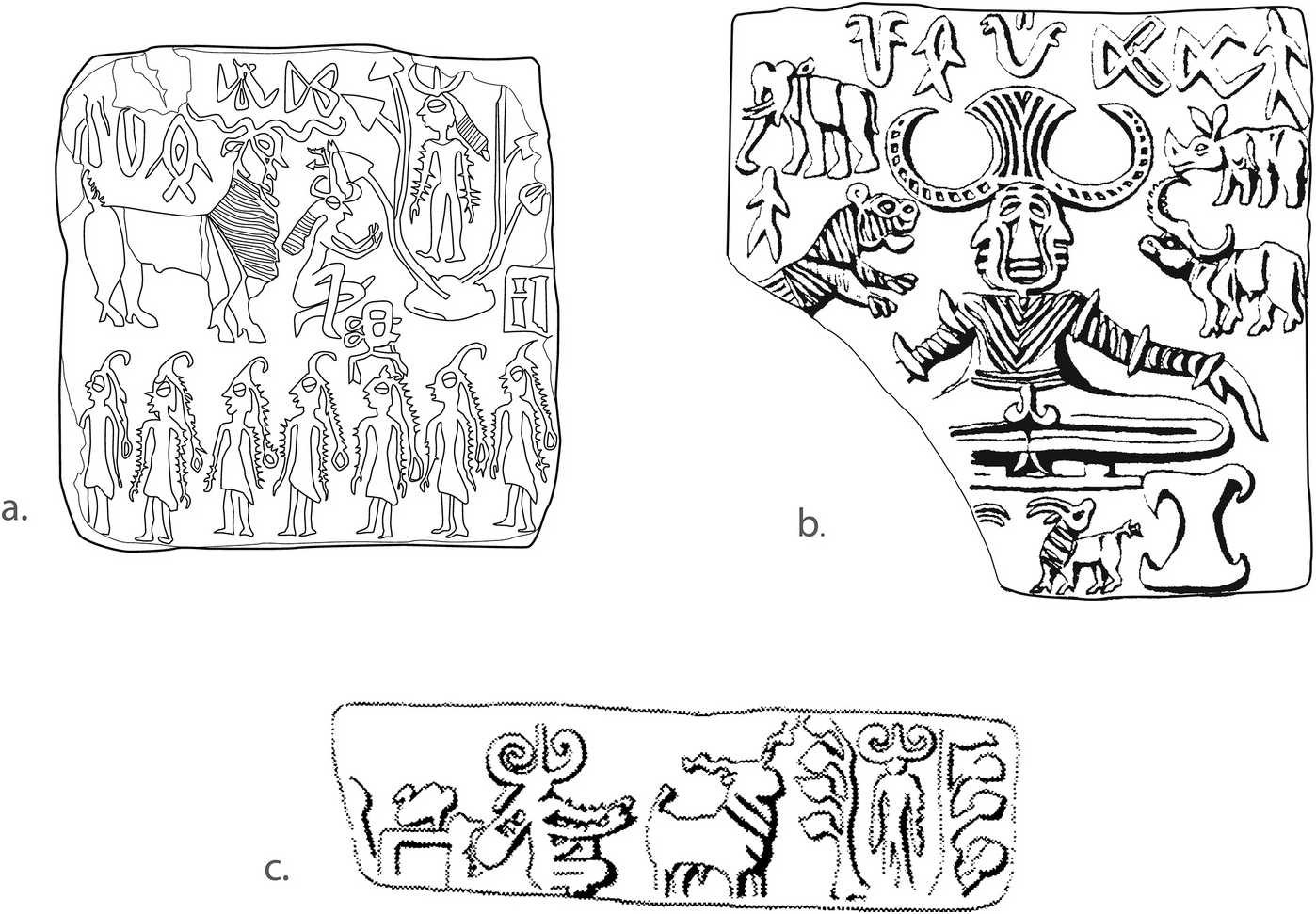
The Harappan symbols found on M-1186A are inscribed in a scattered manner (see Image-23); however, they together seem to form a single word. It is unclear whether the inscription contains 5 symbols or 6 symbols (refer to Image-23); nonetheless, it is clear that the inscription runs right to left. Hence I have numbered the concerned symbols from 0 to 5, from left to right (refer to Image-23 and the Decipherment Table given below).
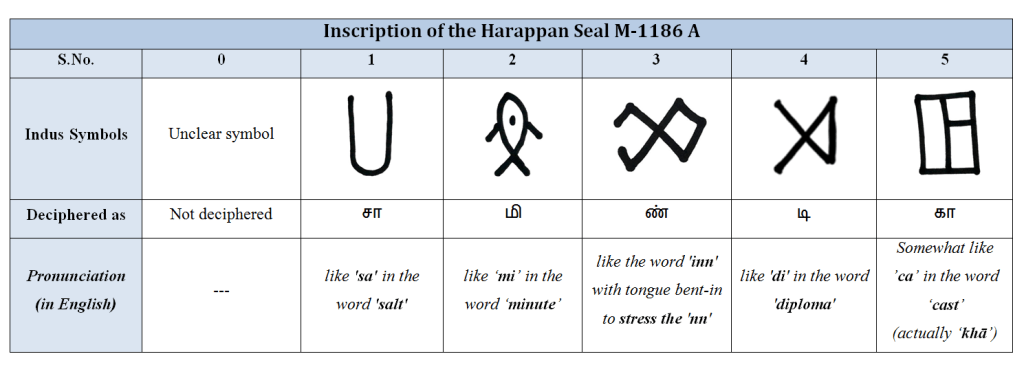
Thus I have deciphered the M-1186A inscription as “சாமிண்டிகா” (Sāmindikhā); this could perhaps be a colloquial pronunciation/spelling of the name “Chamundika.” The Google search results show that “Samindika” (not sure if pronounced as “Sāmindikhā”) is quite a common name among both males and females of the Sinhalese people.
Discussion:
Though I have decoded the inscription and the iconography of M-1186A, I find myself unable to expound on the actual and complete story of the seal; hence, I shall be more than happy to receive input from the readers.
Closing Message:
With this part-9, the sequel series titled ‘TAMIL BACKGROUND OF THE HARAPPAN SCRIPT’ comes to an end; hoping to meet you all soon with a new topic.
End-Note:
Thanks for reading this post; please leave your feedback in the comment box below.
Check the Home page for the latest posts from our blog.
Browse the Blog page to find all the posts.
Visit the About page for the introduction to the blog.
Learn about the Research, Titbits, and Bliss sections of this blog.
To know the terms and conditions of this blog, please read the Norms page.
Go to the Contact page to message me and/or to find me on social media.


Ma’am, I am amazed at how much you are able to decipher from the picture!
I could not make head or tail of it, even after reading your article….
Anyway, all the best for your future endeavours!
🤩
LikeLiked by 1 person
Thanks a lot for your encouraging feedback Sir 😊🙏🏻
LikeLike
The person/goddess/god standing in the middle of the pipal tree is one of great authority, perhaps revered as an earthly deity. Noting that others with a pipal tree crowns on their heads are usually seated
suggesting that they are subject to the one standing; perhaps serving in different districts of the nation.
The one kneeling is perhaps a visiting dignitary noting the Markhor accompanying as a symbol of personal and very respectable authority. An emissary from another district who desires to make an agreement with the central authority for goods and services in return for women to be wives.
There does not appear to be very many people of ordinary status in these pictograms however there are many seals with very strong and authoritative animal presences which could identify the personal status and authority of the owners. They may possibly not even animal worshipers but a very orderly system of authority.
LikeLiked by 1 person