About the Post:
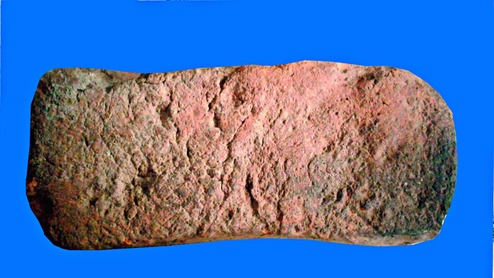
(Image Courtesy: telegraphindia.com)
“The discovery of some Harappan-type bricks from Raghopur Diara of Vaishali district near Patna, which was published in The Telegraph on April 8, 2017, is of immense importance to the country from both archaeological and historiographical perspectives. The findings may not only answer many hitherto unsolved questions that shrouded the last phase of the great Harappan civilization, but may also force us write our early-period history afresh as well.”, writes Krishnendu Das – a research scholar at the University of Calcutta. I thought of probing this matter a bit to find out if it supports my theory that the Harappan elements were associated with the Kuru Dynasty of Mahabharata fame, and hence this post.
Sneak Peek:
According to my research, Mahabharata is the historical record of the Harappans. The pile of ancient bricks accidentally discovered in Bihar seems to uphold my conviction. Read on to know more………
Raghopur Diara:
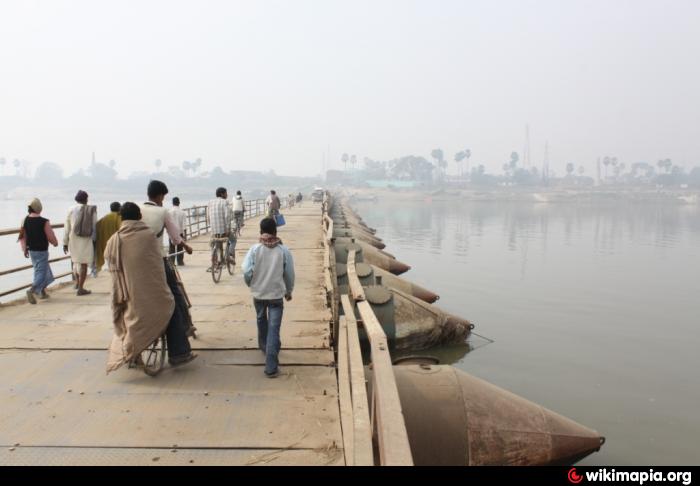
Raghopur is a rural area in the Vaishali District of Bihar (in India), situated between two streams of the Ganges river; it is a river island. The definition of ‘Diara/Diyara land‘ may be taken as ‘the land lying adjacent to or surrounded by the perennial river and subjected to diluvion (the gradual washing away of soil along a watercourse) or alluvion (the action of the sea or a river in adding to the area of land by deposition) action of that river’. Raghopur Diara is connected to Patna (the capital city of Bihar) by Pipa Pul Bridge.
Vaishali:
.jpg)
Vaishali or Vesali was a city in antiquity and is now an archaeological site. Vaishali got its name from King Vishal, a predecessor to Lord Rama. British archaeologist Alexander Cunningham, in 1861, identified the present village of Basarh in the Vaishali District of Bihar as the ancient Vaishali City. Vaishali was the capital of the Lichchavi State, considered as the First Republic in the World. Apart from the Hindus, Vaishali is a place of religious importance for the Buddhists and Jains also.
One can find in Wikipedia, the following information about Vaishali:
Bihar consists of three distinct regions, each has its own distinct history and culture. They are Magadh, Mithila and Bhojpur…………………….Mithila first gained prominence after the establishment of the Videha kingdom………………….The Videha Kingdom later became incorporated into the Vajji confederacy which had its capital in the city of Vaishali, which is also in Mithila.
Videha Kingdom:
The Kingdom of the Videhas was an ancient kingdom located in what is today known as the northeastern parts of Bihar in India and the eastern Terai of Nepal; Mithila was the capital city of the Kingdom of the Videhas in ancient India. The location of Mithila is disputed among Janakpur in present-day Nepal, Baliraajgadh in present-day Madhubani district of Bihar in India, Sitamarhi in present-day Bihar in India, and Mukhiyapatti of Mukhiyapatti Musharniya rural municipality of Dhanusha in present-day Nepal. In the Ramayana, Lord Rama’s spouse Sita is the princess from Videha. The Videha Kingdom is mentioned in the Mahabharata also.
The Raghopur Brick:
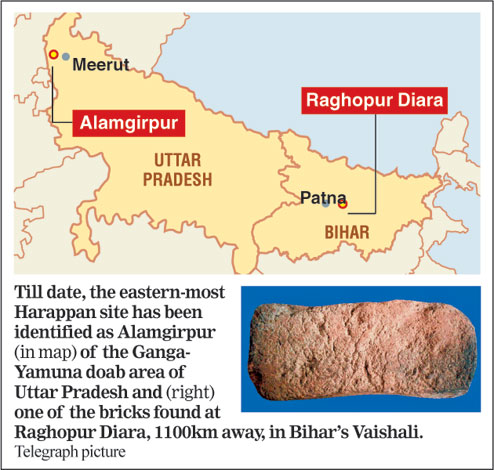
A landowner in Raghopur, while digging for piling work to build a house at the diara, came across thousands of large bricks; he used some of them and kept the rest as samples out of curiosity. Later, the director of the state archaeological directorate Atul Verma visited the place, checked the samples, and took two bricks back with him to Patna. Verma got the bricks tested and found that the thickness, width, and length of the bricks are in the ratio 1:2:4, just as those found from the Harappan sites; the experts also confirmed the similarity. One brick is 7.5 cm thick, 15 cm wide and 30 cm long, while the other is 8 cm thick, 16 cm wide, and 32 cm long. The Raghopur bricks were fire-burnt while those at the Harappan sites were sun-dried or fire-burnt. The nearest known Harappan site to Raghopur Diara of Bihar is Alamgirpur in Uttar Pradesh (in India), situated around 1000 km northwest of Patna.
Regarding the discovery, Krishnendu Das says:
“In the mature phase, there was a standard ratio of the Harappan bricks as mentioned above. The kiln fired bricks which were recovered from Raghopur Diara was exactly the same as the mature Harappan bricks…………………..Now, many archaeologists feel that we should look at the decline of Harappa from an altogether different angle. They believe that instead of downfall of the civilization, we could perhaps simply call it a process of gradual de-urbanisation Harappan civilization. Whatever may be the cause behind this de-urbanisation, scholars have always remained sure that a group of Harappan people had migrated towards the east. The discovery of late Harappan sites, such as Alamgirpur, Hulas, Mandi, Sanauli and so on, are nothing but examples of eastward migration of the civilization. But the unique case of finding of mature Harappan kiln fired bricks at Raghopur Diara, about 1100 kilometres southeast of Alamgirpur, is sure to perplex archaeologists. The main question doing the rounds is that if the sites in Uttar Pradesh are known as late Harappan sites, how can mature Harappan civilization travel further eastward? Therefore, scholars may now have to trace the entire course and span of Harappan civilization anew if more associated Harappan materials are excavated from Raghopur Diara or its surroundings that authenticate the importance of the primary finding. The context of the archaeological material is of utmost importance in archaeology. The findings have sent archaeologists across the country in a tizzy and many of them are already set to go to Raghopur Diara to survey the area in search of more clues.”
The ‘Kuru’ Connection:
Excavations are yet to be conducted at Raghopur Diara; it seems that except for the bricks no Harappan artifact has been found there to date. Hence, we know neither the authentic date of the bricks nor if the site once belonged to the Harappan civilization. However, Krishnendu Das has stated that the length, width, and thickness of the Raghopur bricks comply with the measurement ratio of Mature Harappan bricks; this means that the date of the bricks is most probably circa 2600–1900 BCE.
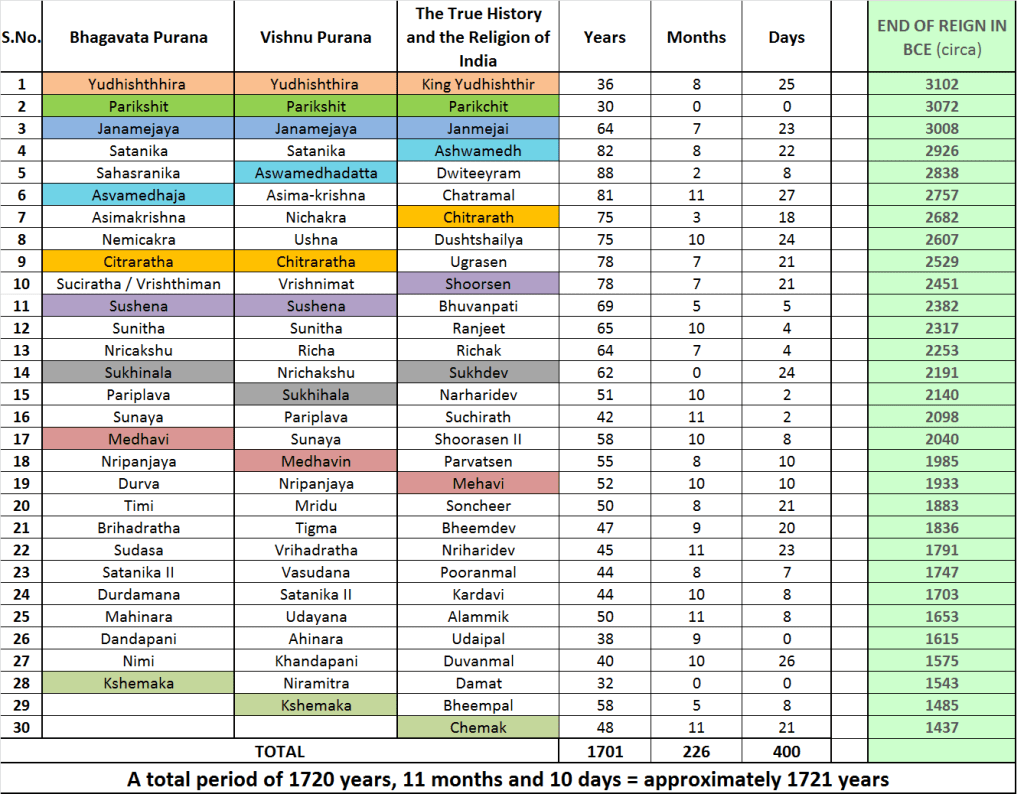
This blog, through the sequel series ‘TRUTH BEHIND THE DECLINE OF HARAPPANS‘ (Part 1 through 7), revealed that the Harappans were none other than the people of the Mahabharata days (circa 3250–3100 BCE) and the post-Mahabharata period (circa 3100–1437 BCE) who belonged to the kingdoms ruled either by the Kuru Dynasty or the royal clans/families with whom the Kurus had an affinal relationship; the far-stretched Harappan entity owed its long-lasting integrity (from circa 3300 BCE to circa 1300 BCE) to generations of mutual kinship/friendship among the concerned royal clans.
A reliable online source states that according to Mahabharata, Janamejaya’s son Satanika married the princess of Videha Kingdom. From the Table given below, we understand that Hastinapur was under the reign of the Kuru-Dynasty king Satanika from circa 3008 BCE to circa 2926 BCE. Thus, we realize that the Raghopur brick story also fits into the theory mentioned above.
Closing Message:
Only archaeological excavations can disclose the true story of Raghopur Diara; I hope it happens soon. Anyway, I shall soon meet you all with another exciting topic.
End-Note:
Thanks for reading this post; please leave your feedback in the comment box below.
Check the Home page for the latest posts from our blog.
Browse the Blog page to find all the posts.
Visit the About page for the introduction to the blog.
Learn about the Research, Titbits, and Bliss sections of this blog.
To know the terms and conditions of this blog, please read the Norms page.
Go to the Contact page to message me and/or to find me on social media.


Very interesting information today, Ma’am.
Why can’t carbon dating be done for these bricks, to correctly establish their age…?
Please continue with this topic if any more information is available.
With my best wishes…
LikeLike
Thanks for your response to my post Sir; surely will post another article on this topic if I succeed in gathering further information.
In reply to your question about determining the date of the bricks, I quote the following except from the news-article published in ‘The Telegraph’:
About deciphering the approximate year or age in which the bricks were manufactured, the director said the same would be calculated if remains of pottery and artefacts are found in the area. “We use potassium-argon dating method to ascertain the dates of artefacts or pottery,” Verma said.
Apart from this, I put forth your question to a archaeology professor. He said that carbon dating is possible only with organic materials. He added that perhaps thermo luminescence method may be used for bricks but generally it is not done; this method is used largely for potteries. He added that the size of the brick itself provides the clue about its date because people of different period used bricks of different sizes.
LikeLike
Thanks Ma’am for your detailed reply.
🤩
LikeLike