About the Post:
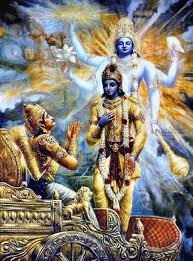
HOW OLD IS KALI YUGA? – Part 1, published in December 2024, proposed that the current Kali–Yuga is approximately 41,000 years old—an interpretation that differs significantly from the commonly accepted view that only about 5,000 years of its 432,000-year duration have elapsed.
This Part 2 builds upon the chronological framework proposed in Part 1 by presenting further evidence from ancient texts indicating that Lord Krishna’s incarnation occurred during the transitional dawn phase of the ongoing Kali–Yuga, rather than toward the end of the preceding Dvāpara–Yuga, as traditionally understood. The scriptural references examined here therefore provide additional grounds for reassessing the conventional chronology of the present Kali Age.
Sneak Peek:
The Kurukṣetra War, commonly known as the Mahābhārata War, is generally believed to have occurred during the recent Dvāpara–Yuga. Intriguingly, however, the Mahābhārata itself places the great battle after the end of the Dvāpara–Yuga. Read on to explore this fascinating chronological detail further…
Structure of a Mahā-Yuga:
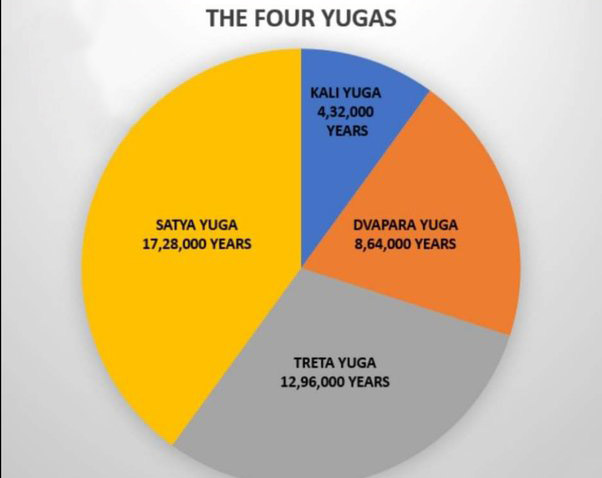
The concepts of Yugas, Manvantaras, and Kalpas were discussed in detail in HOW OLD IS KALI YUGA? – Part 1. For convenience, only the structure of a Mahā–Yuga, also known as a Chatur–Yuga, is briefly recalled here:
A Chatur–Yuga, aka Mahā–Yuga, comprises a Krita-Yuga, a Tretā-Yuga, a Dvāpara-Yuga, and a Kali-Yuga. Each Krita, Tretā, Dvāpara, and Kali-Yuga consists of three phases: the sandhyā (dawn phase), the proper or core phase, and the sandhyāṃsha (dusk phase).
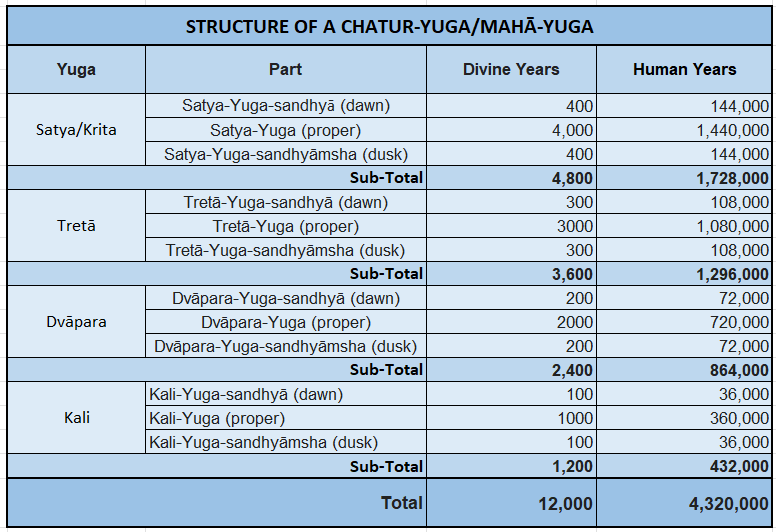
Source: The Kindle Edition of Horace Hayman Wilson’s THE VISHNU PURANA (pages 19 & 20) and Wikipedia
Enthralling Evidences:
In light of the Chatur–Yuga structure outlined in the table above, the following statement in the Mahābhārata implies that the great war between the Kuru cousins—the Kauravas and the Pāndavas—was fought at Kurukshetra, a sacred region also known as Samanta-panchaka, during the transitional period between the proper Dvāpara–Yuga and the proper Kali–Yuga:
Context:
Words spoken by Ugrasrava Sauti, the son of Lomaharshana, to the rishis of Naimishāranya, as recorded in Kisari Mohan Ganguli’s English translation of the MAHĀBHĀRATA, Book 1 (Ādi-parva), Section II, Page 16.
Excerpt:
“…In the interval between the Dwapara and the Kali Yugas there happened at Samanta-panchaka the encounter between the armies of the Kauravas and the Pandavas…”
However, the statement quoted above does not explicitly clarify whether this intervening period refers to the Dvāpara–Yuga–sandhyāmsha (dusk phase of the Dvāpara–Yuga) or the Kali–Yuga–sandhyā (dawn phase of the Kali–Yuga).
Fortunately, another passage in the Mahābhārata, presented below, helps resolve this ambiguity by indicating that the Kauravas—including the Pāndavas, who were also referred to as Kauravas by virtue of their paternal lineage—were born during the Kali–Yuga–sandhyā (dawn phase of Kali–Yuga), as indicated by the words “when the Kali Age will set in“:
Context:
Words spoken by Lord Nārāyaṇa to Rishi Apāntaratamas, also known as Rishi Sarasvat/Saraswat, during the Svāyambhuva-Manvantara, who was subsequently reborn as Sage Vyāsa in the Vaivasvata-Manvantara, as recorded in Kisari Mohan Ganguli’s English translation of the Mahābhārata, Book 12 (Shānti-parva), Section CCCL, Page 196.
Excerpt:
“…When the Kali age will set in, certain princes of Bharata’s line, to be called by the name of Kauravas, will take their birth from thee. They will be celebrated over the Earth as high-souled princes ruling over powerful kingdoms. Born of thee, dissensions will break out among them ending in their destruction at one another’s hands excepting yourself. O foremost of regenerate persons, in that age also, endued with austere penances, thou wilt distribute the Vedas into diverse classes. Indeed, in that dark age, thy complexion will become dark…Vasishtha endued with great intelligence and like unto an ocean of penances, and whose splendour transcends that of the Sun himself, will be the progenitor of a race in which a great Rishi of the name of Parasara, possessed of mighty energy and prowess, will take his birth. That foremost of persons, that ocean of Vedas, that abode of penances, will become thy sire (when thou wilt take birth in the Kali age). Thou shalt take thy birth as the son of a maiden residing in the house of her sire, through an act of congress with the great Rishi Parasara…”
Interestingly, the following sentences from the Harivamsha Purāna—traditionally regarded as a supplement to the Mahābhārata—likewise indicate that Lord Krishna, a contemporary and kinsman of both the Kauravas and the Pāndavas, lived during the Kali Age:
Context:
Words spoken by Lord Krishna during his conversation with Muchukunda, a former king of the Solar Dynasty, blessed with an exceptionally long lifespan, as recorded in Bibek Debroy’s English translation of the critical edition of HarivaMSHa, Chapter 85, Page 343.
Excerpt:
“…O lord! I am Vasudeva’s son and have been born in Yadu’s lineage. O king! I am known as Vasudeva and I am the one who has come here. I got to know from Narada that you were born in treta yuga. Know that it is kali yuga now…”
However, the references quoted hitherto do not specify when, within the 36,000-year duration of the Kali–yuga–sandhyā (dawn phase of the Kali–Yuga), the Kauravas, the Pāndavas, and Lord Krishna lived. Fortunately, this crucial chronological detail can be inferred from the following excerpt from the ViSHNu PurāNa:
Context:
Words spoken by Maharishi Parāshara to his disciple Maitreya during a conversation that took place sometime after the Kurukshetra War, when Parikshit, the grandson of the Pāndava Arjuna, had become the monarch of the Kuru Kingdom, as recorded in H. H. Wilson’s English translation of the VISHNU PURANA, Book 4, Chapter XXIV, Page 487.
Excerpt:
“…The day that Krishńa shall have departed from the earth will be the first of the Kali age, the duration of which you shall hear; it will continue for 360,000 years of mortals. After twelve hundred divine years shall have elapsed, the Krita age shall be renewed…”
In the context of the Chatur–Yuga structure presented in Table No. 1, Maharishi Parāshara’s specification that the Kali Age, which commenced on the day of Lord Krishna’s departure from the mortal world, was to continue for 360,000 human years makes it clear that he was referring to the commencement of the proper Kali phase of the Kali–Yuga, rather than to the commencement of the 432,000-year Kali–Yuga as a whole.
Interestingly, the VISHNU PURANA account of the same meeting between Lord Krishna and Muchukunda, discussed a few paragraphs earlier in this article, contains the following words spoken by Muchukunda to Lord Krishna, indicating that Lord Krishna incarnated during the 28th Chatur–Yuga of the current Manvantara:
Context:
Words spoken by Muchukunda to Lord Krishna after recollecting the prophecy of Garga, as recorded in H. H. Wilson’s THE VISHNU PURANA, Chapter XXIII, Page 567.
Excerpt:
“Thou art known, supreme lord, to be a portion of Vishńu; for it was said of old by Garga, that at the end of the twenty-eighth Dwápara age Hari would be born in the family of Yadu. Thou art he, without doubt, the benefactor of mankind; for thy glory I am unable to endure…”
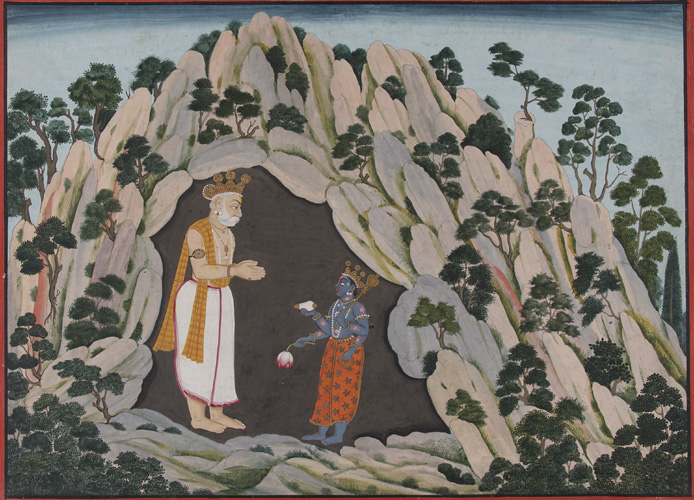
However, in the above excerpt, Muchukunda states that Lord Krishna incarnated at the end of the 28th Dvāpara–Yuga. Incidentally, similar chronological references occur in several other Hindu scriptures. This raises the possibility that the Kali–Yuga–sandhyā, although technically the dawn phase of the Kali-Yuga, was, in chronological usage, regarded as the concluding phase of the preceding Dvāpara-Yuga.
In light of Puranic accounts of Hindu chronology and cosmology, we understand that Muchukunda was referring to the 28th Chatur-Yuga of the Vaivaswata-Manvantara. Incidentally, as mentioned earlier in HOW OLD IS KALI YUGA? – Part 1, the traditional Sankalpam recited during Hindu rituals indicates that we are currently in the 28th Kali-Yuga of the Vaivasvata–Manvantara of the Shveta-Vārāha-Kalpa, which is also referred to as the Vārāha-Kalpa in several Hindu scriptures.
Closing Message:
Interestingly, conventional Hindu calculations place the commencement of the present Kali–Yuga in 3102 BCE, the Gregorian year conventionally associated with the beginning of the Kali-Yuga. Fortunately, Dr M. L. Raja presents numerous archaeological findings supporting the view that the present Kali–Yuga commenced around 3101–3102 BCE. I am grateful to Mr Rangarathnam Gopu, a Professor at Saveetha Engineering College and a volunteer of Tamil Heritage Trust, for bringing Dr M. L. Raja’s research to my attention.
Furthermore, the traditional belief that the core events of the Mahābhārata occurred approximately 5,000 years ago finds substantial support in the conceivable connection between the Harappan Civilisation and the Mahābhārata, as demonstrated through a series of articles published on this blog and in my maiden book, ‘The True Harappans‘.
However, the foregoing discussion clarifies that Lord Krishna’s departure from the mortal world marked the internal transition from the dawn phase (Kali–Yuga–sandhyā) to the core phase (proper Kali-Yuga) of the 28th Kali–Yuga within the Vaivasvata-Manvantara of the Shveta-Vārāha-Kalpa.
Therefore, in my interpretation, the Kali Year designated as 5126 or 5127 in Hindu Panchāngas, corresponding to 2026 CE, implies that the ongoing Kali–Yuga is approximately 41,000 years old, rather than merely about 5,000 years old, as is commonly believed.
End-Note:
Thanks for reading this post; please leave your feedback in the comment box below.
See the Home page for the latest blog posts.
Browse the Blog page to find all the uploaded posts.
Visit the About page for an introduction to the blog.
Explore the blog’s Research, Titbits, and Bliss sections.
Go through the Norms page for the blog’s terms and conditions.
Click Contact to message me or to find me on social media.
And kindly check out the book(s) I have published.

